

Tinkercad is an easy-to-use computer-aided design (CAD) application that runs in a browser, but it is not without limitations. That’s why I was excited to hear about SketchForge, a completely open source alternative with some interesting additional features and a lot of promise for the future.
It is perfect for both beginners and homelabbers.
The simplicity of Tinkercad, fewer limitations
Pick it up in minutes

Tinkercad (above) was the first software I used design a model for 3D printing. It is incredibly easy to learn as it is aimed at beginners and children. The application takes a shape-based modeling approach, where primitives such as cubes and cones are positioned, scaled, and combined in a way that is intuitive.
SketchForge (below) has two main modes: geometry and sketch. Geometry mode takes exactly the same approach as Tinkercad. Drop shapes onto the canvas, resize them to the precise size you want, rotate and drag them around the canvas, and
Group them with other shapes to form solids.
The same simple techniques for creating more complex shapes work in SketchForge as they do in Tinkercad. For example, you can intersect two shapes, define one of them as a “Hole”, and then merge them to cut one shape from the other. You can then ungroup the shapes to move the hole or turn it back into a solid object.
In this mode, you also get access to some features that don’t exist in Tinkercad, including chamfers and edge fillets. You can even group two shapes and create a clean fillet at the point where they intersect, and undo any of these changes at any point.
In sketch mode, SketchForge introduces a feature that Autodesk (owner of Tinkercad) limits to its Autodesk suite. Use the “3D Sketch” tool to set points and curves, then press “Finish Sketch” to convert your design into a 3D object. You can even import an image to trace it beforehand.
When you’re done, you can export your object to STL, OBJ, and STEP files for use in a slicer or other CAD software. You can try this functionality on the SketchForge website, although if you’re serious about SketchForge then you’ll want to host it yourself.
Self-hosting SketchForge is easy
Use Docker and keep everything on your network

Although you can try the full feature set in your browser at the SketchForge websiteIf you want to save and retrieve your work, you’ll need to host SketchForge yourself. It all works without logging in, with the models saved locally within your browser data.
You’ll need Docker Desktop (or just Docker Compose) to do this, so if you already have a server set up then it’s perfect. Otherwise, first download and install Attachable desk for your operating system. Next, head to the GitHub page and download the project (press the arrow next to Code then choose Discharge ).
Extract the ZIP file to a location of your choice, then use your command line tool (I used Terminal on a Mac) to navigate there. Finally, run the following command to build and deploy SketchForge:
docker compose -f deploy/docker/compose.yaml up --build -d
Once the Terminal window has done its job, open a browser window on the same system and navigate to localhost:3000. You should see SketchForge up and running. To access the app on any computer on your network, simply use the correct IP address or hostname, for example: http://192.168.0.110:3000 either http://your-server-name.local:3000.
A good start that will only get better
Stay tuned to the project for updates.
I first heard about SketchForge when the project’s creator posted about it on reddit. In this post, he admits that there are some teething problems with the software and that it is in active development. Although the project has already achieved a lot, there are still important things to come.
In addition to stability improvements and bug fixes, there are many features in the works including “better booleans/grouping, precision tools, measurement tools, export/import of editable projects, tutorials, and more creator-focused features.”
Some of those features will really elevate this beyond Tinkercad for the type of casual 3D printer owner who doesn’t necessarily need the full weight of a professional CAD tool, but appreciates the simplicity and ease of access that browser-based solutions can offer.
It is one more tool for the arsenal, with the Additional benefits of self-hosting.
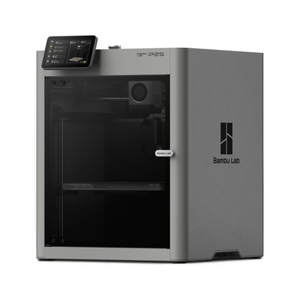
- Construction volume
-
256x256x256mm
- Print speed
-
600mm/s
The Bambu Labs P2S 3D printer is ready to use and can start printing within 15 minutes. It features up to 20-color printing with the AMS unit, has an improved built-in camera for remote monitoring and time-lapses, and has a closed body for printing even with high-temperature filaments.
SketchForge is a step above Tinkercad in terms of accessibility and overall feature set, but if you really want to improve your modeling skills then you’ll want invest time (and possibly money) in a suitable CAD tool.



