

TL;DR
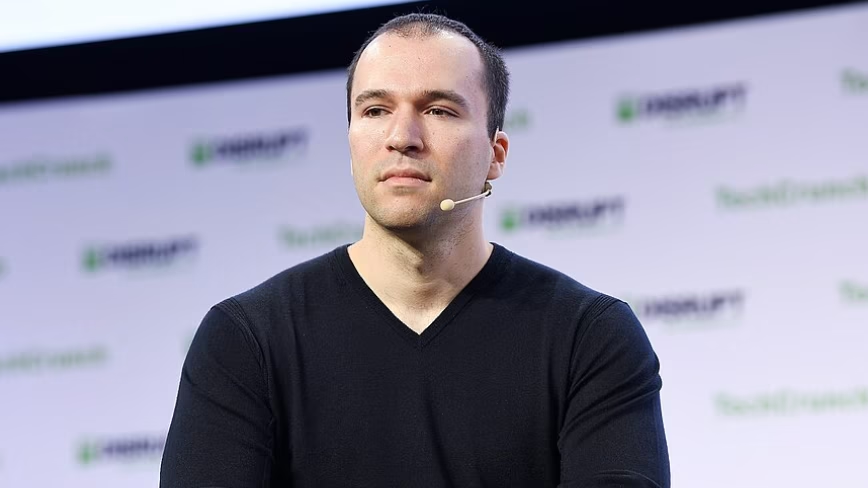
Brockman called Kimi K3 “pretty good,” but said it’s too early to tell if Moonshot is derived from OpenAI, since the White House accused the startup of intellectual property theft.
OpenAI President Greg Brockman called Moonshot AI’s Kimi K3 “pretty good” in a Bloomberg interview on Tuesday, a rare public acknowledgment by a US border lab that a Chinese rival has produced a competitive model. Brockman said it is “too soon” to determine whether Moonshot trained K3 by distilling results from OpenAI’s own systems, a practice the company has repeatedly accused Chinese labs of. Its measured tone contrasted sharply with the White House, which hours earlier had launched its most specific accusations yet against the Chinese startup.
According to Bloomberg, OSTP director Michael Kratsios accused Moonshot of accessing banned Nvidia chips through intermediaries in Thailand and conducting large-scale distillations against American AI models. The accusations came the same day that Treasury Secretary Scott Bessent said the administration would examine Chinese open source models for stolen intellectual property and could impose sanctions within weeks. Nvidia CEO Jensen Huang rejected the alarmcalling Chinese open models “excellent”and urging the government to allow American companies to use them.
The distillation load has been increasing for months. In February, Anthropic accused Moonshot, DeepSeek and MiniMax of making approximately 16 million trades across some 24,000 fraudulent accounts to extract knowledge from their Claude models. OpenAI has raised similar complaints, and the White House now appears to be treating the allegations as a matter of national security rather than a business dispute between rival laboratories.
Brockman framed OpenAI’s position around the company’s infrastructure investments, arguing that the US has a “big advantage” because of the billions that have been invested in computing. He said open-weight models like the K3 are not truly free because running them at scale still requires expensive hardware, a point that undermines the narrative that Chinese labs can simply give away frontier-level AI. He estimated that China remains about four months behind the United States in overall model development.
K3 is an open weight model of almost three billion parameters that Moonshot released on July 16, and has shook Washington and Wall Street matching or surpassing the best American systems in several benchmarks. The model topped Arena’s frontend coding leaderboard within 24 hours of launch, placing it ahead of flagship offerings from Anthropic and OpenAI. Moonshot is pricing K3 at a fraction of what U.S. labs charge, accelerating the commoditization of the model layer that investors have been warning about since DeepSeek’s price cuts earlier this year.
Brockman, who donated to a Trump-aligned super PAC, declined to enter the debate over whether Chinese models should be banned. Instead, he highlighted that OpenAI believes open models are important to “democratize access to AI,“A position that aligns him more closely with Huang than with White House officials pushing for sanctions.



