
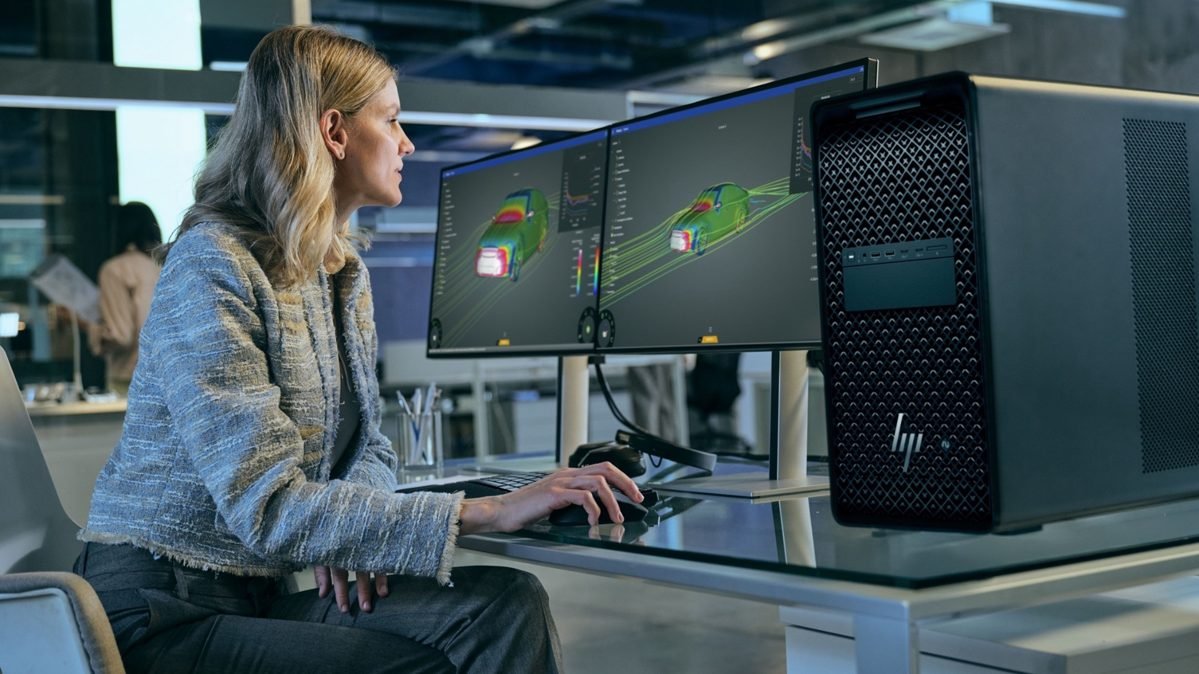
HP used its Imagine 2026 event to launch a refreshed line of Z workstations aimed squarely at professionals whose daily work pushes hardware to the limits: AI developers training models locally, visual effects artists running heavy simulations, and engineers iterating on complex 3D designs.
The flagship announcement is the HP Z8 Fury G6i, a desktop workstation that can be configured with up to four NVIDIA RTX PRO 6000 Blackwell Max-Q Workstation Edition GPUs along with next-generation Intel processors. It’s a machine designed for multi-GPU AI simulation, rendering, and training workloads, and HP is positioning it as the reference host for its Z Boost GPU sharing platform.
Along with the Z8 Fury, HP introduced something it calls the HP Max Side Panel: an optional chassis expander for the Z8 Fury and Z4 workstations that increases internal volume by 15 percent. The idea is simple: as GPUs become physically larger with each generation, the Max side panel gives users room to install larger cards without having to change the entire rig. HP says it’s the only workstation chassis expander of its kind on the market and is designed for tool-free installation.
Mobile workstations are also updated
On the laptop side, HP announced the ZBook X G2i, ZBook 8 G2i, and ZBook 8 G2a. These are mobile workstations with AMD and Intel processor options, discrete or integrated graphics, and up to 128GB of RAM.
The ZBook

Meanwhile, the ZBook 8 G2i combines its 3D design capabilities with a new GaN power adapter that HP says is 40 percent smaller and 50 percent lighter than its predecessor, a small but practical upgrade for anyone who lives out of a laptop bag. HP also cites preliminary testing from Intel showing that the ZBook 8 G2i processes designs in Autodesk Inventor 3.3 times faster than the previous generation.
Z Boost expands beyond AI
HP’s Z Boost, a software solution that allows users to share GPU resources from a desktop workstation over the network, will also receive an update. Previously limited to AI workloads, Z Boost now also supports rendering workflows. HP says early customer deployments have seen up to 5.7x faster rendering speeds in applications like CATIA and Siemens NX when connected to remote GPUs through the platform.
The pitch is simple: pair a ZBook on the go with a Z8 Fury in the office and harness the power of your GPU without moving files or interrupting your workflow.
Hybrid AI infrastructure
HP also used the event to talk about its broader involvement in hybrid AI infrastructure. The company’s ZGX Nano and upcoming ZGX Fury are designed to provide IT departments with scalable, rack-ready local computing for AI inference and tuning, an alternative to the cloud. HP framed this as a response to organizations that are reconsidering their cloud-only strategies and seeking greater control over data residency, security and costs.
Availability
The HP ZBook 8 G2i, ZBook 8 G2a, Z4 G6i desktop, and Z8 Fury G6i are expected to be available on HP.com starting in April. The ZBook
Opus 4.6



