
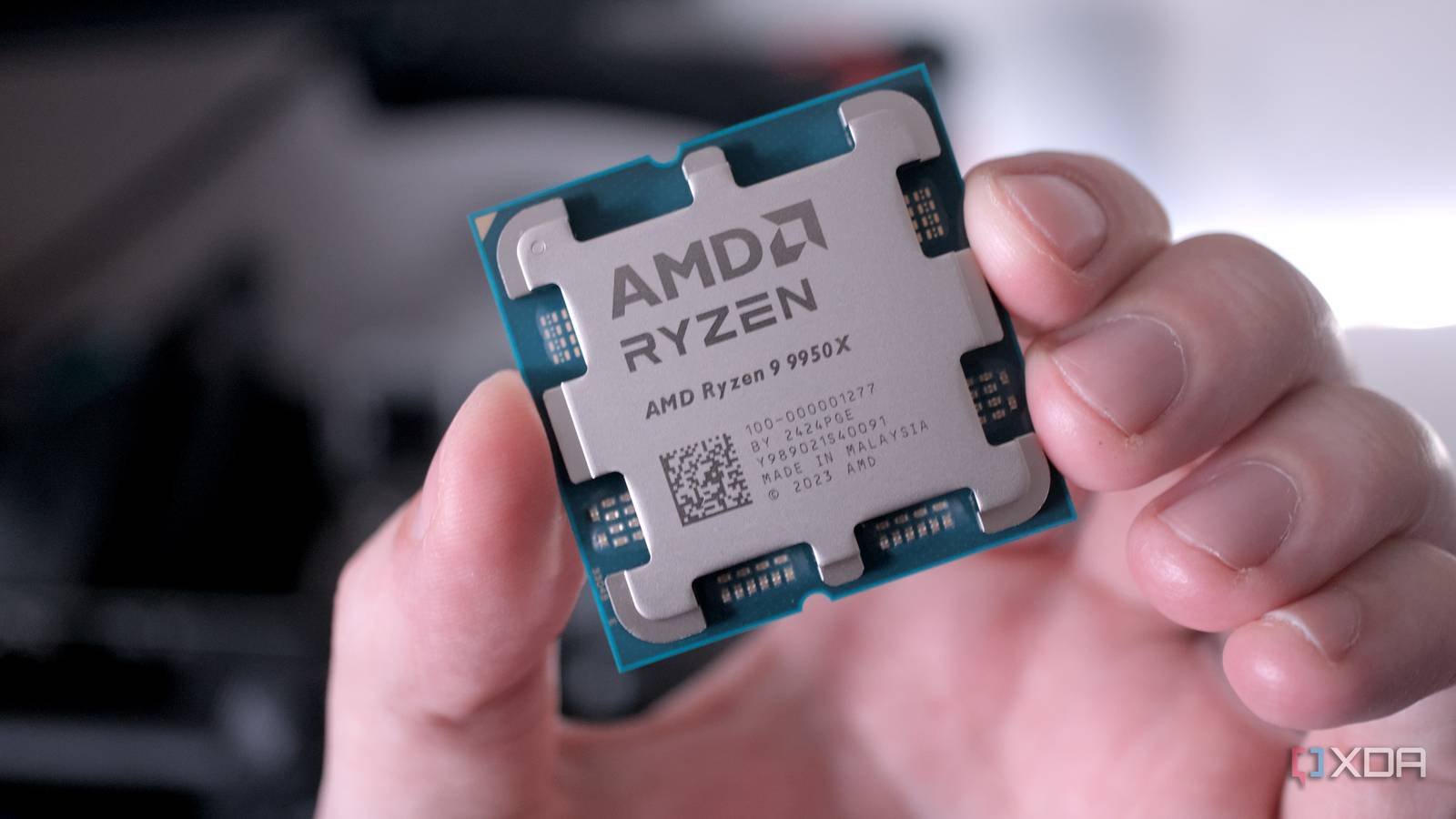
I decided to run some tests on my main gaming rig. I use it for both work and play, but I wanted to see how much difference it makes to run the chip as cool as possible with a beefy 360mm all-in-one (AIO) liquid cooler versus a standard air blower. So, I ran my AMD Ryzen 9 9950X3D hard in the most unscientific tests known to man. I used two comparable cooling setups, the same workloads, identical thermal paste, and roughly the same ambient temperatures. I found almost no difference in performance.
Now, I knew that would happen, but it’s something I keep seeing pop up on social platforms and even sometimes in my own inbox, people asking if they should cool their CPU as much as possible or aim for a quiet PC system. It all comes down to what you want to achieve with that particular system. If it is a compact mini PC with limited space and a multi-core Intel or AMD processor, it will most likely generate some noise if you press it hard. For standard mid-tower builds, you can create a near-silent PC without doing anything.
Fresher is always better
But how cool should you aim for?
Let me clarify one thing before I start writing a comment below this article. I’m not suggesting for a second that running your CPU at 80 degrees Celsius is better than 50 or lower. Electronics, especially processors, prefer colder temperatures. It absolutely affects the longevity of the product, although even if you run the chip at thermal throttle levels most of the time, you’ll probably still get many years of use, thanks to modern advancements and binning. AMD and Intel know a thing or two about their own CPUs.
The two chip manufacturing giants do not design or build CPUs to run as cool as possible. Instead, they design their chips to perform as specified within a set of thermal limits. Modern Ryzen and Core CPUs from the respective brands have incredibly sophisticated and mature internal thermal management systems. These adjust clock speeds, voltages and power delivery on the fly at record speeds. Boosting occurs when thermal space is available and the CPU will back off when there is little left.
Thermal throttling used to be a concern, and still should be to some extent, but modern chips work slightly differently in that both Intel and AMD design their processors to take advantage of all available thermal capacity. Maximum efficiency is not at the lower end of the thermal scale. It’s a bit similar to power supplies, where their maximum efficiency usually occurs around 50% load. AMD and Intel chips are specifically designed to operate at 95°C sustained under load. As long as you meet or exceed the thermal design power (TDP), you’re golden.
My AMD Ryzen 9950X3D It has a TDP of 170W. That’s the amount of thermal output the chip is expected to produce, and my cooling setup needs to be rated to handle that to avoid performance loss. I used the aforementioned 360mm AIO radiator kit and a more affordable air cooler with two 120mm fans. The temperature difference was around 10°C in favor of the AIO kit, but that is to be expected due to the greater fluid headroom and the ability of the radiator with its three fans to expel more heat.
Still, the air cooler handled the test loads well enough that I decided to keep it installed. There was no drop in performance, which matches the idea that most consumer processors can be cooled with a cheap and cheerful CPU cooler. It also resulted in a quieter system, thanks to two fewer fans in the case (I didn’t replace the three in the rad bracket) since there was no pump moving liquid in a closed loop.

The costs of too much cooling
Sorry, can you repeat that?
Keeping the AMD Ryzen 9 9950X3D (and most other CPUs) at reduced temperatures usually means running tougher cooling settings. This means that the pumps and fans spin faster. Depending on how aggressive or smooth your cornering is, this could result in excessive noise. Running the air cooler at close to maximum RPM to achieve the lowest possible temperatures sounds like my standing desk could transform into a platform suspended in mid-air.
It doesn’t help that motherboards still ship with some aggressive fan curves in firmware. Without interfering with these settings, your case and CPU fans will suddenly speed up when opening a new browser tab, simply because they are reacting to a small increase in temperature readings. This constant turning up and down can be really annoying, compared to constant, gradual changes. By smoothing out the fan curves, it allows the system to run hotter effectively.
But not for much. Those precious few degrees you’d typically find with a softer fan curve will result in quieter operations across various workloads. Whether it’s starting a stream from Netflix or YouTube, running your favorite game or even shredding some data and maximizing all available cores. Even with a cheap air cooler with two 120mm fans, the 9950X3D idles at around 30°C. Running X4: Foundations, a notoriously CPU intensive game? 65°C. Stress tests on all cores take things up to just north of 70°C.
These are all perfectly reasonable temperatures, but back in the days of setting up custom liquid cooling loops, I’d prefer 50 degrees for maximum readings. It was great to chase the lowest possible numbers and take everything up to 11, but there’s just no need to do that anymore. As with overclocking, I no longer feel like chasing lower temperatures. Slight undervoltage and consistent fan curves keep everything under control without sacrificing performance.

But you may need lower temperatures.
Video editing and big data work.

When systems run at full load for hours at a time, it may be worth investing in high-range cooling. Video editing, 3D rendering, and heavy data processing can be incredibly taxing on a system. If you’re like me, who renders a video once every two days for an hour or two, you’ll probably be better off with a standard setup. But if it’s your livelihood, having thermal consistency over long sessions can improve clock speed stability under load, as well as chronic high temperatures that could plague silicon for a few years.
But for an average PC, the GPU and other parts do a lot of the heavy lifting. The CPU is hardly pressed hard and is really one of the parts where the thermal concern is almost non-existent. I practice it Arguably, the difference between 55°C and 75°C is not something you’ll notice in-game.and I found no notable observations during the two weeks of testing. Hotter does not necessarily mean worse. As long as you’re not thermally throttling, your CPU will be happy and working as designed.




