
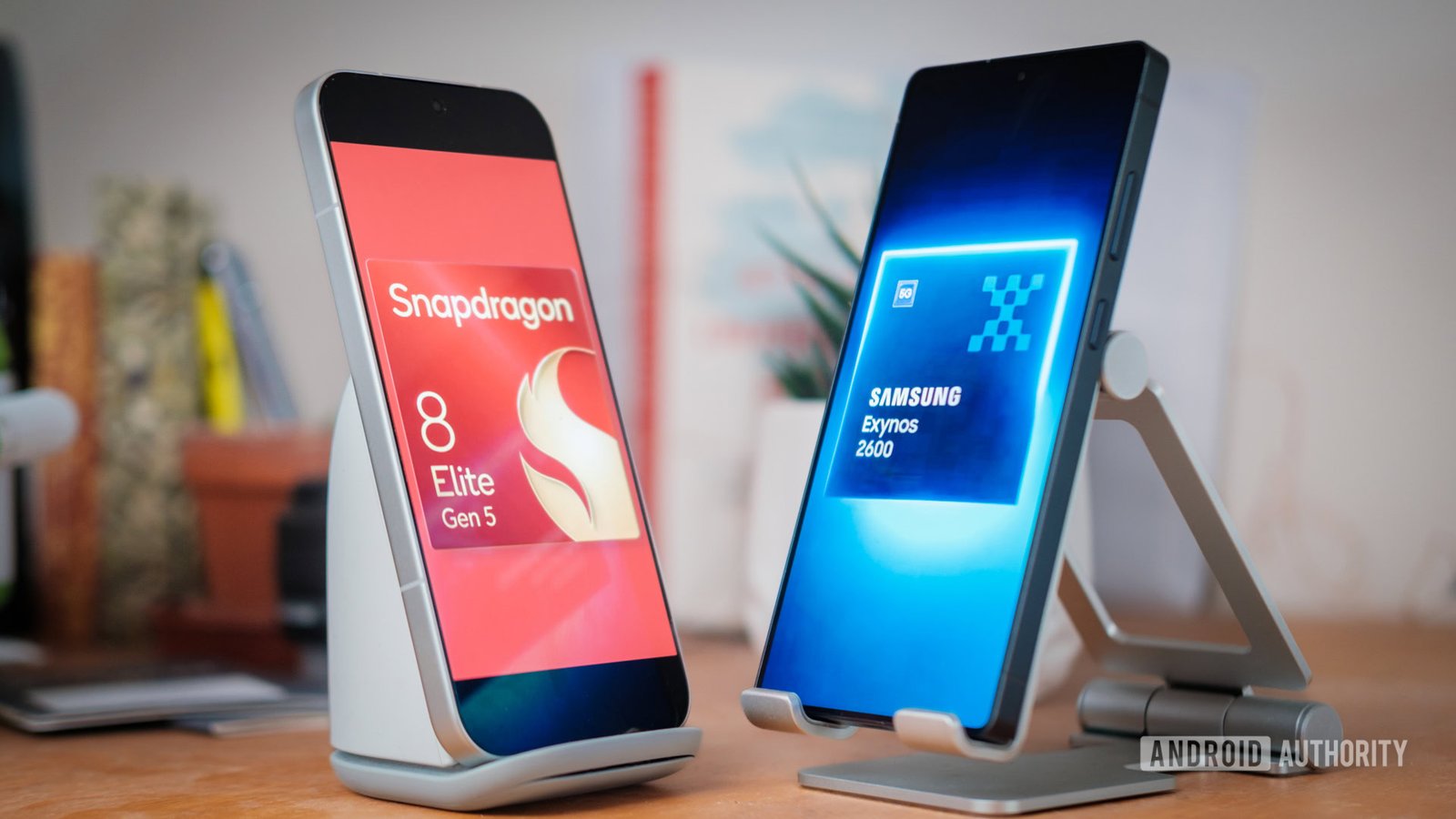
Samsung’s efforts with custom chips haven’t exactly gone well. After years of manufacturing setbacks, design changes, and repeated pauses, the company is finally aiming to get Exynos back on track. For global customers, that the comeback begins with the Galaxy S26where Samsung’s in-house silicon returns to the flagship line.
Exynos has endured a turbulent decade. The Galaxy S23 skipped it entirely due to inconsistent performance, overheating, and low efficiency, while last year’s Galaxy S series also dropped it, likely influenced by Qualcomm’s big jump with the Snapdragon 8 Elite, along with the reported low performances of Samsung’s 3nm process. Although an Exynos 2500 appeared in the Z Flip 7Its limited use highlighted current challenges. In response, Samsung has restructured its chip design and manufacturing teams, with ambitious plans to revitalize Exynos, including a long-rumored project. Custom GPU for the next Exynos 2800.
Graphics have been a defining part of this journey. For the past four generations, Samsung has leaned on AMD’s RDNA architecture for its
Exynos has improved a lot

To start, let’s look at Exynos in isolation in the latest Galaxy S flagships (we’ll leave out the Exynos 2500 in the Z Flip 7 for a more similar comparison). Between the Exynos 2200 and 2600, single-core CPU performance in Geekbench 6 increased by 111%, while multi-core increased by 211%. This is a big leap and a clear sign that Arm’s off-the-shelf CPU cores are still scaling welleven without the fully custom designs used by Apple and Qualcomm.
The graphs tell a similar story. Performance increased by 212% in 3DMark Wild Life Extreme and 253% in the Solar Bay ray tracing test over the same period. AMD’s Xclipse GPU has also matured nicely, ironing out early driver issues and now offering the kind of raw power expected from a modern flagship GPU.

In total, Exynos has roughly tripled its performance between the 2200 and 2600. That said, most of that jump came with the 2400, which nearly doubled performance. The 2600 is a more modest step up, offering gains of 40% to 60% in various tests. In isolation, it’s still an excellent track record, one that the PC market would envy. The problem is that Exynos has not improved in isolation.
AMD vs Arm for mobile graphics

Brady Snyder / Android Authority
Samsung’s switch to AMD’s unproven RDNA architecture was a bold and risky move. The Exynos 2200 was the first to market with hardware-accelerated ray tracing on mobile devices, giving Samsung a clear feature advantage and a strong marketing angle around gaming.
That advantage did not last long. Qualcomm added ray tracing with the Snapdragon 8 Gen 2, while Arm revamped its lineup with the Immortalis series of GPUs that same year. Since Qualcomm’s internal Adreno is off limits, the most meaningful comparison is AMD versus Arm, and the results here are mixed.
Looking at MediaTek’s Dimensity 9200 (with Immortalis-G715) up to Dimension 9500Samsung’s initial lead in ray tracing quickly evaporated. The Exynos 2200, despite launching first, is about 33% behind the Dimensity 9200 in ray tracing performance in 3DMark’s Solar Bay test, although the time gap makes that comparison a bit unfair.

Robert Triggs / Android Authority
This comparison points to the missing piece: the Exynos 2300 canceled in 2023. Based on the trend line we’ve drawn, it probably would have been very competitive, but performance issues prevented it from shipping. As it stands, Arm’s Immortalis GPUs now consistently outperform Exynos in the same area that AMD was supposed to dominate. The Exynos 2600, for example, trails the Dimensity 9500 by about 9% in this ray tracing test.
The biggest problem is traditional rasterization, which is still much more important for most mobile games. Here, Exynos has consistently lagged behind. The 2200 was about 45% slower than the Dimensity 9200 in Wild Life Extreme, and even now, the Exynos 2600 is about 19% behind rival chips from Qualcomm and MediaTek.

Robert Triggs / Android Authority
That gap is actually wider than previous dual-chip Galaxy S generations, which isn’t a great look for Samsung’s flagship chipset. Perhaps price, area, and power considerations have still made this move worthwhile from Samsung’s perspective, but from a gaming perspective, AMD’s Xclipse hasn’t provided a clear advantage.
Snapdragon remains the premium option

Robert Triggs / Android Authority
None of this will surprise long-time Samsung fans. A decade ago, Exynos and Snapdragon were true peers, but more recently, Snapdragon stepped up and stayed there.
Even when Exynos appeared on newer Galaxy S models, it effectively became the second-tier option. Samsung Ultra models have gone Snapdragon-only, reflecting the chip’s continued leadership in CPU performance, gaming and, increasingly, on-device AI. This has also created a familiar imbalance in global markets, where some customers get the faster Snapdragon variant while others get Exynos.
It’s unclear whether this strategy significantly reduces costs or simply offsets Samsung’s own chip development expenses. Given the company’s restructuring efforts and reported performance challenges, any near-term benefits are likely to be limited.
Exynos hasn’t stood still, but its rivals have advanced even faster.
To be clear, Exynos has not stood still. Its generational advancements are truly impressive and the Exynos 2600 is by no means a slow chipset. But over the past five Galaxy generations, Samsung’s custom silicon has consistently lagged behind its closest rivals (aside from Google’s Tensor). The move to AMD graphics hasn’t changed that dynamic either.
Instead, Exynos remains a strategic investment. It gives Samsung control over its own silicon roadmap, reduces reliance on third-party vendors, and allows for deeper customization, whether it’s features like Arm SME2 for AI either Heat Pass Block (HPB) Technology for thermal management on the 2600. This could be an optimistic sign of things to come, we’ll just have to see what’s next when Samsung’s partnership with AMD finally comes to an end.
I don’t want to miss the best of Android Authority?


Thank you for being part of our community. Read our Comment Policy before publishing.



