
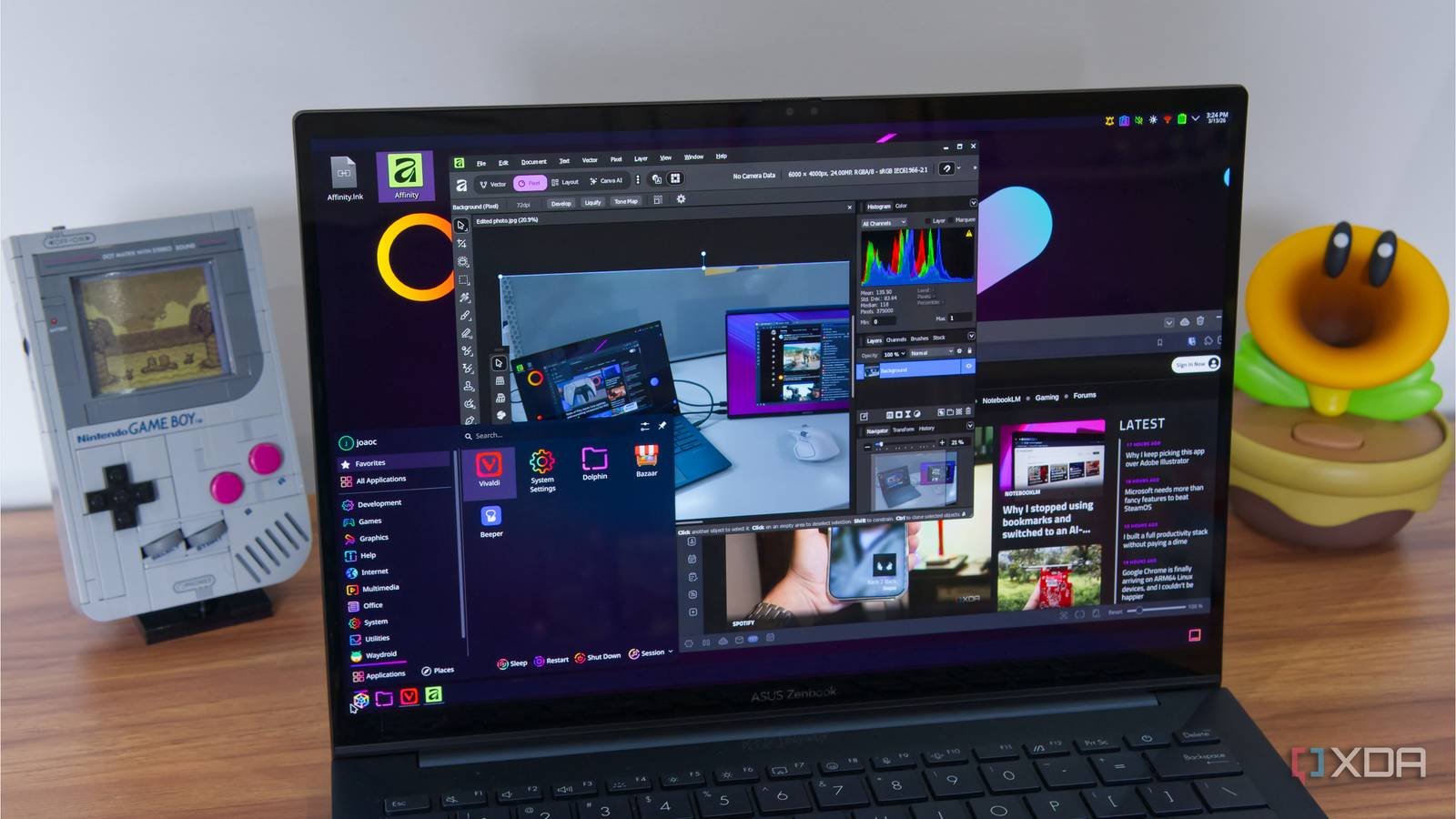
One of the best things about Linux is how much you can customize your system down to the deepest level. You can switch between different kernels, drivers, desktops and applications, making everything work just the way you want. However, for most people, that will come down to desktop choice, which is often also related to the layout you choose.
Between GNOME, KDE Plasma, Cinnamonand many others, there are a ton of options for the desktop, and while having options is certainly a good thing, there comes a point where it can be a problem. And Linux is probably at that point.
Desktop choice becomes layout choice
Finding what you want can be a challenge

Technically, the desktop you choose doesn’t have to be tied to a specific distribution. On most distributions, there are several desktop packages you can install, and you can switch between them as needed. But that doesn’t change the fact that when you choose a distribution, you almost always also choose a default desktop.
Whether it’s ubuntu, hatLinux Mint, Bazzite or almost any other distro, when you choose it you are choosing the desktop you want to start with it. That means finding the exact desktop and layout you want becomes much more difficult. If you want to start with a desktop you like, you may have to give up certain things that a different layout does better.

You may also be looking for more specific desktop customizations that are included by default in some distributions, but that complicates things further. Many distributions with more specific or niche features may not have the broad support of more well-known distributions, making it difficult to know for sure if you will still receive updates in a few years.

Once you’re familiar with these concepts, you can of course customize everything yourself from the start, and something like Arch Linux doesn’t even have a default desktop and just lets you choose one from the start. But for a beginner, the overwhelming sea of options can be a deterrent and cause choice paralysis.
Split efforts
Desktop computers have limited support
The thing about having so many options to choose from is that the community itself becomes increasingly divided, making it difficult to add new features and ideas to all of them. What ends up happening is that a lot of tools you may like only support one specific desktop, and finding alternatives can be nearly impossible.
For example, GNOME has its GNOME extensions with a dedicated marketplace and they can radically change almost everything about your desktop. They can move icons, change the appearance of the panel, and even give you a tiled window manager. There is a huge degree of customization here, but once you move to KDE Plasma, all that goes away.
Instead, KDE has its own type of customization where you can create multiple panels on each side of the screen and add multiple widgets to them that can enable all kinds of features. Cinnamon has something similar, but notably, these are different systems, so what works on one doesn’t necessarily exist for the other.

That divide in the community means that a wide range of tools may never be available to a large subset of the Linux community, and that’s simply not a problem on Windows, where everyone has the same foundation. And keep in mind that GNOME, KDE, and Cinnamon are some of the largest and most popular desktops out there. There are many more options that don’t come close to that level of support, making them very difficult to hold.

A great example is COSMIC, which was born after the developers of Pop! OS decided to separate from GNOME. COSMIC is a really promising desktop with some cool features of its own, but a lot of the things it wants to do just aren’t supported by the community right now because it’s a very new platform with very few users. As a result, COSMIC feels very hindered.
How many will survive?
Small communities can result

This without taking into account the fact that so many desktop computers can be born simply out of spite or small deviations from an original equipment. Both Cinnamon and COSMIC were born through similar processes, and while these can be sustained in the long term, many other options can end up falling by the wayside when the community that started the project abandons it.
Carry NitrixFor example. This Linux distribution used to be based on previous versions of KDE Plasma, injecting a lot of customization into them to create a custom shell. When the old versions of KDE Plasma it relied on were no longer supported, the team attempted to create its own shell with Maui, but the team simply couldn’t sustain the development of a full desktop experience on its own. Ultimately, the distribution settled for using the Hyprland desktop.

That’s what happens when everyone has a slightly different vision of what they want and tries to do something new. Sometimes having a niche community isn’t a bad thing, but with something as fundamental as a desktop computer, it’s important that a project has a foundation to sustain itself and move forward for a long time. Just as the Maui Shell ended up being left behind, many other desktop computers may suffer a similar fate in the long term.
It’s better to play it safe
If you’re considering switching to Linux or are relatively new to it, your best bet is to stick with a desktop environment that has proven popular and will stick around for a long time. Options like GNOME, KDE Plasma, or Cinnamon are great examples of desktops that have stood the test of time and will likely continue to be supported in the future. It’s better to familiarize yourself with the customization tools and make these desktops work for you than to try to find something more unique or too specific. This way, you can be sure that you will be supported for much longer and you won’t have to worry as much about your workflow being interrupted at some point.



