
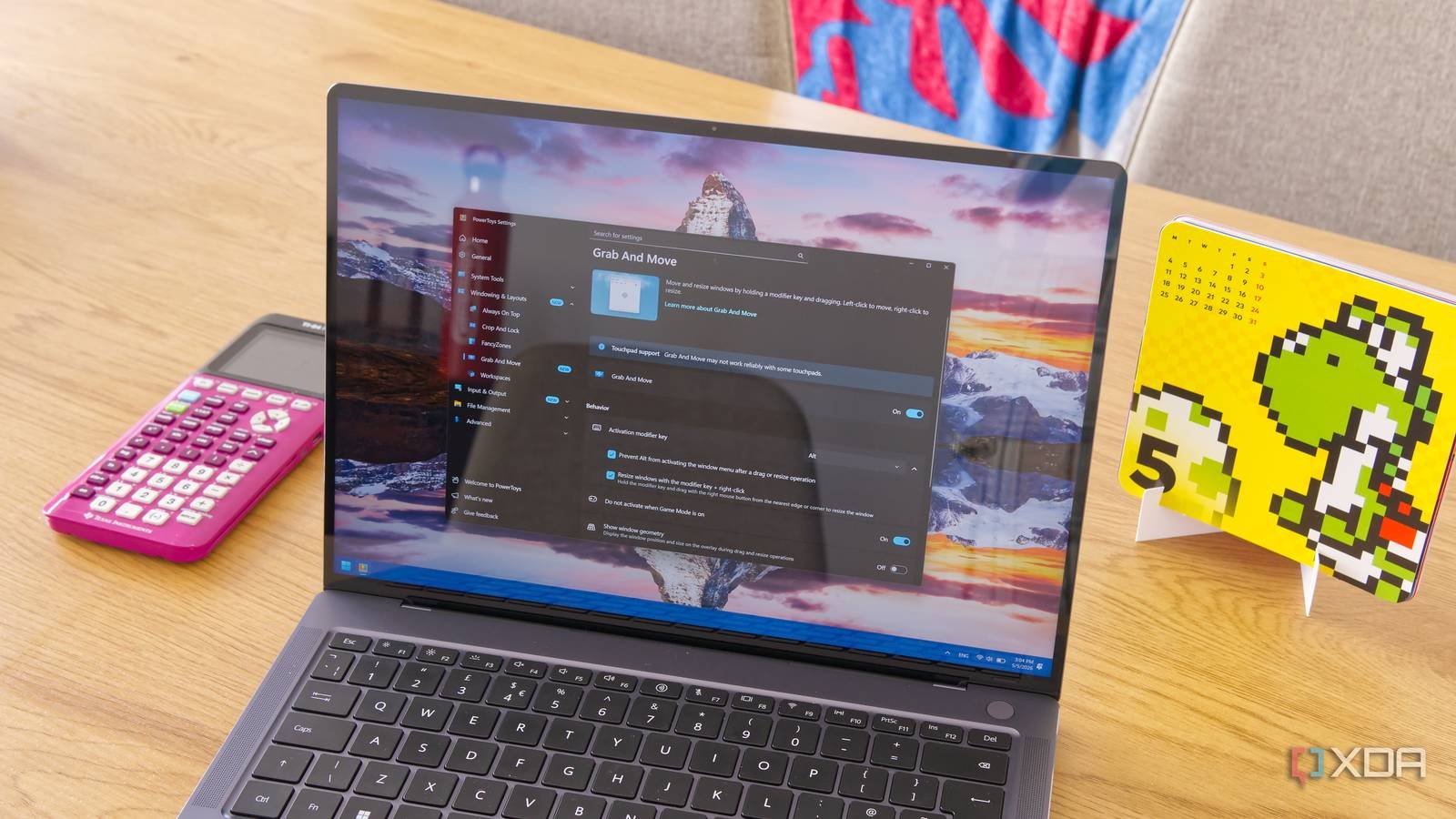
Despite its name, windows 11 It’s not always the best at window management, at least not without help. I have long been a fan of power toys for giving me a lot more flexibility when it comes to managing my open windows to improve my productivity with FancyZones, but the way the setting works may not be for everyone.
However, recently Microsoft added another feature that makes window management even easier and, frankly, a game-changer. It’s called Grab and Move and it should be a feature on all computers.
Drag windows no matter what
Who needs title bars anyway?

The name Grab and Move gives away the main trick of this tool, but that doesn’t make it any less useful. Typically, to drag and move a window, you click on it in the title bar, which brings it to the foreground and allows you to drag the window over others as you like. However, some apps may have custom title bars, which can make dragging less convenient or at least less predictable. And what if you didn’t have to rely on title bars?
That’s the question Grab and Move tries to answer, and frankly, it’s a perfect answer. With this tool, all you need to do is hold down a modifier key (which is Alt. by default), and then all you need to do is click anywhere on the window to start dragging it. This can greatly reduce the time wasted trying to click on the right area of the window to drag it correctly. A great example of this is PowerToys itself. Command Palette Toolwhich is a home bar without a title bar. There is a small portion of the window that can be used for dragging, but there is no clear visual indicator of it and it’s a little hard to hit. Grab and Move makes it completely trivial.

Also, here’s another thing: using Grab and Move, you can also drag windows that are not currently in focus without shifting focus to them. Windows will move maintaining their current position in the stack, so they will move behind other windows that may be on top of them. It’s a small benefit, but a welcome one.
Even resizing works
No more searching for window edges
Moving windows is probably the most useful part of this tool, but it can actually do something else: resize windows. Using the same modifier key, but with a right click, you can resize any window from wherever your mouse is at the time. It may take some getting used to, but it’s a pretty cool capability.
In some ways, this is even more useful, because while most apps have decently large title bars that make it easy to drag a window, it can sometimes be tricky to align your mouse cursor with the edge of a window (let alone a corner) to resize it correctly. This way you can do it from any position and again it works even if the window is not in focus.
The tool takes the initial position of the mouse relative to the window to determine how resizing works. If your mouse is closer to the right edge of the window when you start dragging, moving to the right will make the window larger in that direction, but if your mouse is closer to the left edge, moving to the right will first shrink the window from the left side until it reaches the smallest width allowed, at which point it begins to expand to the right.
That same logic applies in all four directions, so you can think of any given window as divided into quadrants that determine the initial resizing behavior. It can be a little confusing, but it’s not much different than what you would expect when resizing a window.
This must become a standard.
Every platform should have this feature.

There’s something interesting about this feature because I’ve never thought of it as something that should exist, but now that I’ve seen it, I think something like this should be built into all PC platforms. Windows shouldn’t rely on an external tool to get this kind of capability, but other platforms need it too.
This certainly feels like the kind of feature you’d find deep in the system settings of something like KDE Plasmaand if it’s not there yet, it should be. It’s perhaps best to keep it disabled by default, but the option should certainly be there.
It’s something you may not realize you’re missing until you try it, but the freedom of moving windows without searching for a specific grip point makes things much easier and can save you a lot of time once you get used to using it. And this is just one of the many ways PowerToys has been improving Windows in recent years, when Microsoft seems to refuse to incorporate those improvements directly into the system. Now more than ever, it’s a good time to give PowerToys a try.



