
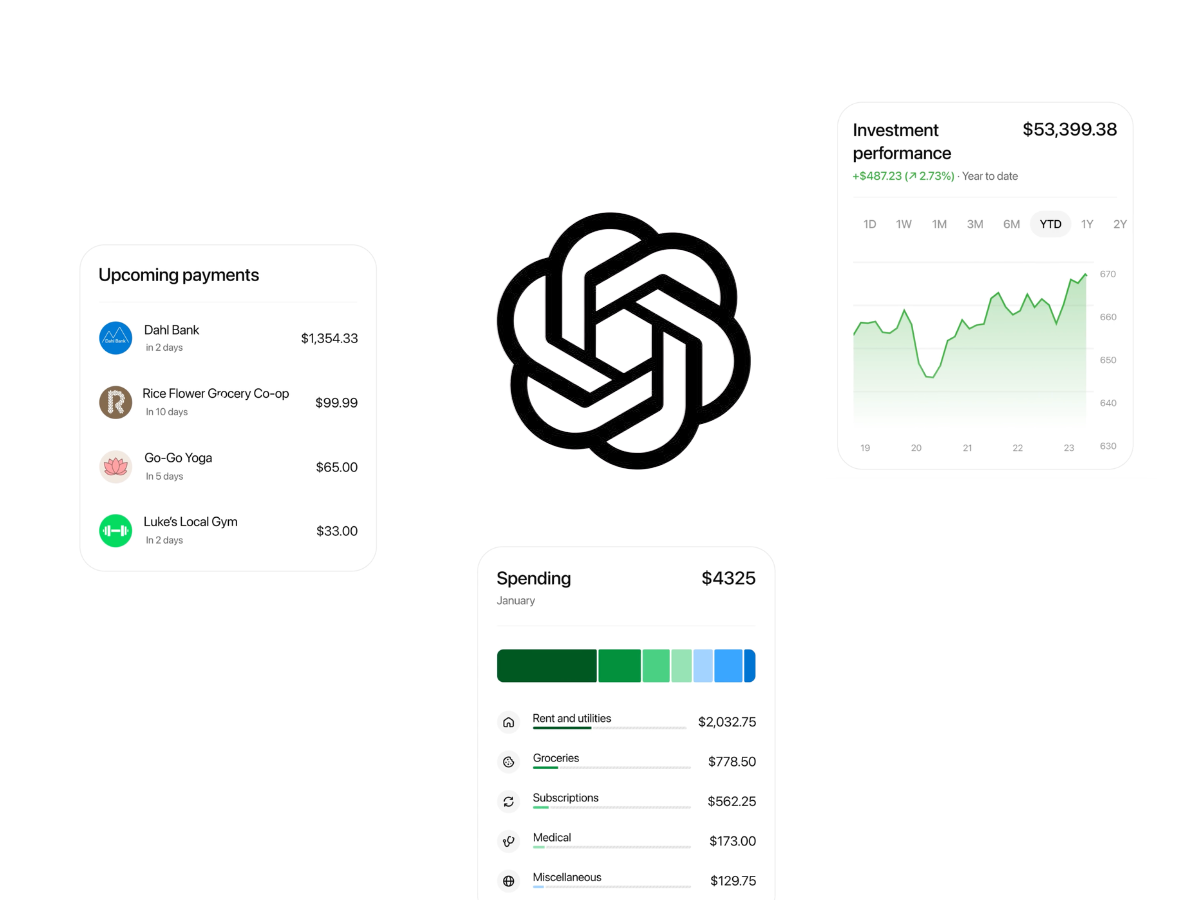
OpenAI has presented a preview of a personal finance feature in ChatGPT for Pro users in the United States. The new functionality allows users to connect their financial accounts, view a dashboard showing balances and expenses, and ask questions about their finances based on actual data in their account. The launch is initially limited to a small group of users on the web and iOSwith plans to expand to ChatGPT Plus and eventually all users.
With this feature, ChatGPT can access balances, transactions, investments, and liabilities through linked accounts. However, you cannot view full account numbers or make changes to accounts. Connections are established through Plaid and support from Intuit is expected soon. At launch, more than 12,000 financial institutions are supported.
How to connect your financial accounts within ChatGPT

To start using the feature, users can open the Finance tab from the ChatGPT sidebar and click Get Started or type “@Finances, connect my accounts” in any conversation.
ChatGPT then guides users through linking their accounts through Plaid. Once authenticated, the synced and categorized data appears in a dashboard that provides an overview of portfolio performance, spending categories, subscriptions, and upcoming payments. The initial synchronization process may take a few minutes.
Users also have the option to add financial memories, which store context, such as a savings goal, a mortgage, an outstanding loan, or a planned major purchase. ChatGPT uses these memories to improve the relevance of future finance-related conversations.
What ChatGPT’s personal finance dashboard can do with your data
The default feature is GPT-5.5 Thinking for financial conversations, while GPT-5.5 Pro is available to ChatGPT Pro users for more precise answers. OpenAI’s internal benchmark gives GPT-5.5 Pro a score of 82.5 out of 100 on a personal finance test, with GPT-5.5 Thinking scoring 79. Outdated models scored lower, with GPT-5.4 Thinking scoring 76.6 and GPT-5.5 Instant scoring 65.1.
The benchmark was developed in collaboration with more than 50 financial professionals to evaluate the quality of response on complex personal finance tasks. OpenAI emphasizes that the experience is intended to inform and not replace professional financial advice.
Privacy controls and action-oriented features through ecosystem partners
Conversations with connected accounts follow the user’s training settings, which can be adjusted through the Settings and Data controls.
Users have the option to disconnect financial accounts at any time through Settings, Apps, Finance, or directly from the Finance page. All synchronized data is deleted from OpenAI systems within 30 days. Users can also delete individual financial memories at any time from the Finance page. Temporary chats are available that do not access connected financial account data and do not appear in your conversation history.
OpenAI recommends enabling multi-factor authentication on the ChatGPT account to provide additional protection.
OpenAI is expanding the capabilities of its finance function beyond simple questions and answers. Through partnerships with companies like Intuit, the company is developing use cases, such as providing a credit card recommendation followed by an approval probability estimate and application process, or helping with tax estimates and scheduling a session with a local tax expert directly within ChatGPT.
The personal finance feature is now available to ChatGPT Pro users in the United States on the web and iOS. OpenAI plans to roll it out to Plus subscribers next, with the ultimate goal of making it widely available. No specific timeline has been announced for a broader release or availability outside of the United States.




