
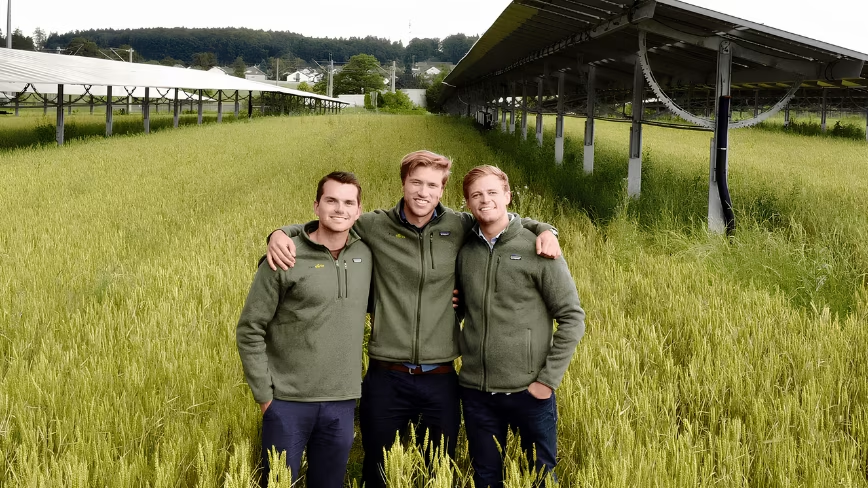
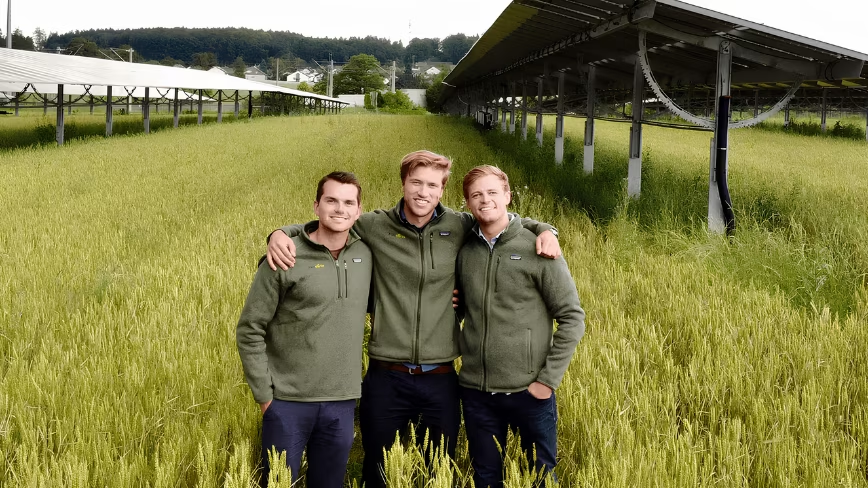
The Munich-based developer behind Germany’s largest agricultural PV installation plans to build 100 MW in the next 18 months. The new debt facility is the working capital pipeline that converts a 250 MW portfolio into deliverable projects.
Munich-based photovoltaic energy developer Field work has obtained a renewable credit line of 12 million euros to finance the construction of a 100 MW portfolio of agricultural-photovoltaic projects over the next 18 months.
The facility is debt rather than equity, making it the working capital the company needs to convert its pipeline of approved or in-approval projects into deliverable, grid-connected capacity at a good pace.
The company is a specialist in this category. Agri-PV is the German abbreviation for agrivoltaics, the dual-use approach that places solar panels elevated above crops or grazing land so that the same hectare produces electricity and agricultural production.
The technology has been moving from a policy-backed demonstration stage to commercial-scale deployment across Europe over the past three years, with Germany being the most developed domestic market thanks to the country’s EEG (Erneuerbare-Energien-Gesetz) tariff framework and bilateral support from the Federal Ministry for Economic Affairs and Climate Action.
Feldwerke’s track record is the part that takes advantage of the new financing. The company Construction of the largest agricultural photovoltaic park in Germany began. in Oberndorf am Lech, Bavaria, in August 2025, and the 17 MWp facility went into operation at the end of March 2026..
A 32 MW project is being developed in Baden-Württemberg along with seven other projects currently under approval. According to figures published by Feldwerke itself, the total portfolio is approximately 250 MW. The new €12 million credit line is sized for the first 100 MW of that portfolio, with implicit unit financing of around €0.12 per watt of capacity (excluding the capital and tariff subsidies on which the rest of each project relies).
The structural choice of a revolving line of credit instead of project finance term debt is the technical detail. A revolver allows Feldwerke to draw down capital as construction milestones are achieved across multiple projects, pay out as permanent financing for each project closes, and draw back against the same line for the next project in the pipeline.
The structure is standard for renewable energy developers operating on a portfolio basis, but is unusual for a startup less than three years old, and the willingness of a lender (the company has not disclosed the bank involved) to extend the credit line is a significant underwriting signal.
The German agricultural PV market in general is the part on which the rest of the trade relies. Germany’s solar incentive stack for 2026 includes the KfW 270 loan program, EEG Marktprämie auctions, dedicated subsidies for agricultural PV and the Bavarian Free Field PV Ordinance, which classifies certain agricultural PV configurations as “privileged” for permitting purposes.
The combination of low-cost public debt, predictable tariff revenues and accelerated permitting has materially improved the unit economics of agro-PV development versus ground-mounted solar, and Feldwerke’s portfolio is calibrated precisely against that set of policies.
The European context followed by TNW is the second stage. He BayWa agro-photovoltaic plan backed by the EU covering six projects in five European countries was the first major policy-supported pan-European pilot programme; Feldwerke is dealing with the commercial implementation of this same thesis.
The broadest cycle of renewable energies in Germany political push that Chancellor Merz has used as the centerpiece of his economic revival framework has produced demonstrably faster permitting schedules through the first half of 2026 (based on EEG auction performance data), which is the procedural change that Feldwerke is now positioned to benefit from at pipeline scale.
Feldwerke was founded in October 2023 and operates from Munich. The company has not publicly disclosed its equity financing stack, its post-money valuation, or the indicative interest rate on the new credit facility. The question the next few quarters will answer is whether the company will execute a parallel capital round backed by the credit facility.
The broadest category of German energy companies has been rising at increasingly defended valuations over the past 18 months, and Feldwerke’s combination of grid-connected operating capacity and visibility into approved pipelines puts the company in a category that investors are increasingly willing to back at scale.
As for operational details: the lending bank is not named, the retirement schedule based on construction milestones has not been disclosed, and the company has not specified which 100 MW of the ~250 MW portfolio will be built first.
What is seen is the structural commitment: 100 MW of new agricultural photovoltaic capacity in 18 months in a German developer with one operational asset and seven under approval. The next 18 months will decide whether the pipeline is delivered as planned or if the credit line absorbs the delay.



