
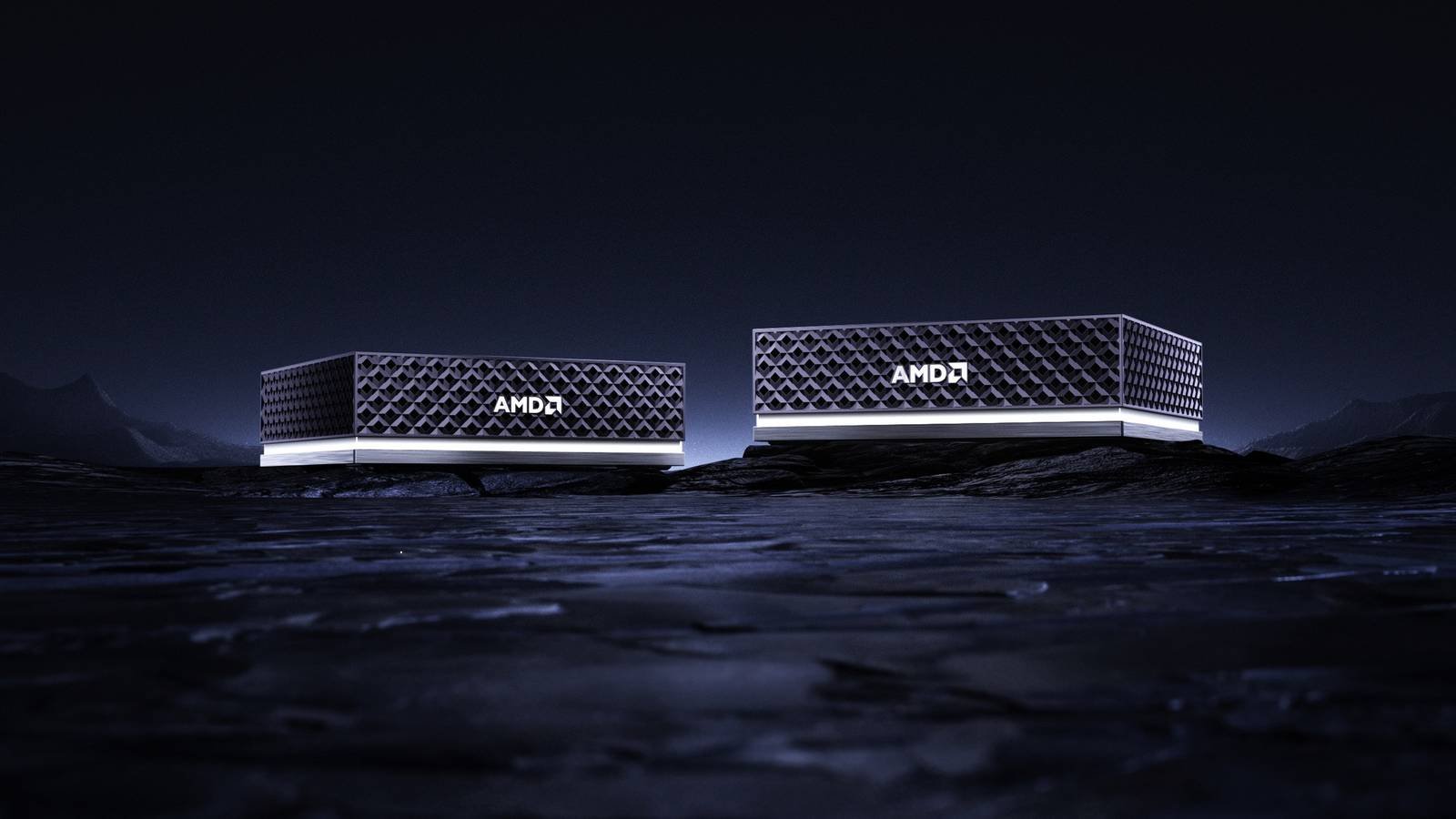
AMD has announced the availability of the Ryzen AI Halo developer platform, powered by AI Max 300-series processors. This range of mini PCs won’t win awards for their gaming prowess, nor are they designed as low-cost options to plug in behind workstation monitors.
At the moment, AMD will only offer one SKU for sale, with the Ryzen AI Max+ 395, but more models with Ryzen AI Max PRO 400 series chips will be released later, some of which will likely be more affordable. These capable compact boxes will allow developers (and prosumers) to run local LLMs with up to 192GB of unified memory.
What’s in the Halo box?
Everything you need for local models.

The driving force behind the launch of a single SKU in June is the powerful AMD Ryzen AI Max+ 395 with its impressive 16 physical cores and 32 threads. Capable of boosting up to 5.1 GHz, this is an absolutely beast of a mobile processor and has appeared in other products. AMD chose the chip to launch the Ryzen AI Halo developer platform thanks to the inclusion of 80MB cache, AMD Radeon 8060S graphics, and a 650 TOPS NPU. Combine all that with 128GB of unified memory and you have the ultimate app for running local LLM immediately. Us love this processor.
With one of these mini PCs, it will be possible to run larger local AI models with all that dedicated RAM. That incredible combination of CPU, NPU and GPU ensures that AI development workflows are optimized, with support for AMD ROCm and widely used frameworks and tools. Although AMD has lagged behind Nvidia’s AI push and platform support, the company is certainly looking to make a splash with this. 128GB of RAM is perfect for reducing reliance on cloud resources for testing, tweaking, and development, something even the incredibly popular RTX 3090 would struggle with.
The first Ryzen AI Halo won’t be cheap, however, with an MSRP of $3,999. You can thank the price of parts for that, as well as the niche nature of the device itself. Pre-orders begin in June 2026, but it will be the next wave of SKUs that will really make this an interesting proposition from AMD. This AI Halo 300 series hasn’t even launched yet, and the company has already revealed what’s next with the Ryzen AI Max PRO 400 series CPUs. These Zen 5 chips combine RDNA 3.5 graphics with XDNA 2 NPUs to deliver impressive results, and are among the first x86 client chips to run 300B models. So, yes, we are talking about very large LLMs.
Go big with Ryzen AI
AMD has its sights set on Nvidia’s DGX Spark
The Max+ 395 is impressive on its own, but the Max+ PRO 495 and the rest of the 400 series go a step further with up to 192GB of RAM. Compare that to the roughly 16GB you’re using with a discrete GPU to run LLM at home, and it’ll be clear where they’re in a league of their own. But it is not just for running and developing LLM. These chips are great for design, rendering, simulation, and engineering, making Ryzen AI Halo a great choice for enthusiasts and developers. The best part is how AMD focused on making it easy to get up and running.
|
Max+ 395 |
Max+ PRO 495 |
Maximum PRO 490 |
Maximum PRO 485 |
|
|---|---|---|---|---|
|
Cores Rags |
16 32 |
16 32 |
12 24 |
8 16 |
|
CPU clock |
Up to 5.1 GHz |
Up to 5.1 GHz |
Up to 5.0 GHz |
Up to 5.0 GHz |
|
Cache |
80 megabytes |
80 megabytes |
76 megabytes |
40 megabytes |
|
GPU |
Radeon 8060S 40 CU |
Radeon 8065S 40 CU |
Radeon 8050S 32 CU |
Radeon 8050S 32 CU |
|
TDP |
45 – 120W |
45 – 120W |
45 – 120W |
45 – 120W |
|
NPU (TOPS) |
50 |
55 |
50 |
50 |
|
RAM |
128GB |
192GB |
192GB |
192GB |
If you choose one with the chips above, you’ll get a system capable of handling the largest modern models. AMD provides an out-of-the-box software stack for Windows and Linux, consisting of the Ryzen AI Developer Center, applications and model preloads, and guides to deliver guided workflows. ROCm is fully supported out of the box with optimized performance and SOTA model support, and fully utilizes the broadest platform of validated tools, frameworks, and drivers. It’s a pretty attractive platform, beefed up with up to 2TB of PCIe Gen 4.0 storage, 10Gbps networking, and Wi-Fi 7.
Nvidia already has the DGX Spark up and running, but it’s limited to Linux, lacks an NPU, and offers weaker performance, according to AMD data. We’re hoping to get our hands on one to test out, as even the Apple Mac Mini M4 Pro and its fantastic hardware and software stack optimized for running AI struggles to run models over 100B, which is something the Ryzen AI Halo can do and then some. And with a TDP of 150W, you’re looking at a monthly bill of around $16 with a price per kWh of $0.15 – not bad compared to the price of AI cloud platforms.



