

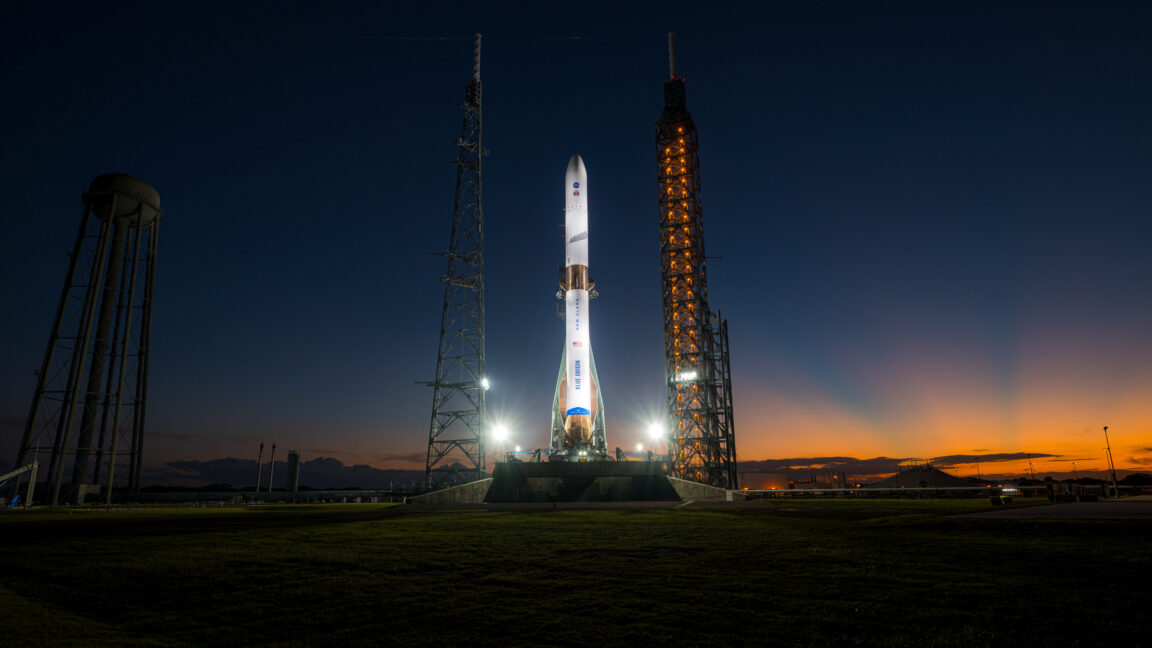
Then there’s the larger Blue Moon Mark 2 lander, which will fly on a larger, more powerful version of the New Glenn rocket with nine first-stage engines, known as 9×4. NASA is counting on the Mark 2 lander, along with SpaceX’s Starship vehicle, to deliver humans to the Moon on a regular basis… and soon.
Platform infrastructure is severely damaged
It is too early to determine the impacts of this failure, but they will be considerable. Early reports from sources suggest that the LC-36A launch infrastructure is severely damaged. A source indicated that one of the lightning towers may not be able to be saved and that the transporter-assembler could also be damaged beyond repair.
The company recently began construction on a second launch site nearby at New Glenn, LC-36B. However, work there is in its early stages. However, completing this new launch tower may be faster than rebuilding the LC-36A. New Glenn almost certainly won’t launch again in 2026, and frankly, a launch during the first half of 2027 would be heroic given the launch site concerns.
Blue Origin has been hard at work developing the larger 9×4 rocket, which is expected to become the fleet’s workhorse over the smaller variant of the 7×2 rocket that exploded Thursday night in Florida. The company may now devote all its efforts to completing work on this larger rocket.
Bezos, who made his fortune with Amazon, has heavily funded Blue Origin since its founding a quarter of a century ago. He has invested tens of billions of dollars in the company. Fortunately for Blue Origin, it has the financial means to sustain the company through this failure and accelerate its recovery efforts. NASA will also be very interested in Blue Origin recovering as soon as possible.
If there is one small silver lining, it is that the rocket that exploded Thursday night was not carrying its payload of Amazon Leo internet satellites. They were safe, at a nearby integration facility, awaiting launch.



