

Before entering the home server ecosystem, I only used PCIe slots to pair graphics cards with my gaming rigs and then forgot about them completely until my next PC building misadventure. But I didn’t know that every unoccupied PCIe slot was a free expansion header that’s just as useful for home lab nodes as it is for an everyday machine. With all sorts of adapters floating around, inserting one into a spare PCIe socket can add extra functionality to budget motherboards.
Take network interface cards as an example. On paper, you’d think they’re only useful for home servers and makeshift routers. But they’re actually quite useful for gaming machines, and it’s a lesson I learned a while ago when I bought a couple of discounted NICs for my home lab and ended up inserting one into my daily controller.
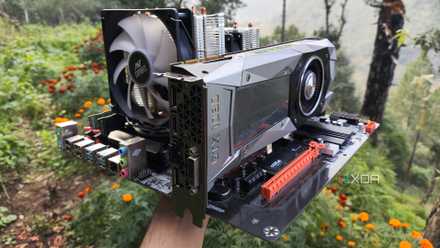
Placing a NIC in an unused PCIe slot solved many problems
It single-handedly got rid of the random disconnection issue that was plaguing my PC

Although my B550 motherboard has a built-in 2.5G Ethernet port, it has this tendency to randomly disconnect from my router out of nowhere. And as much as I would like to claim otherwise, losing Internet and LAN access, even for a couple of seconds, is enough to cause problems in my daily tasks. Anything involving the Proxmox shell interface would end up failing because a disconnection would cause the session to restart and sometimes you would lose hours of progress.
Multiplayer games are another area where a single disconnection can mean the difference between victory and defeat, especially since certain games wouldn’t let me meet up with my friends even after I regained my internet connection. Yes, I’m looking at you, Elden Ring: Night Reign and all the deep of the night Points I lost because I couldn’t rejoin the team after getting an error on day 1. But I digress.
Upgrading the Ethernet units didn’t help alleviate this problem, nor did changing the Cat6 cable between my PC and the router. Throwing in a cheap USB to RJ45 adapter seems like a decent option, but the USB ports are just as unreliable as my faulty Ethernet port, if not worse.
I finally installed a NIC in my gaming machine and I regret not doing it sooner. Since I plugged the NIC into a free PCIe slot and my CPU has enough PCIe lanes to support it, I no longer have to worry about the sudden disconnection issue affecting my setup. The best part? It ended up increasing my LAN speed considerably, although that wasn’t my primary intention.
Improved transfer speeds on my PC.

To be clear, the NIC in question is the TP Link TX401 10GbE, and it’s something I hadn’t even purchased for my gaming PC. In any case, I had planned to use it as a makeshift. FreeBSD server (and that’s not even the craziest part of my home lab), but I ended up deleting it after having problems with the Marvell AQtion drivers on the OS.
But to my surprise, adding a 10G card to my main PC turned out to be quite fruitful. Since it’s my daily driver, I set Kopia to send snapshots to my NAS every week, and the 10GbE connection greatly reduced transfer times. And as crazy as it may sound, a 10 gigabit network makes my NAS a viable storage hub for Steam games. In any case, I haven’t had any latency issues when storing graphically demanding titles on a (SSD-based) iSCSI pool over a 10G connectionwhile loading times were good enough that I honestly couldn’t tell if my games were running on a local drive or a network share.

But other adapters are just as useful
I also have a USB extender and NVMe adapter connected to the mobo.
Even with the slots hogged by the mammoth RTX 3080 Ti and my beloved 10G network card, I still have extra PCIe sockets on my ATX motherboard, which currently houses a few adapter cards. Since there are no USB ports, I used a x4 slot to connect a PCIe to USB adapter to my PC. While the two USB 3.2 ports are undoubtedly useful, the two USB Type-C ports are what make the $30 I spent on this adapter worth it, especially since my cheap mobo doesn’t include a single Type-C connector.
For the final x4 slot, I ended up grabbing an NVMe to PCIe adapter card. While it only supports Gen 3 speeds, it is more than enough to store additional documents, container data, and LLM files. And that’s just my main PC.
Once you get into the server ecosystem, there are even more useful PCIe cards. I already have a SATA expansion board for my storage machine and I plan to purchase another IPMI expansion board for the remote NAS I use for my 3-2-1 Backup Pipe.



