

linux Lite 8.0 has been released. The new version is based on Ubuntu 26.04 Resolute Raccoon and comes with Xfce 4.20 as a desktop environment.
Following its usual pattern, major Linux Lite updates are tied to new versions of Ubuntu LTS, with version 8 arriving approximately two years after Linux Lite 7.
Key changes include rewritten helper applications that now use GTK4, Firefox replacing Google Chrome as the default browser, and the Calamares installer replacing Canonical’s Ubiquity.
The update also supports local updates from Linux Lite 7.x to 8.x. The new version has a download size approximately 410 MB smaller than its predecessor.
Firefox replaces Chrome, with optional local AI in Linux Lite 8.0
The default web browser has moved from Google Chrome to Mozilla Firefox. Linux Lite has not provided an official reason, but the change appears to be related to Google’s silent inclusion of a 4GB Gemini Nano model in Chrome and platform restrictions on uBlock Origin starting in 2024.
Despite moving away from Chrome, Firefox now includes AI features by default through a new MyAI feature. This tool offers a selection of local language models.
Linux Lite emphasizes that AI is a controversial topic and presents this feature as a user-choice offering rather than imposing AI functionalities on them.
\Those who prefer not to use MyAI can remove it with a few simple commands: open a terminal and run the necessary commands, then right-click the MyAI bookmark in the Firefox toolbar and select Remove Bookmark.
Helper applications rewritten in GTK4 and new Lite terminal/Lite software
Fifteen of Linux Lite’s custom helper applications have been rewritten using GTK4, including a new Terminal Lite that replaces Xfce Terminal and a new Software Lite that replaces Synaptic. The move to GTK4 introduces some interface changes.
Traditional menu bars are no longer supported, so new helper apps now include hamburger menus and place main actions in the title bar.
Lite Terminal offers features like predictive autocomplete and a title bar that turns light red when you run sudo. Lite Software has fewer sorting options compared to Synaptic, and package lists can currently be sorted by name only.
Other notable changes in Linux Lite 8.0
- Calamares now replaces Canonical’s Ubiquity as the installer, although the release notes warn of potential problems on less powerful computers.
- An OEM installation mode is included, allowing users to create their own account on first startup.
- Version-to-version in-place upgrades are now supported, allowing Linux Lite 7.x users to upgrade directly to 8.x without a fresh installation.
- A one-click Lite Game Center now installs Steam, Lutris, Proton, Wine, and game controller support in one action.
- Junk file cleaner has been added.
- The system monitor has been replaced by btop and a new Lite System Monitor application is included along with an improved About applet.
- The default search engine is now the project’s own SearXNG instance.
- A lower latency kernel option is available for those who need it.
- Starship has been set as the custom shell prompt for Bash. Default,
Snap and Flatpak remain excluded, in line with previous versions of Linux Lite.
Secure Boot, Performance, and Resource Usage Limitations in Linux Lite 8.0
Linux Lite 8 does not support secure boot. Users must disable secure boot in their firmware before installing. The project explains this choice as a way to keep the system simple and reliable, avoiding complications such as MOK enrollment and bug fixing issues that could cause problems after kernel updates.
A full installation of Linux Lite 8 requires approximately 7.8 GB of disk space and uses approximately 897 MB of RAM when idle after updates.
Immediately after installation, there are about 160 updates available, and about 40 more arrive after the first reboot.
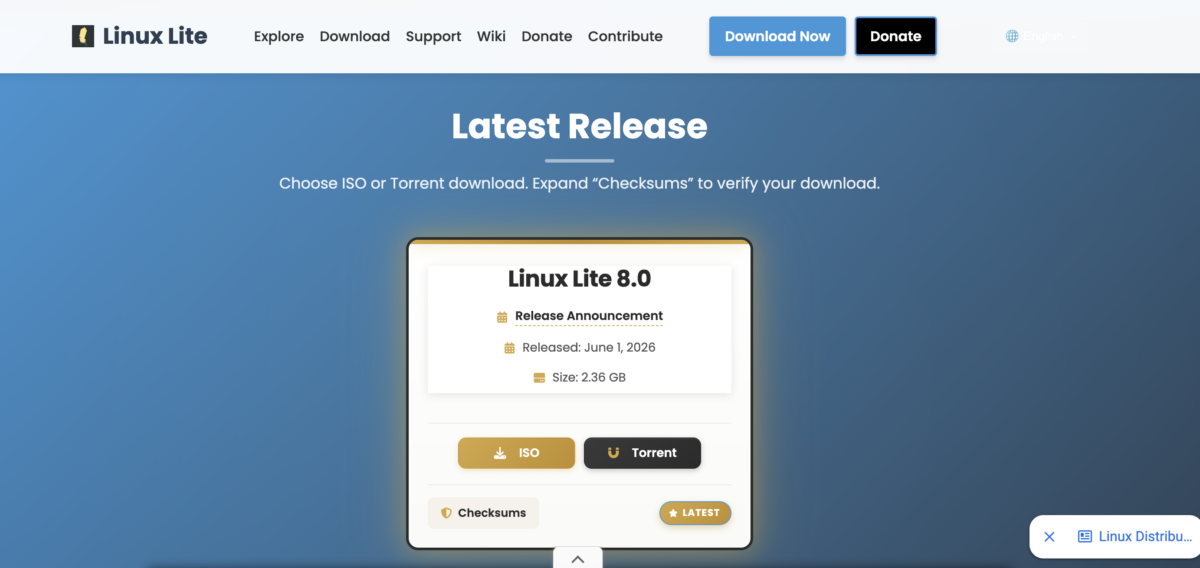
Linux Lite 8.0 is now available for free download from the official website of the project.




