

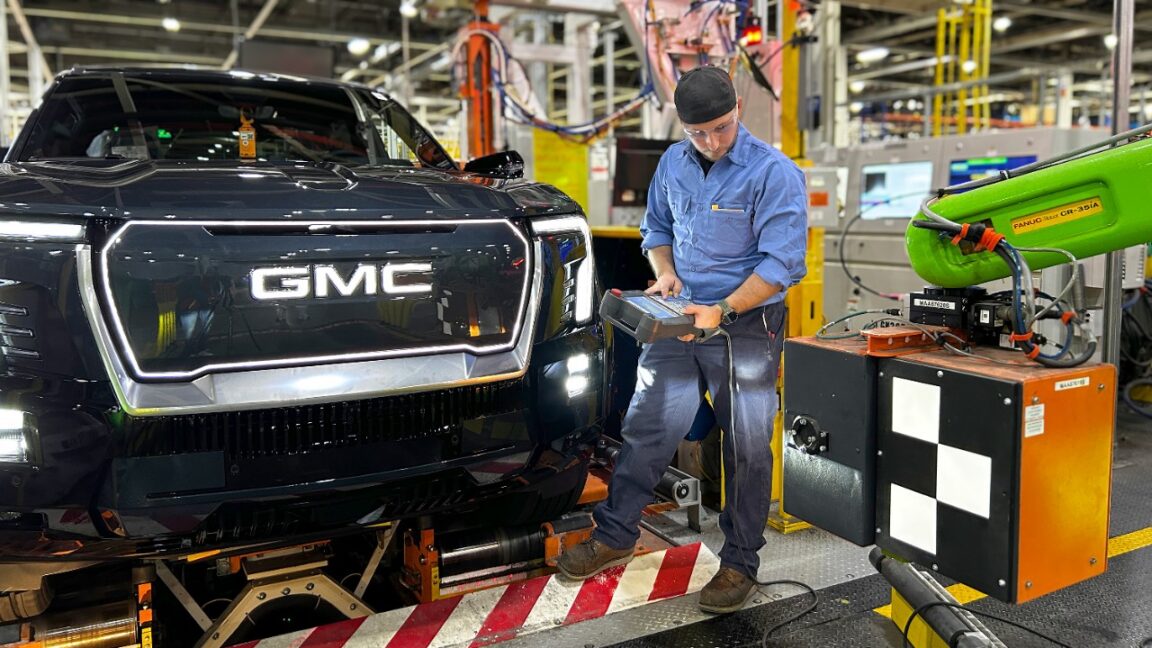
Dozens of new robotic arms have been installed at General Motors’ main electric vehicle factory in Detroit, even as 1,300 workers remain out of work following what was supposed to be a temporary layoff. The latest push toward automation has drawn opposition from unions over a potentially existential problem for automakers and their workers.
General Motors installed approximately 50 robotic arms at GM’s Factory Zero plant in Detroit, Michigan, according to a report from Crain’s business in Detroit. Manufactured by Japanese robotics company FANUC, the robots are designed to help attach various components to vehicles during the assembly line process. But leaders of the United Auto Workers (UAW), the main U.S. auto workers union, reacted angrily to the new robotic presence, as GM has yet to call any of the workers affected by allegedly temporary layoffs in March.
More than 1,000 union members are still “indefinitely laid off,” said James Cotton, president of UAW Local 22. The Detroit News. He said the company could put some of those members back to work instead of installing the 50 robots.
The temporary layoffs were preceded by permanent layoffs which will involve another 1,200 workers at GM’s Factory Zero in October 2025.
Many automakers, including Stellantis NV and Ford Motor Companyhave deployed assembly line robots, such as Fanuc robotic arms, as they push to automate more operations in the United States. Hyundai Motor Company plans to deploy Atlas humanoid robots made by Boston Dynamics—which Hyundai acquired in 2020—a start working at the automaker’s flagship electric vehicle facilities in Georgia by 2028.
Andrew Bergman, a Local 22 member and union organizer who was among those fired by GM, described corporate leaders in the auto industry as prioritizing profits over human workers.
“Technological development has the ability to make work safer for the working class and allow workers to have a shorter work week without losing pay,” Bergman told The Detroit News. “But in the hands of bosses and billionaires it is used to increase profits and lay off workers.”
The Detroit News also highlighted how corporate leaders and workers delivered “strikingly different messages” about artificial intelligence, robotics and automation during separate meetings held in Detroit during the same week in June.
While the Reindustrialization Summit featured speeches from a startup founder about how robots could “power our industrial base with superhuman manufacturing,” the UAW Constitutional Convention prominent UAW president Shawn Fain Warning against “the threat of humanoid robotics and mass automation” that undermines workers’ employment and wages at a time of growing wealth inequality.



