

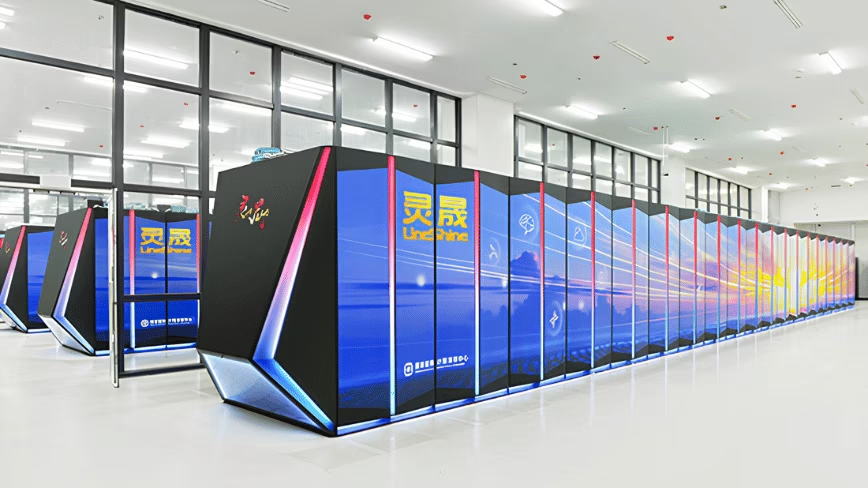
A supercomputer in Shenzhen just topped the world rankings for the first time since 2017. The headline is speed. The real story is the silicon: it works without a single chip from Nvidia, AMD or Intel.
China has regained the supercomputing crown. On Tuesday, the organizers declared a machine called LineShine the fastest in the world at the ISC conference in Hamburg. The result ended a long American run atop the closely watched TOP500 chart.
LineShine, located at the Shenzhen National Supercomputing Center, achieved 2,198 exaflops on the standard benchmark. That’s more than 20% faster than El Capitan. The US Department of Energy machinery has led since November 2024 and helps maintain the US nuclear arsenal.
LineShine is the first Chinese system to be ranked number one in almost a decade.
The speed is surprising. The question is how China got there. LineShine was built entirely without US chips, a direct response to years of US export controls.
An all-CPU machine, by design
Most major supercomputers are based on graphics processing units, the same Nvidia and AMD chips that are driving the rise of AI. LineShine does not. It is the first system on the list to exceed two exaflops of sustained double-precision performance using only regular processors.
The design is ambitious.
The machine includes nearly 14 million computing cores in 90 cabinets, consuming about 42 megawatts of power. At about 52 gigaflops per watt, it’s unusually efficient for its size. It has already made a complete simulation of Earth’s systems and a model of the human brain, the kind of heavy science it was built for. Its custom LX2 processors use Armv9, the instruction set licensed from Britain’s Arm Holdings.
They run KylinOS, a Chinese version of Linux, with a local network called LingQi that ties everything together. Reports link the chip’s work to Huawei, whose return to the forefront has unsettled Washington.
Instead of splitting work between CPU and GPU, LineShine integrates GPU-style math into the processors themselves. Jack Dongarra, TOP500 organizer, He inspected the machine and called it impressive.. “They made us better by developing a system that doesn’t rely on GPUs,” he said.
The machine also tops a second ranking that weighs real-world workloads, and its designers have submitted 14 nominations for the Gordon Bell Prize, the highest honor in scientific computing. They have not said who made the chips or by what manufacturing process, the detail Washington would most like to know.
A message to Washington
China stopped shipping machines to the TOP500 in 2023, after the United States tightened chip export rules. Therefore, choosing to enter LineShine counts as a declaration, not a formality. Dongarra was told that the system was built without government funding, which is why its designers felt free to participate.
“I’m not surprised it’s the number one system,” said Addison Snell of Intersect360 Research. “What surprises me is that they presented it.”
The moment fits a larger pattern. Instead, US restrictions aimed at slowing China’s progress accelerated their drive toward self-sufficiency. The result is a stack of chips, software and local networks that no longer require American hardware. A machine that doesn’t need parts from Nvidia, AMD, or Intel is the clearest proof yet that the strategy is working.
It also exposes an uncomfortable gap in the rules. Washington has been restricting GPUs, the most useful chips for AI, for years. LineShine relies on CPUs, which face much more flexible controls.
“The US government should have stricter controls on the export and manufacturing of CPUs for the Chinese market,” said Jimmy Goodrich of the Institute on Global Conflict and Cooperation at the University of California. “It is a legal loophole in the current regulations.” That gap echoes one Washington is already trying to close. close foreign subsidiaries.
The fastest computer, not the fastest for AI
Here’s the trick. Topping the TOP500 is not the same as winning the AI race, and the two are drifting apart. The list measures high-precision mathematics, 64-bit calculations used for climate models and nuclear simulations. Modern AI relies on cruder and faster approaches.
In a benchmark created to mimic AI-style work, LineShine ranked only fourth. In that mixed-precision test it managed 7.92 exaflops, a much smaller jump over its main score than a GPU machine would record. Its all-CPU design lacks the dedicated low-precision circuitry that makes GPUs so fast at model training.
The worst part for those with bragging rights is that the biggest American AI systems aren’t even in the running. The vast clusters run by xAI, Microsoft, Amazon and Google are commercial, not academic, and remain off the list entirely.
“If hyperscalers were to present their systems, this ‘world’s fastest’ wouldn’t be in the top five,” Goodrich said. In other words, the crown is real, but the title is narrower than it appears.
The case for caution
None of this means that China has closed the gap. Its domestic GPU industry is still several years behind Nvidia and AMD, which is exactly why it eluded them with a CPU-only machine. Building a record-breaking computer from homegrown parts is a true engineering feat and a powerful political signal. This is not the same as overtaking the United States in the most important workloads for AI.
The broader trend is harder to dismiss. Export controls have pushed Chinese companies to opt for customized chips, domestic operating systems and their own interconnects, the same ingredients on display in Shenzhen. Companies of car manufacturers Cloud giants are now designing silicon to take Nvidia out, and even Nvidia is looking for ways to make a comeback with Arm-based technology. Own CPUs. One policy aimed at keeping China dependent is to teach it to build alone.
So the open question isn’t really who owns the fastest computer this month. It’s about whether a wall of export controls slows China down or simply forces it to build a parallel set that the United States can’t see or disable. LineShine suggests that the second answer is a winner. China deliberately assembled the fastest machine on Earth, out of everything the United States tried to keep away.



