
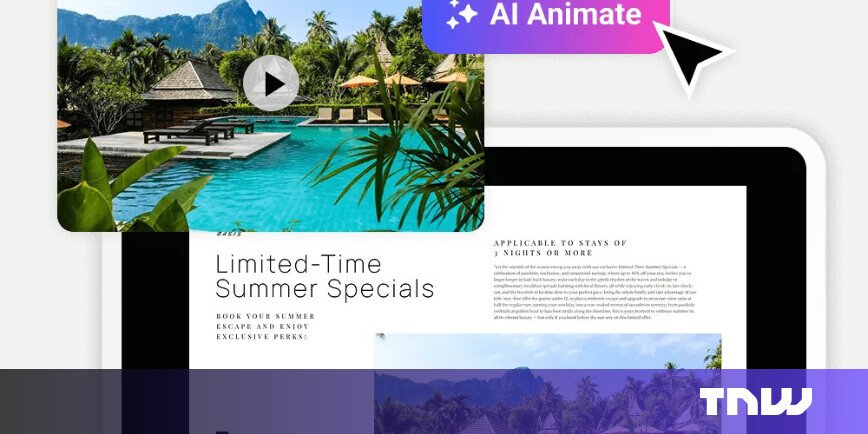
Interactive content now generates 52.6% greater engagement than static formats, as users spend much more time interacting with dynamic media and show greater recall of the brands that use them. In practical terms, that shift may have transformed expectations for how digital content should be produced, especially in commercial and B2B environments, where attention is often a scarce commodity. Flipsnack presents its new Living Visuals to meet this demand, integrating perfectly AI-powered movement to transform static catalogs into immersive, dynamic, performance-based flipbooks.
“We are moving from reading business documents to experiencing them,“says Adrián Moza, executive director of Flipsnack. “With Living Visuals, teams can now create immersive catalogs with an instant cinematic layer within the document, without the need for video production equipment or new software..”
Identifying this broader behavioral shift, Moza has noticed how audiences are increasingly engaging with content that moves, whether it’s GIFs, short-form videos, website interactions, or dynamic product displays on social and e-commerce platforms. In his opinion, static images, although still essential, compete in an environment where movement captures attention faster and maintains it for longer. Living Visuals responds to this by incorporating subtle, auto-playing animations right into digital catalogs, brochuresand sales materials.
“Now that we’re past interactivity, the future is immersion,“says Moza.”We’re empowering teams to turn flat, static documents into a powerful competitive advantage..”
Instead of an additional or standalone production workflow, Flipsnack integrates it natively within its platform. A user can transform a still image into a dynamic visual element within a flipbook without the need for editing software, timelines, or technical expertise.
According to Moza, accessibility becomes the fundamental objective. “Motion, which is tied to video production assets, can be democratized by being available to marketing teams, sales professionals, and designers working within existing content systems.”Living Visuals can go beyond basic aesthetics to make your content unmissable, significantly increasing the performance of key pages.”says Moza.

Performance also carries measurable results. Flipsnack’s built-in analytics allow businesses to track engagement metrics such as impressions, views, and time spent on pages. Movement, in this context, is not only aesthetic; It becomes a functional lever linked to conversion and decision making. Industries where visual storytelling drives results, such as retail, real estate, hospitality, and B2B sales, will benefit the most from this evolution.
A deeper look at the technology reveals a strategic constraint. The animations are designed to be subtle, cinematic, and integrate seamlessly into the document experience. This avoids overwhelming the viewer while directing their attention to key elements, highlighting a product detail, enlivening a property image, or creating a sense of depth within a catalog. “Teams don’t need to rethink their entire workflow“says Moza.”They can improve what already exists and immediately see the impact.“
This approach reflects a nuanced understanding of how companies embrace innovation. According to Moza, radical change often faces resistance, while incremental improvement within familiar systems could accelerate adoption. By incorporating AI-powered motion into an already established interactive document platform, Flipsnack lowers the barrier and amplifies the outcome.
Moza also points out examples emerging from early use cases that illustrate the potential of the dynamic flipbook. “A static image of a product can be converted into a realistic image that conveys texture, movement, or context. A catalog page can subtly guide the viewer’s eye through featured items. A proposal can highlight key sections with motion cues that reinforce the hierarchy of messages,” says Moza, highlighting that each app is built towards a single goal: deeper engagement.
“Living Visuals is about helping content work without adding complexity,” Moza emphasizes. “It’s about making every page work harder.“The timing of this innovation is equally significant. It points out how Attention spans continue to shrink.while expectations for digital experiences increase. In his view, successful platforms are those that anticipate how users want to consume content rather than react to established norms.
Living Visuals positions Flipsnack within that anticipatory space, where interaction evolves toward immersion.
“Immersive content is not another ephemeral trend; It is an address“, Moza shares. “And the teams that adapt early will define what business communication will look like for years to come..”
Movement, once a differentiator, is becoming a basic expectation. Flipsnack’s Living Visuals notes that precisely changes that, transforming documents into experiences and content into something that actively participates, rather than passively exists.



