
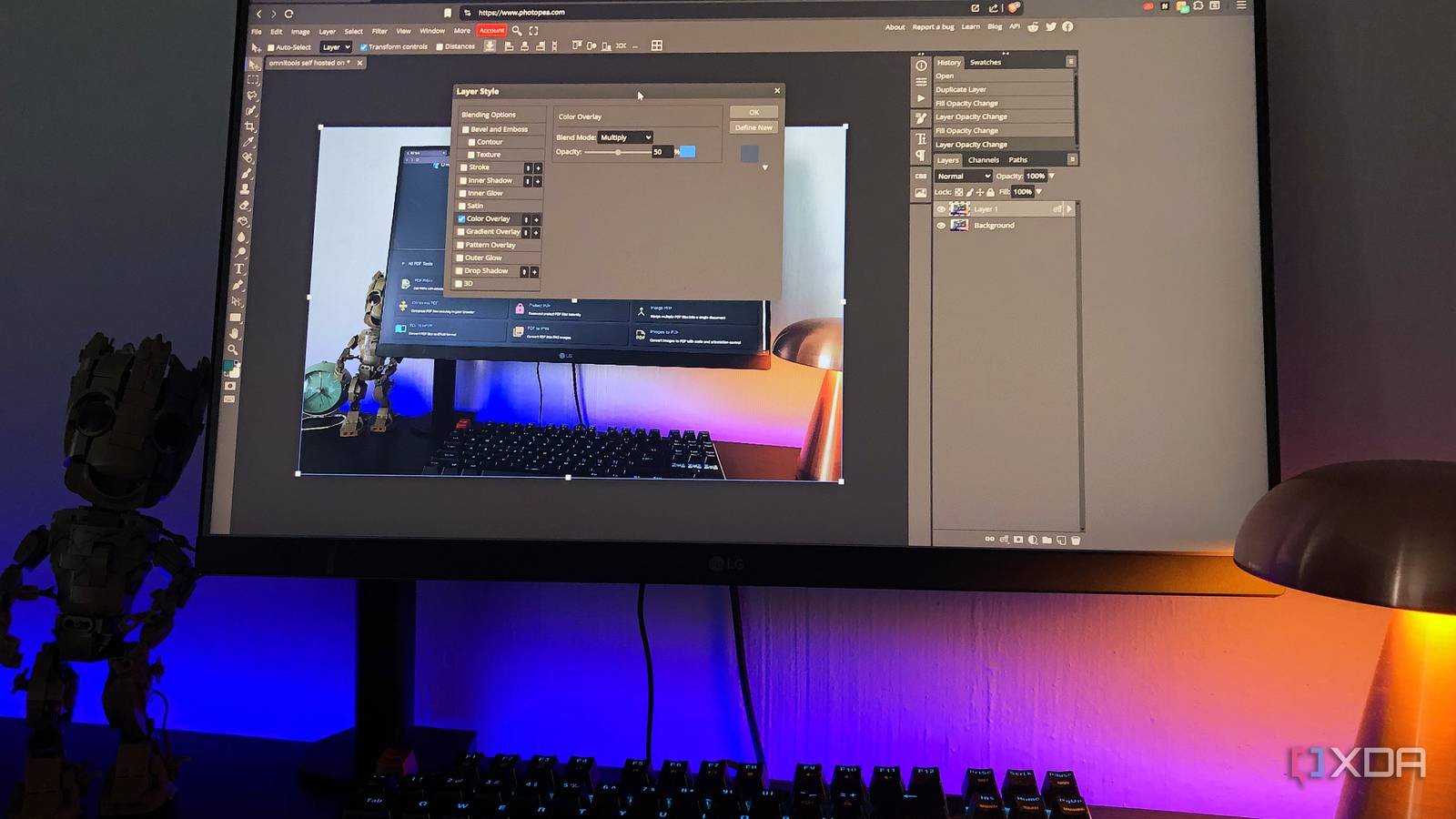
For as long as I can remember, GIMP has always been recommended as the free program and open source alternative to Photoshopand for good reason. I’m not here to downplay its capabilities, it’s clearly a super capable editor that holds its own against paid software. While its functionality isn’t perfect on all fronts, my problem was never what it was capable of doing: it’s the experience of doing it.
Although GIMP 3.0 and 3.2 brought us some long-awaited UI updatesIt is still behind other editors and I am not the only user who has this opinion. I still have GIMP installed and open it from time to time, but I long ago stopped trying to make it my go-to editor because I end up fighting with the interface and user flow more than editing. Luckily, there are lots of alternatives to GIMP that will give you the same functionality, if not better. But if I had to choose one, it would be Photopea…
Photopea is not open source, but that’s not the whole story
Why it is still a worthy alternative to GIMP

I know that one of the main reasons people switch to GIMP is specifically because it’s open source. So why would you recommend a closed source alternative? Well, Photopea actually has similar principles to GIMP. The whole thing was built by one developer, Ivan Kutskir, a Ukrainian programmer based in Prague, who started it as a hobby project in 2012 and has been the main force behind it ever since. There’s no venture capital money, no corporate owner waiting to pull the plug, and no backend server handling your files.
Everything runs entirely in your browser, meaning your designs and images never leave your machine. The business model is also simple: ads on the free tier and a premium subscription if you want to remove them. The code is proprietary primarily out of necessity: the developer has been open about the fact that keeping it closed is what prevents larger campaigns from simply copying the code base and competing directly with it. For a one-person project going up against companies like Adobe, it’s a pretty reasonable decision.
It is also worth noting that Photopea was Designed from the ground up to feel like Photoshopnot GIMP or something in between. So if you’re switching from an Adobe product, the layout and logic will look familiar. This intentional design philosophy is a big part of why I think it works as a daily driver in a way that GIMP doesn’t.
Does what GIMP does
Without the learning curve
Honestly, the overlap between Photopea and GIMP is more extensive than people realize. The obvious is all there: layers, masks, blending modes, curves, levels, hue/saturation controls, etc. GIMP’s layer system (including layer groups, blending modes, and layer masks) maps almost one-to-one to Photopea’s. Adjustments from GIMP’s Colors menu (curves, levels, hue/saturation, color balance) are also available in Photopea, either destructively via the Image menu or as suitable adjustment layers if you want to keep things non-destructive.
Touch-up tools are transported with the same cleanliness. GIMP’s Clone tool is Photopea’s Clone Stamp, and GIMP’s Heal tool is Photopea’s Healing Brush – same functionality and use cases. The Script-Fu console and batch processing, or the BIMP plugin if you used it, are replaced by Photopea’s Actions panel, which records and plays back steps across multiple files in the same way.
The unexpected is GIMP’s Channels dialog, which hardcore users rely on for complex selections, color separation, and alpha work. And it exists in Photopea as a complete Channels panel with the same RGB and alpha channel editing you’d expect. It’s the kind of feature that tends to be missing in lighter editors.
GIMP’s export options are actually one of its strengths that people don’t talk about enough, and they carry over to Photopea as well. WebP, TIFF, PDF, SVG, and most of the formats you would open GIMP for are available. Photopea also opens XCF files, which is GIMP’s native format, so existing project files are not far behind. Finally, both GIMP and Photopea open and handle PSD files with ease (most of the time).

Where Photopea really advances
The gaps that GIMP hasn’t closed yet

By far the biggest reason Photopea works better for me isn’t any specific features, it’s just easier to use. Everything lives in one window, the toolbar is where you’d expect, and the menu structure follows a logic that most people are already familiar with. GIMP’s tools still feel vaguely scattered rather than part of a cohesive design, and some essential actions are buried deep enough that muscle memory never develops. The newly released GIMP 3.2 gave us some visual cleanup and the team is clearly putting in the work, but years of accumulated interface quirks aren’t something a single release can undo.
Then there is non-destructive editing. GIMP 3.0 gave us some non-destructive abilities and 3.2 added non-destructive layer types that begin to approximate smart objects. So credit where credit is due. But Photopea still has more complete non-destructive editing, plus it has real smart objects. Another is adjustment layers. Again, 3.2 gave us some improvements by allowing non-destructive filters to be applied to layer groups that are set to Pass Through mode. But Photopea handles curves, levels, and other adjustments as proper, stackable, non-destructive adjustment layers, the same way Photoshop does.
Should you make the change?
Honestly, it depends on the type of workflow you are comfortable with. I don’t think GIMP is a bad editor, but its disadvantages outweigh those of other editors. And I tried to make GIMP work for me, but it turns out I prefer a more standardized user flow. If you’re in the same boat, I recommend taking a look at Photopea. Although Photopea has a very different architecture being closed, browser-based and practically a Photoshop clone, it shares the accessible design ethos of GIMP and can cover virtually all of the same design tasks.



