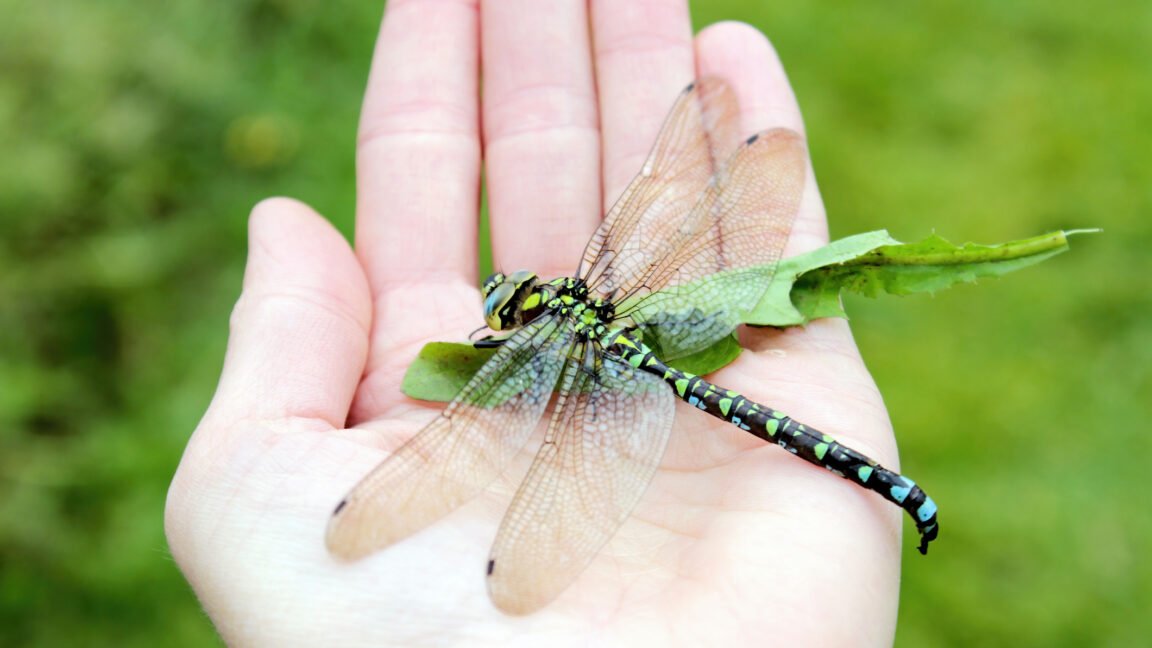
Three hundred million years ago, the skies of the late Paleozoic were filled with giant insects. Meganeuropsis permianaA predatory insect similar to a modern dragonfly, it had a wingspan of more than 70 centimeters and weighed 100 grams. Biologists looked at these ancient giants and wondered why they aren’t so big anymore. Thirty years ago, they came up with a answer known as the “oxygen restriction hypothesis.”
For decades, we thought that any dragonfly the size of a hawk needed highly oxygenated air to survive because insects’ respiratory systems are less efficient than those of mammals, birds or reptiles. As atmospheric oxygen levels decreased, there was no longer enough to sustain the giant insects. “It’s a simple and elegant explanation,” said Edward Snelling, a professor of veterinary science at the University of Pretoria. “But it’s wrong.”
Insect breathing
Unlike mammals, insects do not have a centralized pair of lungs or a closed circulatory system that delivers oxygen-rich blood to their tissues. “They breathe through an internalized tube called the tracheal system,” Snelling explained.
Air enters the insect’s body through specialized portholes in its exoskeleton called spiracles. From there, it travels through larger tubes, the tracheae, which gradually branch into microscopically thin, blind-ended tubes known as tracheoles. These tracheoles are embedded deep in the insect’s tissues, and mitochondria from neighboring cells cluster next to them.
Insects can actively pump air in and out of larger tracheae by flexing their bodies, but this active pumping stops at the end of the line, in the small tracheoles. Here, oxygen delivery depends on passive diffusion to cross the final barrier into the tissue.
The problem with diffusion is that it is notoriously slow. The oxygen restriction hypothesis held that the larger the insect grows, the farther oxygen must travel to reach the deeper tissues.
“As insects get bigger and bigger, the challenge of diffusion becomes greater,” Snelling said.
To prevent the muscles from suffocating, a larger insect would need much wider or numerous tracheoles to maintain the oxygen supply, which meant there had to be a structural tipping point. If an insect grows too large, the volume of breathing tubes needed to supply oxygen to its muscles would take up too much physical space. The tracheoles would crowd the very muscle fibers they were trying to feed, leaving the insect with severely impaired flight performance.