

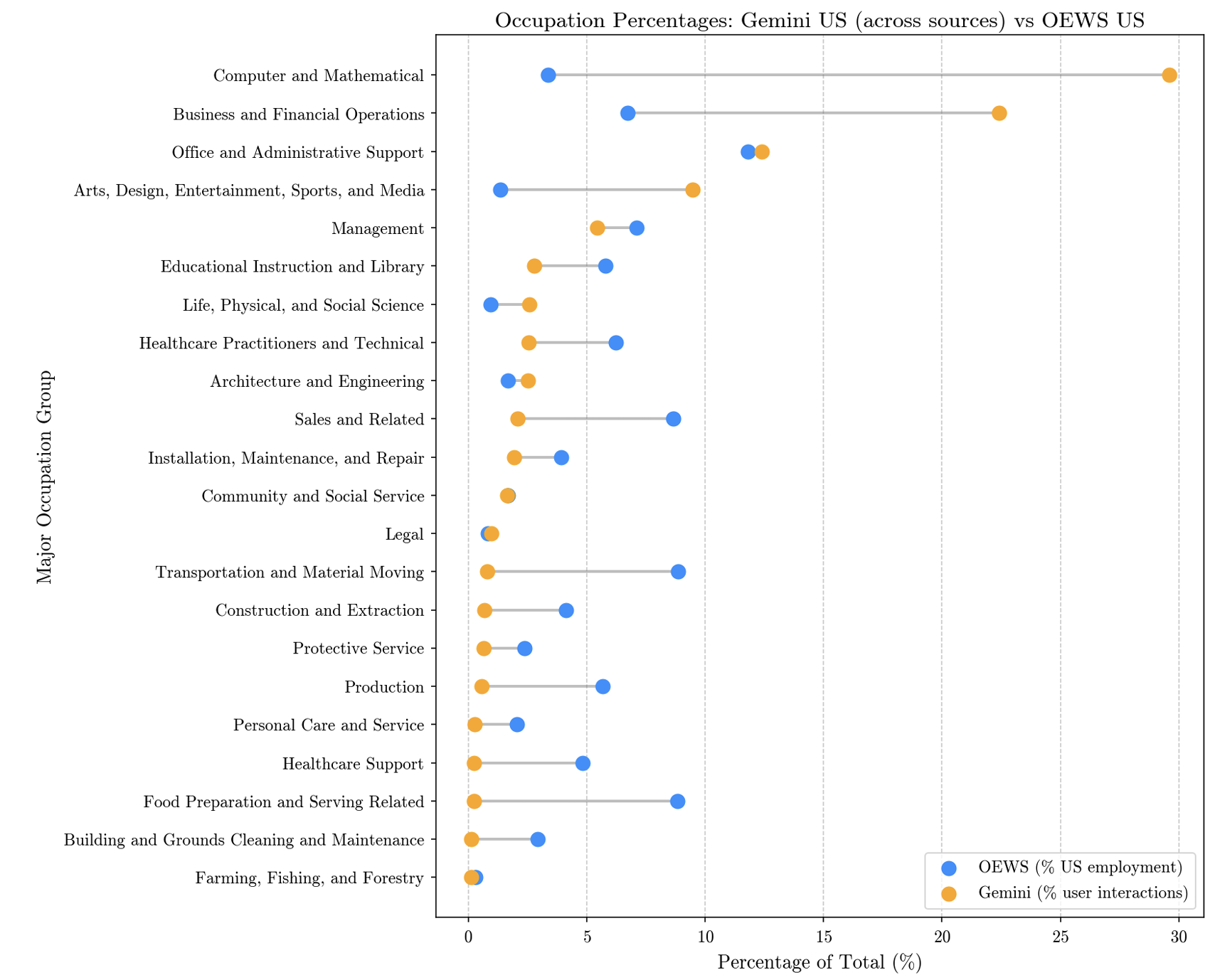
Certain administrative jobs are highly overrepresented in Gemini usage data.
The researchers also attempted to measure how deeply AI was being integrated into various jobs, looking at how often individual, granular O*NET job tasks were attempted using Gemini. Across that database, ATLAS researchers only classified 21 percent of all work-related tasks as “Gemini tasks”—those that met a minimum threshold of 25 related interactions attempted in the massive sample.
For many occupations (29%), not a single relevant job task met this “non-negligible” Gemini use threshold, suggesting that those jobs have been minimally affected by the AI revolution so far. For another 30 percent of all occupations, less than a quarter of the tasks tracked had significant Gemini-related use, suggesting that humans were still responsible for the vast majority of components of those jobs.
In only 3 percent of occupations was Gemini regularly consulted for at least three-quarters of the relevant tasks of that job. Jobs such as software quality assurance analysts and testers, human resources specialists, and document management specialists fall into this group and are apparently the most affected by the use of AI in the study.
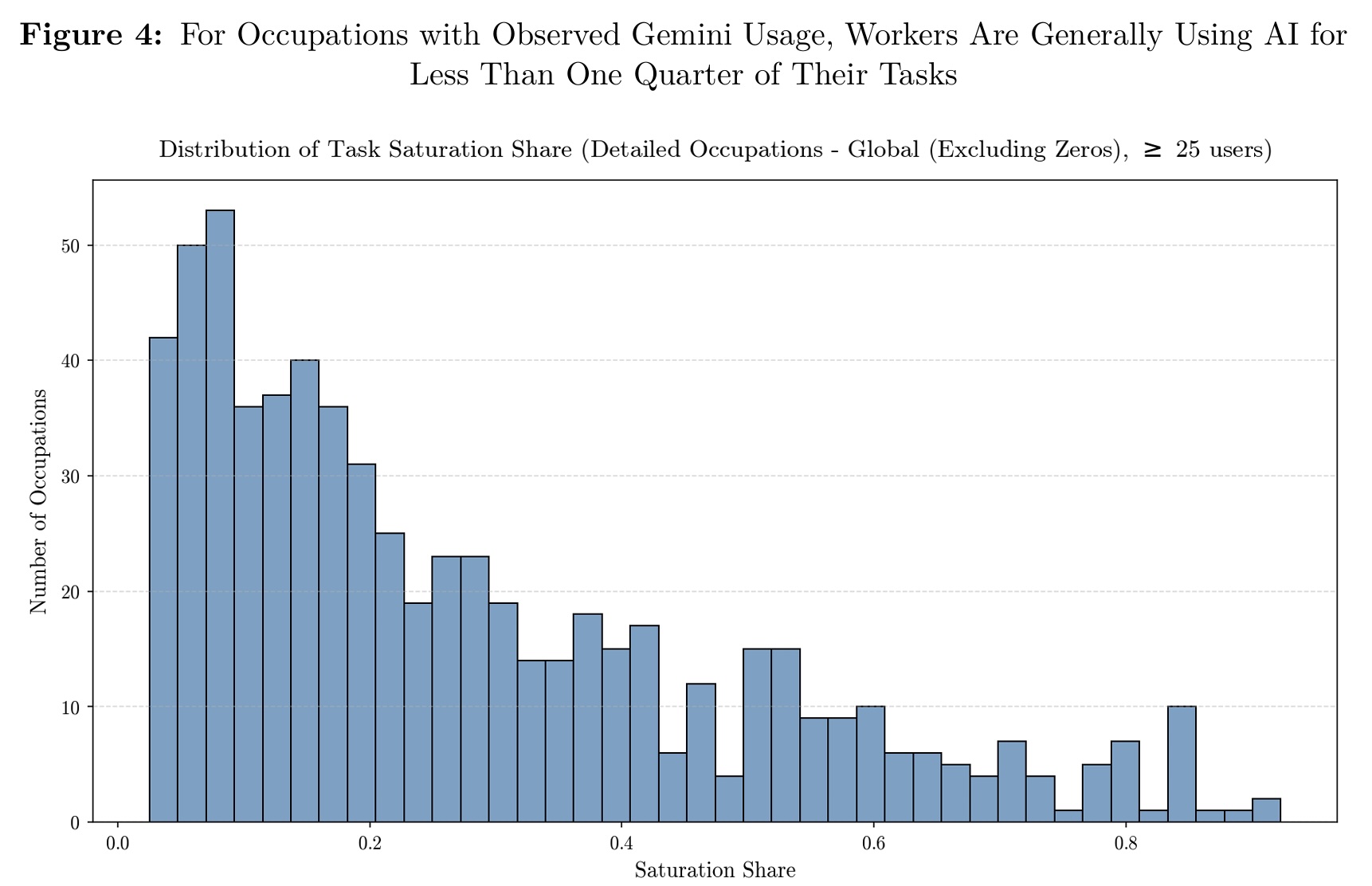
For most jobs, less than 25 percent of O*NET tasks had a meaningful attempt at assistance from Gemini.
Taken together, the researchers write, these types of numbers suggest that “AI currently serves primarily as a complement to existing work” and that “AI appears useful for a subset of tasks performed within occupations, but does not currently appear to be used comprehensively to perform work currently performed by humans.” While the researchers say this situation may change “as new advances in AI emerge,” it is also possible that new workflows “maintain a degree of complementarity between workers and AI systems.”
Give AI the non-routine, low-experience job
Beyond looking at high-level occupations, Google researchers also looked at the specific types of job tasks that Gemini users ask the model to perform. Cognitive tasks (i.e., those that primarily involve thinking) accounted for a whopping 86 percent of measured Gemini interactions (by volume), while interpersonal and manual tasks were underrepresented in the sample compared to their prevalence in the workplace.



