

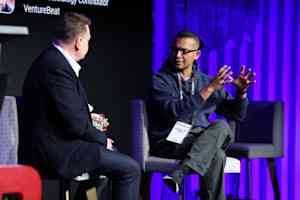
Instacart poses a provocative question: What if most of the work its engineers do today was, in fact, done by machines?
In VB Transform 2026CTO Anirban Kundu argued that development teams continue to waste time on exhausting, repetitive and high-volume work; this should be absorbed by AI agents so that humans can focus on problems that require judgment, intent, and exception handling.
In fact, in 97% of cases, Instacart creators don’t even read the code anymore.
“In the past, the tactical level was creating the code,” Kundu said. “At the more tactical level in the future, the question will be: ‘How do you navigate the AI system to get what you want?’”
AI generating code, performing "pretty serious evaluations"
That doesn’t mean humans never look at code; Agents handle most of the code generation and boilerplate, particularly with newer projects where code is generated or regenerated weekly.
“The benefit of this is that we no longer care about tech debt,” Kundu said. “Things that aren’t active are simply removed and then rebuilt, kind of like we used to create assembly code or object code.”
So why not 100%? The remaining 3% are found in legacy, compliance and latency-sensitive systems and workflows, or driven by a “code load” that is idle, dormant, or half-active. These cases still need careful human attention.
However, Instacart is slowly “smoothing out those parts,” breaking down systems into a project aptly named Atoms, and then rebuilding them into a cleaner, more modular form. The Kundu team started with “monoliths” and is moving to architectures based on remote procedure calls (RPC).
But evaluation remains one of the general challenges. Code reviews are not as relevant when AI generates code; as Kundu pointed out, “the lines of code will be correct, the syntax will meet your expectations”, so the goal is to move to an “intent model”. That is, training developers to ask different models the right questions from an intent perspective.
Assessments are then performed independently: approximately 7,000 automated assessments are run each month, and the system responds to more than 8,000 developer queries in real time with approximately 99.9% accuracy.
Identifying "hiccup" that human intuition might have overlooked
In combination with this, Instacart has created a site reliability engineering (SRE) system based on years of the company’s own incidents and root cause analysis rather than generic failure data. Instead of teaching a model how production outages work in the abstract, the team fed it the specific ways Instacart’s systems have broken over time, along with the ways humans have diagnosed and fixed them.
As a result, the company has seen accuracy in detecting and mitigating production issues increase from approximately 60% to more than 90%.
Kundu pointed to an example with Instacart’s internal tool, Blueberry. The AI SRE colleague looks at about 200 Slack channels, monitoring signals and looking for patterns in human conversations and alerts.
In one incident, a database fragment backed by an EBS volume had a “hiccup” for a period of time. The human team did not immediately suspect problems with the AWS disk and was “obviously struggling” to figure out why this particular chunk was misbehaving.
But about 20 minutes later, Blueberry posted on Slack, pointing out a specific issue and linking it to a feature flag-like system called "roulette" that had been inappropriate. "It was supposed to unfold at this cadence, (but) it had been too much,” Kundu said.
Blueberry noticed and the team resolved the incident. “Would a human have been that fast? I think the problem is that human intuition would slow us down a little bit,” Kundu said.
We humans tend to use patterns we’ve seen before and then resort to debugging; Kundu called this “the first-brain, second-brain kind of thing.” But Instacart’s SRE agent is actually “more comprehensive in its ability to look at everything and then be able to decide what matters or doesn’t matter.”
Redefining the job of the engineer
Looking ahead, the most tactical work for engineers will be navigating AI systems: designing and overseeing evaluation processes; coordinate multiple experiments and simultaneous functions; manage constraints such as limited traffic at the top of the funnel for testing; figure out when to escalate the situation; Identify edge cases and where things could go wrong.
Domain expertise is also being rethought in the age of AI. Instead of hindering changes through a single “proprietary” team touching the code, Instacart is embedding domain knowledge into definitions and specifications that any team can use.
“We’ve lived in this world where this group or this engineering team is the one that can touch the code and make the modification,” Kundu said. “We’re trying to move toward a world where code is completely democratized across all groups.”



