
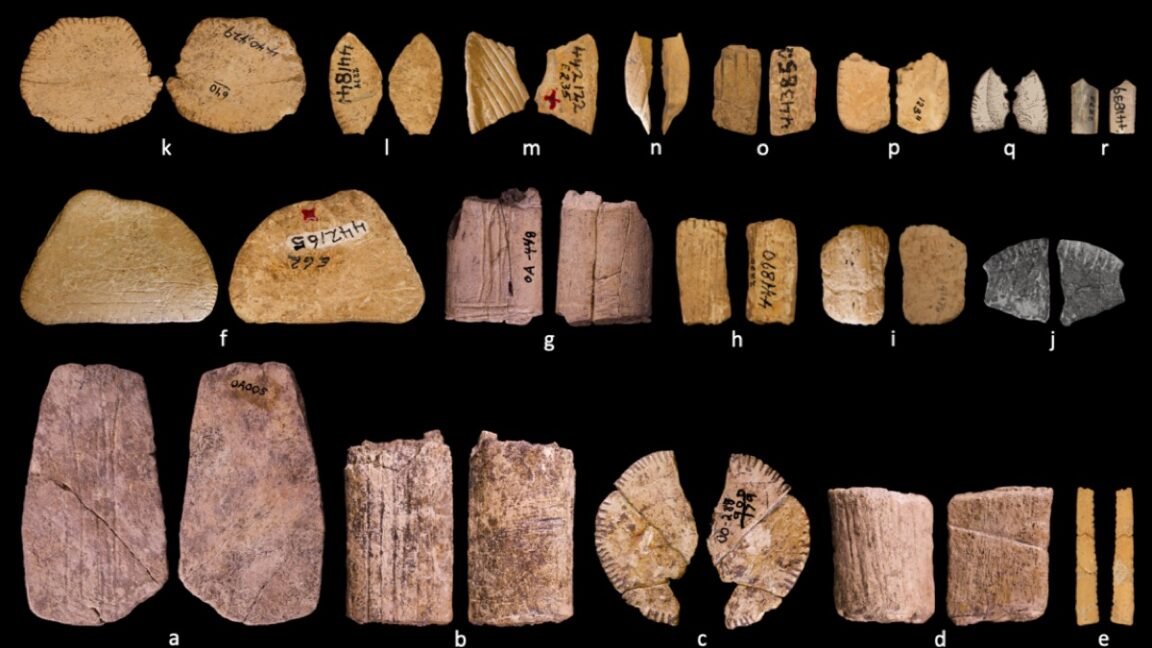
Madden was able to conclusively identify 565 Native American dice from 45 different sites and designate an additional 94 artifacts as “probable” dice. Objects with a punched or punched hole were excluded from their evaluation because they could also be beads or other decorative objects rather than dice. He also excluded objects whose two sides could only be distinguished by shape, without clear markings, for similar reasons. The oldest artifacts, from Folsom deposits in Wyoming, Colorado and New Mexico, date back to the end of the last Ice Age, about 12,000 years ago.
According to Madden, dice and games of chance in these societies were nothing like contemporary games of chance, where the house always has the advantage; rather, they probably served a social function.
“These games are one on one; there is no house Madden said.. “It’s a fair game, everyone has the same opportunities, the same conditions, and it was used as a form of exchange, particularly between groups of people who were not in frequent contact with each other, so they didn’t really know each other. It is truly a form of gifting over time that creates long-lasting, reciprocal relationships. “This is not a business transaction where you and I are going to exchange something and then go our separate ways.”
The findings also shed light on early Native American concepts of probability. “When we look at the origins of dice, we are literally looking at the origins of probabilistic thinking,” Madden said. “It was always thought to have started in the Old World, in the Bronze Age, about 6,000 years ago. This research shows that Native Americans were rolling dice, generating random outcomes, and using those random streams of probability and playing games of chance 6,000 years earlier. So if we want to understand the history of probabilistic thinking, we now need to look at the Old World at the end of the last Ice Age.”
That said, “These findings do not claim that Ice Age hunter-gatherers were doing formal probability theory,” Madden added. “But they were intentionally creating, observing, and relying on random outcomes in a repeatable, rule-based way that took advantage of probabilistic regularities, like the law of large numbers. That’s important for how we understand the global history of probabilistic thinking.”
American Antiquity, 2026. DOI: 10.1017/aaq.2025.10158 (About DOIs).



