
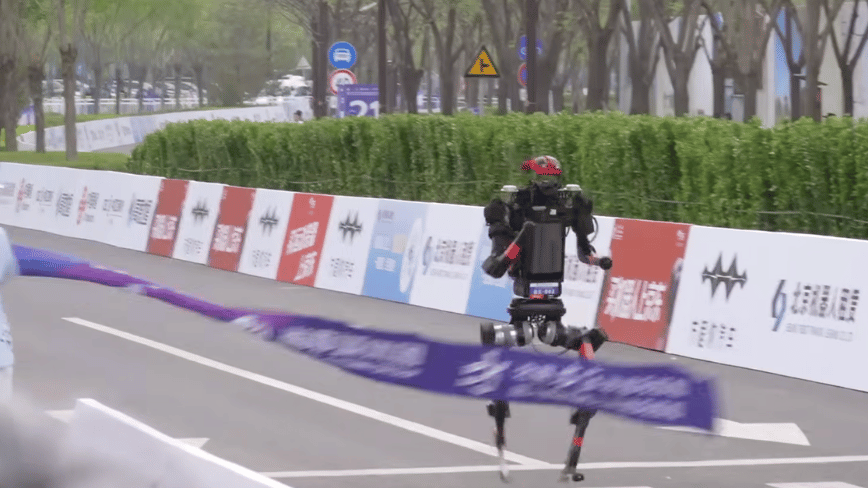
A humanoid robot named Lightning today completed the Beijing E-Town Half Marathon in 50 minutes and 26 seconds, breaking the human world record by almost seven minutes. The robot, built by Shenzhen Honor Smart Technology Development Co., traveled the 21-kilometer route autonomously, without remote control, using multiple sensor fusion and real-time decision-making algorithms. A second Lightning unit, this one remotely controlled, crossed the finish line even faster: 48 minutes and 19 seconds. The world record for the human half marathon is 57 minutes and 20 seconds, set by Ugandan Jacob Kiplimo in Lisbon on March 8.
The robots and the approximately 12,000 human runners followed the same route but competed in separate lanes. The human race was won by Zhao Haijie of China in 1 hour, 7 minutes and 47 seconds. The robot race was won by a machine that stands 169 centimeters tall, has an effective leg length of 95 centimeters designed to mimic elite human runners, generates 400 newton-meters of maximum torque and uses a patented liquid cooling system with a heat exchange flow rate exceeding four liters per minute, technology borrowed from Honor’s smartphone division.
The scale of the event
This was the second edition of the Robot World Humanoid Robot Games Half Marathon, jointly organized by the Beijing Municipal People’s Government and China Media Group. The first, held on the same date last year, was plagued by mishaps. Only six of 21 robotic runners completed the course. Several stumbled, fell out of control or simply lay down on the starting line. The winner, a Tiangong Ultra robot, finished in 2 hours, 40 minutes and 42 seconds.
The 2026 edition was a different event in almost every aspect. One hundred and twelve teams from 26 brands participated, with more than 300 individual robots, including five international teams from Germany, France and Brazil. Approximately 40% of the teams competed in the autonomous navigation category, in which robots must navigate the course without human intervention. Net times for remotely controlled equipment were multiplied by a coefficient of 1.2, a 20% penalty designed to encourage autonomous capability. The three podium finishers in the autonomous category were Honor robots, and all three recorded times faster than the human world record.
The improvement from 2025 to 2026, from six finalists out of 21 to more than 100 teams competing with autonomous navigation, represents the kind of year-over-year progress that makes the event significant beyond the spectacle. Still, Lightning collided with a barricade near the finish line and fell, requiring staff to help him back before he completed the race. Another robot fell at the starting line. But the failures were exceptions and not the norm, unlike last year.
Who built the winner?
Honor, the smartphone maker spun off from Huawei in 2020, is the first major phone company to enter the humanoid robotics market. It unveiled its humanoid robot program at Mobile World Congress on March 1 and committed $10 billion over five years to AI development. The company says Lightning’s running speed of four meters per second is 14% faster than Boston Dynamics’ Atlas. The entire process from development to entering the marathon took a year.
Du Xiaodi, Honor engineer of the winning team, said the value of the competition lies in technology transfer: “Looking ahead, some of these technologies could be transferred to other areas. For example, structural reliability and liquid cooling technology could be applied in future industrial scenarios.” Running functions as a forcing function for locomotion, balance, navigation, and endurance, the same capabilities required for factories, construction sites, and eventually, home environments.
China’s humanoid robot industry
The marathon is a showcase for an industry China is building with the kind of coordinated state investment it previously applied to electric vehicles and solar panels. The 15th Five-Year Plan, which spans 2026 to 2030, elevates robotics and “embodied intelligence” to one of the country’s top ten “new industrial avenues.” The government has committed a state-backed fund of one trillion yuan ($138 billion) for humanoid robots, industrial automation and embedded artificial intelligence. In February, the Ministry of Industry and Information Technology released the “Standard System of Human Robots and Embodied Intelligence,” drafted by more than 120 research institutions and manufacturers, with a roadmap to drive Chinese standards toward international ISO and IEC adoption by 2028.
The MIIT describes humanoid robots as “the next revolutionary innovation after computers, smartphones and new energy vehicles.” The industry is expected to surpass 20 billion yuan ($2.8 billion) in scale by the end of this year. chinese companies They already dominate production. AGIBOT shipped more than 5,000 units in 2025. Unitree Robotics shipped 5,500. UBTech shipped more than 1,000 and plans to reach 5,000 this year and 10,000 in 2027. Chinese companies accounted for nearly 90% of global shipments of humanoid robots last year. By comparison, Boston Dynamics, Figure AI, and Agility Robotics each shipped approximately 150 units.
The gap between running and being useful
The question the marathon raises is whether speed on a road translates into capacity in a factory or a home. Western humanoid robot companies, including Tesla with OptimusFigure AI, and those who supply BMWhave emphasized dexterity and manipulation: picking up objects, assembling components, navigating messy indoor environments. Chinese companies have invested heavily in bipedal locomotion and speed, which produces more dramatic demonstrations but addresses a smaller portion of the problem.
The global humanoid robot market is projected to reach between $6.5 billion and $15 billion by 2030, according to the research firm, and Goldman Sachs estimates $38 billion by 2035. The difference in projections reflects genuine uncertainty about how quickly robots that can run half marathons will learn to do things that people will pay for. Industrial deployment progresses: Figure 02 completed an 11-month pilot at a BMW plant, moving more than 90,000 components. But the gap between controlled factory deployment and the type of general-purpose humanoid robot that China exhibited at its Spring Festival Gala is still extensive.
Lightning’s 50-minute half marathon is a true engineering achievement. A robot that navigates 21 kilometers autonomously, maintains balance at 25 kilometers per hour, manages thermal loads through liquid cooling and recovers from a collision with a barricade has demonstrated capabilities that did not exist on any humanoid platform a year ago. The question is not whether the technology is awesome. It’s a question of whether the country investing $138 billion in it will find applications that justify the expense before the rest of the world catches up. a different approach to the same problem.



