
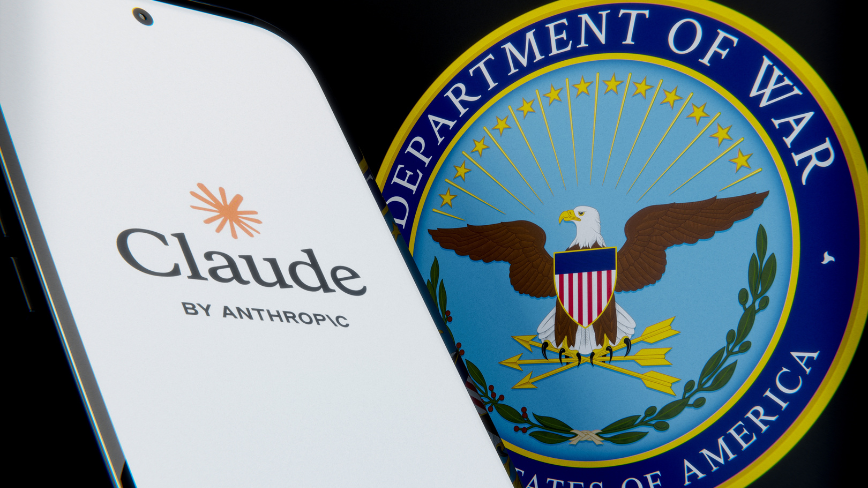
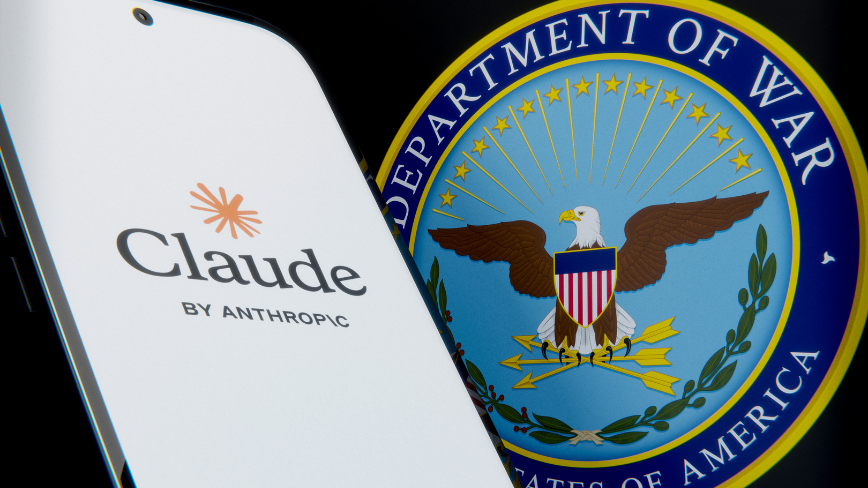
The US president told CNBC on Tuesday that Anthropic is “taking shape” following a meeting at the White House last Friday in which the company’s CEO, Dario Amodei, discussed its Mythos AI model with Chief of Staff Susie Wiles and Treasury Secretary Scott Bessent.
The Pentagon’s blacklisting of Anthropic remains in legal limbo, as a federal appeals court and a San Francisco district court have reached conflicting conclusions.
President Donald Trump told CNBC Squawk Box on Tuesday that an agreement that allows anthropicAI models to be used within the Department of Defense are “possible,” and he describes the company as “taking shape.”
“They came to the White House a few days ago and we had very good conversations with them, and I think they are taking shape.” Trump said.
“They are very intelligent and I think they can be very useful.” The comments mark a striking rhetorical shift by a president who, in late February, posted on Truth Social ordering all federal agencies to “IMMEDIATELY CEASE all use of Anthropic’s technology” and declared that his administration would “not do business with them again.”
Trump’s comments follow a meeting at the White House on Friday, April 18 in which Anthropic CEO Dario Amodei met with Chief of Staff Susie Wiles and Treasury Secretary Scott Bessent to discuss the company’s new Mythos model, a cutting-edge artificial intelligence system that Anthropic has described as highly capable in cybersecurity tasks and has so far made available to only a small group of organizations.
The White House described the conversation as “productive and constructive.” Anthropic said Amodei had a “productive discussion” with administration officials about how the company and the US government can “work together on key shared priorities such as cybersecurity, America’s leadership in the AI race, and AI security.”
When reporters asked Trump about the meeting at a runway in Phoenix, he responded, “Who?” and said he had “no idea” Amodei had been there.
The meeting took place in the context of a dispute that has few precedents in the relationship between Washington and the technology industry.
In July 2025, Anthropic signed a $200 million contract with the Pentagon, becoming the first artificial intelligence lab whose models were approved for use on the Department of Defense’s classified networks.
But when negotiations over deploying Claude on the department’s GenAI.mil platform began in September, the talks broke down. The Pentagon demanded that Anthropic grant unrestricted access to its models for all legal purposes.
Anthropic drew two firm lines: its AI would not be used in fully autonomous weapons systems that select targets without human intervention, and it would not be used for domestic mass surveillance of Americans.
Defense Secretary Pete Hegseth responded by designating Anthropic as a “national security supply chain risk” by the end of February 2026, a label previously reserved for companies associated with foreign adversaries.
The formal designation, confirmed to Anthropic management on March 5, required defense contractors to certify that they were not using Anthropic models in their work with the military. Trump expanded the measure with his Truth Social directive.
The designation, as Anthropic argued in subsequent litigation, was unprecedented: As U.S. District Judge Rita Lin noted in a scathing 43-page ruling granting Anthropic a preliminary injunction in late March, it appeared aimed not at a genuine national security threat but at punishing the company for “bringing public scrutiny to the government contracting position”—“classic unlawful First Amendment retaliation,” she wrote.
The legal situation remains divided. A federal appeals court in Washington, D.C., denied Anthropic’s request to temporarily block the supply chain risk designation on April 8. Judge Lin’s preliminary injunction in San Francisco, from a separate but related case, bars Trump’s ban on Social Truth from Claude from applying to the rest of the government.
The practical effect is that Anthropic is excluded from Pentagon contracts but can continue to work with other government agencies while both cases proceed. The Department of Defense continued to use Claude during the US-Iran war, which began before the blacklist went into effect.
What seems to have changed the White House’s stance is Mythos. Parts of the intelligence community and CISA, the Cybersecurity and Infrastructure Security Agency, have been testing the model.
The White House Office of Management and Budget is establishing protocols to allow federal agencies access to a controlled version.
Treasury Secretary Bessent’s presence at Friday’s meeting was interpreted by sources close to the negotiations as a sign that the economic and financial security arguments for access to Mythos had reached the highest levels of the administration.
As an administration source told Axios: “It would be tremendously irresponsible for the United States government to deprive itself of the technological advances that the new model presents. “It would be a gift for China.”
If any resumption of Anthropic-Pentagon relationship Is it possible remains uncertain. Trump’s comments Tuesday refer to talks that have been promising but did not produce a deal.
The appeals court ruling on supply chain risk designation still stands. Hegseth has not retired his position. Meanwhile, Anthropic has hired Ballard Partners, the lobbying firm where Wiles previously worked, to promote War Department acquisitions, a move that signals it understands the political dynamics as well as the legal ones.
The company’s annualized revenue has reached $30 billion and it is considering an initial public offering; supply chain risk designation damages business credibility even when it does not block trade deals.



