
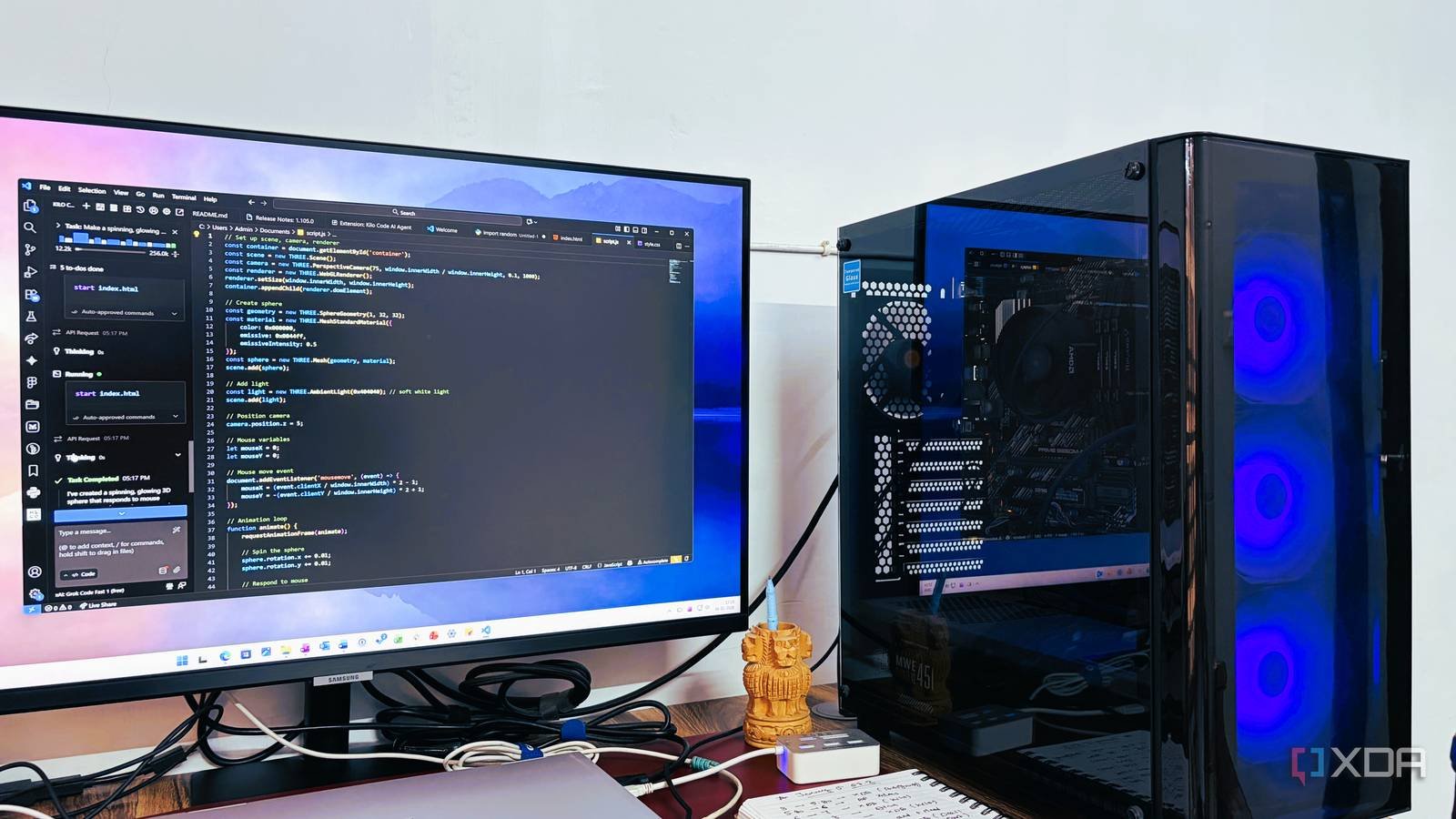
However, VS Code is probably the most used code editor out there. I’m not sure it’s fair to continue calling it just a code editor.. It has become the center of gravity for many developers and its extension model is the reason why many workflows end up living within it instead of around it. Extensions can plug directly into the UI and use the same APIs that VS Code uses, making the editor feel less like a fixed product and more like a platform.
The current market, however, is divided into two camps. One group wants to own the full editor experience, even if that means rebuilding the surface from scratch. Cursor, Windsurf and Antigravity are some of the clearest examples. These tools don’t really escape VS Code’s orbit; They are trying to control it. Then there are tools like Codex, GitHub Copilot and claudius which extend VS Code, and I think that approach is the smartest.

Editors trying to replace VS Code fight gravity
VS Code is already too big
A dedicated AI editor sounds attractive because it can shape the entire workflow around agents, chat, and automation. Tools like Cursor and Windsurf build on that by designing everything around AI from the start. The problem is not the idea, but the cost of the change. VS Code is already at the center of most development workflows. It has your extensions, keybinds, themes, debugging settings, and project-specific tools checked. Moving to a new editor means rebuilding all of that before even getting to the AI part.
VS Code is also superior to its forks because it has been battle-tested and includes features that are important to both individuals and businesses. Everything you use in VS Code is free. It’s an open source tool, so there is some level of transparency here. Since it is owned by Microsoft, the telemetry data is still shared with the company, so it is not completely transparent.
Then there are other features, like the extensions marketplace. Since it is VS Code’s own marketplace, you have access to everything. In tools like Cursor and Windsurf, certain extensions are not available or do not work as they should. Personally, I’ve also experienced better performance and support for things like Jupyter Notebooks in VS Code than in Cursor or any other fork. For business users, something like Live Share is more reliable and useful for team collaboration than the experimental features of Cursor or other forks.
While a forked editor provides full control over the experience, it must also keep up with the VS Code ecosystem, maintain support for extensions, and convince you to move your daily work to a new environment. Most developers aren’t looking for a new place to work. They want better tools within the setup they already rely on. That makes replacement strategies harder to scale beyond early adopters and experimentation. The more AI becomes a standard feature, the less reason there will be to switch publishers just to get it.
Codex, Claude Code and similar extensions are on the right track
The smartest tools are the ones that build on VS Code rather than trying to replace it. Extensions like GitHub Copilot, OpenAI Codex, and Claude Code connect to the same APIs as any other extension, but change what the editor can do. You still work within the same interface, but with more capabilities. You’ll see suggestions appear as you type, chat panels can reference your code base, and commands can modify files in a project.
I was able to accomplish almost everything I could do with Cursor using the Claude Code extension in VS Code. I think he OpenAI’s Codex extension is also quite capable. The main limitation is that you cannot switch between models within a single interface. For example, Cursor allows you to choose the model you want to use, but that is not possible with Codex or Claude. You can fix this problem with a tool like Continue. It’s an open source tool that allows you to switch between AI models, so you can choose something like Gemini 3.1, GPT-5.5, or whatever best suits your needs.
These tools can read your project, understand how files relate to each other, and make coordinated changes. That means you can request a refactoring, build a feature, or explore a code path without putting everything together manually. And since this happens within VS Code, it fits into the rest of your workflow.

VS Code is being adapted for the AI change
Native AI editors do not break Visual Studio Code. Microsoft’s popular IDE is becoming the place where those capabilities finally reside. Tools like Cursor and Windsurf are valuable experiments in rethinking the developer experience, but they’re still orbiting the very ecosystem they’re trying to replace. Meanwhile, extensions like GitHub Copilot, OpenAI Codex, and Claude Code are quietly redefining what VS Code can do without asking developers to start over. For me, VS Code already has the ecosystem, so I find it easier to extend the editor than to replace it entirely.



