
TL;DR
Google launched Fitbit Air, a $100 screenless fitness tracker that rivals Whoop’s hardware design but cuts your subscription by more than half, bundled with a Gemini-powered AI health coach for $10 a month. The device launches alongside a forced migration of Fitbit data to Google accounts by May 19 and a name change of Fitbit software to Google Health, raising privacy questions over the company’s handling of sensitive health data.
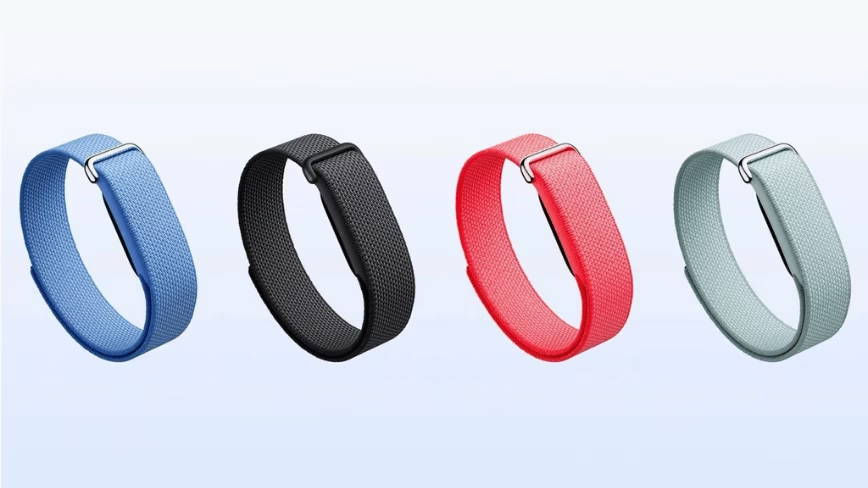
Google spent $2.1 billion to buy Fitbit in 2021, three years dismantling the brand, and on Thursday he released a 100 dollar bill Device without a screen, without buttons and without independent functionality to recover it. Fitbit Air is a soft fabric band with a five-gram sensor package underneath that tracks heart rate, steps, sleep, blood oxygen saturation, and heart rate variability.
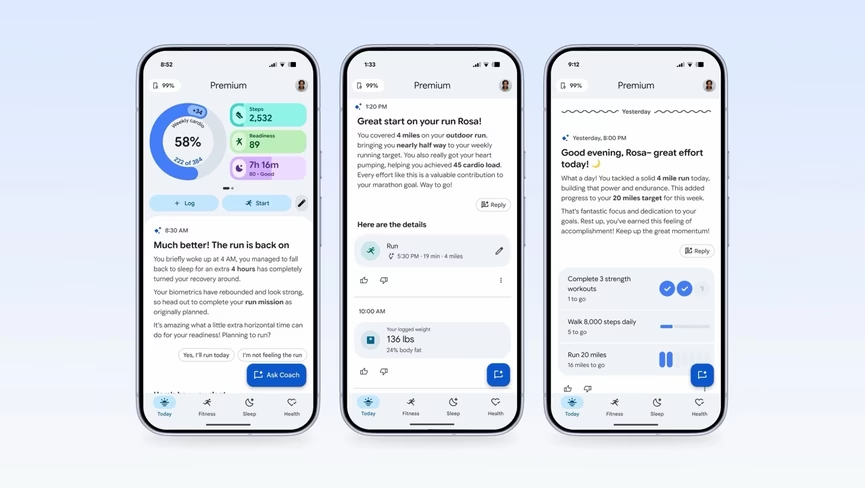
Google Health app, source: Google
You can’t display a notification, make a call, or tell the time. What you can do is feed data into a new Google Health app powered by a Gemini-based AI health coach that interprets metrics, designs workout plans, analyzes food photos for macronutrient content, and provides personalized coaching for $10 a month. The device goes on sale on May 26. Pre-orders begin Thursday. And the product Google is actually selling is not a fitness bracelet. It’s a subscription.
The device
The Fitbit Air weighs 12 grams with the band and five grams without, making it lighter than most smart rings. Battery life is seven days and a five-minute quick charge adds a full day of use. The bracelet comes in four colors: obsidian, mist, lavender and berry, with additional straps available for $35. With no screen or physical buttons, the device uses haptic feedback for an alarm clock and a small LED to indicate battery status. Supports voice input to record activities and meals, but cannot respond audibly.
It can detect atrial fibrillation, a feature that has become standard on recent wearable devices after years of regulatory clearance work. The sensor pack is removable and clips onto the fabric band, a design that is unmistakably inspired by Whoop’s hardware architecture.
The resemblance to Whoop is not coincidental. Whoop, which raised $575 million in March at a $10.1 billion valuation, has built a business around the thesis that a screenless wearable device focused on recovery, stress and sleep data can generate premium subscription revenue without the distraction of notifications, apps and screens. Whoop doesn’t charge for hardware but requires an annual subscription starting at $200. Google’s Fitbit has been developing health monitoring capabilities, including FDA-approved atrial fibrillation detection algorithms.that bring you closer to the clinical-grade data that Whoop and Oura users rely on to make training decisions.
The Fitbit Air’s $100 price tag and optional $10 monthly subscription cut the annual cost of Whoop by more than half and Oura’s $349 ring by more than two-thirds, while offering a comparable sensor suite. The question is whether the AI trainer can provide information that justifies the continued cost, or whether most users will rely on the free tier and treat the device as a basic tracker.
The software
The most significant announcement is the name change of the software ecosystem from Fitbit to Google Health. The new app, available on both iOS and Android, is structured into four tabs – Today, Fitness, Sleep and Health – and provides standard metrics including steps, calories, sleep stages and vital signs. Users can manually record meals and menstrual cycles and share data with contacts or other health platforms. The free tier covers all tracking features.
The $10 monthly subscription adds Google Health Coach, an AI assistant powered by Gemini that analyzes sensor data in the context of the user’s set goals and provides training recommendations. Users can upload food photos to assess calories and macronutrients, a feature that takes advantage of the multimodal capabilities of Gemini vision models.
Rishi Chandra, who heads Google’s health and wearables division, described Health Coach as the start of a platform strategy. “We want every hardware product we’re building, from the Pixel Watch to the entire Fitbit portfolio, to really be optimized around this Health Coach.” said. Google has invested tens of billions of dollars in AI capabilitiesfrom its own Gemini models to a reported $40 billion investment in Anthropic, and Health Coach represents one of the first consumer apps designed to turn that investment in AI into recurring subscription revenue through a mass-market hardware device.
Chandra’s analogy, that the Health Coach aims to provide everyday users with the support structure of a professional athlete’s nutritionist, sleep coach, and physical trainer, articulates the value proposition. Execution depends on whether Gemini can produce health information that is consistently useful rather than generically encouraging, a distinction that will determine whether users continue to pay after the three-month free trial included with the device.
the market
The bracelet market that Fitbit Air enters is dominated by Chinese manufacturers. Xiaomi controls about half of the global wristband market, according to IDC, followed by Huawei with about a quarter and Samsung with 10 percent. Fitbit owns about six percent. Whoop, despite its $10 billion valuation, only owns two percent. The market grew by 14.7 percent in 2025, mainly driven by Xiaomi’s focus on affordability and scale.
The Fitbit Air’s $100 price tag positions it above Xiaomi’s cheaper bands, which start below $30, but well below the premium segment where Whoop and Oura operate. The strategic positioning is clear: Google is targeting the gap between Chinese budget bands and premium health trackers, offering AI-based insights at a price point that neither end of the market currently offers.
European Commission prepares to force Google to open Android to rival AI assistantsa regulatory action that could affect the extent to which Google Health and its Gemini-powered coach can be included as default experiences on Android devices. But the cross-platform strategy of Fitbit Air, which launches simultaneously on iOS and Android, suggests that Google is positioning Health as a standalone product rather than exclusive to Android.
Chandra described the Fitbit brand as Google’s flagship wearable for a broader audience, with the Pixel Watch reserved for committed Pixel and Android users. The distinction matters: Fitbit’s historical strength was its platform neutrality, and the decision to launch Google Health on iOS indicates that Google sees subscription revenue as more valuable than ecosystem lock-in.
the migration
The launch coincides with a deadline that underscores the tensions in Google’s health data strategy. Fitbit users who have not migrated their data to a Google Account by May 19 will lose access to the Fitbit platform entirely, and data deletion will begin on July 15. The deadline, originally set for 2025, was extended to February 2026 and then delayed again to May due to user pushback.
The forced migration converts Fitbit health data—years of sleep logs, heart rate trends, activity logs, and weight measurements—from a standalone health platform to a dataset attached to a Google account. Google has committed to keeping health data separate from Google Ads and has said it will not use the data for advertising purposes. Seven EU countries accuse Google of violating the GDPR by tracking usersand the migration of sensitive health data to Google’s account infrastructure raises the same category of privacy questions that regulators across Europe have been raising about the company’s data practices for years.
Google’s history of discontinuing products It casts a shadow over the Fitbit Air launch that no amount of marketing can dispel. The company has killed off more than 290 products and services, from Google Reader to Google Plus and Stadia, and the three-year silence between Fitbit’s last major hardware launch and the Air has already raised questions about whether the brand was being killed off. Chandra’s claim that the Fitbit Air brands “the beginning of a resurgence“For Fitbit it is precisely the type of commitment that Google has made before abandoning products.
The difference this time may be the subscription model. Google Health at $10 a month, connected to a hardware device that costs $100, generates recurring revenue that Google’s previous consumer products, many of which were free or one-time purchases, did not generate. The Fitbit Air is Google’s cheapest bet on consumer health. The AI trainer is the most ambitious. And the question that will determine the survival of both products is whether a company that has never maintained a consumer subscription business outside of YouTube can build one around a device that can’t even tell time.



