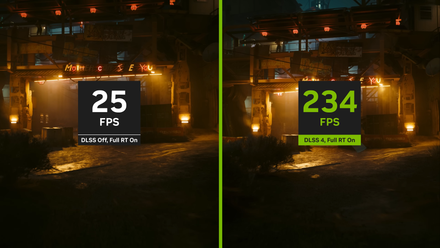
I’ve always been skeptical about frame generation, to the point that for the first few years I didn’t even bother trying it on my RTX 4090 outside of benchmark testing. Sure, it was impressive to see the FPS counter almost double while Monitoring in MSI Afterburnerbut the games never felt like they were actually running at those frame rates. I couldn’t get over how my inputs always felt a little off, but I now know that’s because I was judging framerate almost entirely through the fast-paced shooters I play most often.
Recently I have been playing Forza Horizon 6and it made me realize that I had never given frame generation in a racing game a fair chance. You could argue that racing games are fast-paced too, but they don’t expose the downsides of frame generation in the same way as something like Battlefield 6 either Call of Duty: Warzone. Most of the time, you’re taking in the scenery and making gentle turns rather than moving or following enemies. And for that type of game, I’d say frame generation actually makes sense.

Forza Horizon 6 works fine without frame generation
That solid base performance gives frame generation a good starting point

Until now, I’ve primarily used frame-raising to fix poor performance in demanding AAA titles like Black Myth: Wukong and Assassin’s Creed Shadowsbut looking back, that’s not the right way to use frame generation. Although Nvidia Cyberpunk 2077 The demos make it seem like this, frame generation can’t compensate for a weak foundation. Since your inputs are tied to your base frame rate, you need to give the frame generation a good starting point so you can really appreciate the additional motion smoothness rather than noticing its limitations.
In a racing game like Forza Horizon 6you’re already getting decent frame rates without frame generation. For example, my RTX 4090 averages just over 100 FPS at 4K, maxed out, without RT. And that’s with DLAA, not DLSS. Yes, enabling RT almost halves my FPS, but I can always use DLSS 4.5 to reach around 80FPS. At this point, responsiveness is already decent for a racing game, so using 2x frame-rate to hit 150 FPS seems more like an improvement than a workaround. Sure, it doesn’t feel like a native 150 FPS, but I’d say the added fluidity more than makes up for it.
Racing games take advantage of the strengths of frame generation
The added fluidity complements the feeling of speed.
In fast-paced shooters, I’m constantly switching targets, tracking enemy movement, and reacting to shots in a split second. I need to do all of that with maximum precision, so it’s more about how the game feels than how fluid it looks. If a game is running at 150 FPS with framerates, but I still don’t feel like I’m playing at those frame rates, I’ll notice it right away. However, in racing games, the fluid motion smoothing it provides is much easier to appreciate because it improves the feeling of speed.
When I drive over 200 mph in Forza Horizon 6I fly past traffic, trees, and buildings, and that’s where the frame generation really shines. It makes the world feel more fluid and helps reinforce the feeling that you’re traveling at ridiculous speeds. While responsiveness is important, especially when playing online multiplayer, it’s not like it demands split-second reactions like a competitive shooter. You’re looking at the path ahead and planning your next turn instead of reacting to unpredictable enemy movement. That’s why I think frame generation is worth it in a game like force.
Although I would never use it in competitive titles.
But now I know the type of games where frame generation really helps.
Forza changed its mind about frame-raising, but that doesn’t mean I’ll turn it back on in fast-paced shooters. The core problem I have with frame generation hasn’t changed.. At the end of the day, I see it more as a smoother movement than an FPS booster, because it simply improves the fluidity of the game. In competitive gaming, responsiveness is just as important as FPS number, so if that doesn’t improve along with my frame rate, those extra frames become much less meaningful to me.
However, I care more about fluidity and immersion when playing racing games or slower single-player AAA titles. Responsiveness still matters here, but I just want it to be decent enough that I won’t immediately notice that it interferes with the experience. As long as my base frame rate is above 60 FPS, I don’t obsess over responsiveness the same way I do when playing competitive shooters. In Forza Horizon 6I only use Nvidia Reflex to reduce latency and keep going. And considering I play with a controller, I’m much less sensitive to small latency differences anyway.
It took Forza Horizon 6 to show me when frame generation shines
The mistake I made was not experimenting with frame generation in a wider range of games. I judged this almost entirely through the first-person shooters I played regularly, where responsiveness is just as important as frame rate. But as I’ve learned, frame generation is worth it when responsiveness isn’t your top priority. That’s usually the case in racing games like Forza Horizon 6 and single-player titles like 007 First light. I still don’t see it as an FPS booster, but as a smoother motion, it absolutely has its place. Sometimes all it takes is the right game to change your perspective on a feature, and I’m glad FH6 It finally showed me what frame generation is really good at.