
In windows 11it may be time to ditch the default Photos app in favor of Lapa private, local photo manager built for speed and control.
If your photo library lives on your computer instead of in the cloud, most modern apps don’t seem designed for that experience. That’s where Lap comes into play. It is a free and open source desktop app available for Windows 11 (and 10), macOS, and linuxDesigned around the simple principle that your photos stay on your device and everything from browsing to searching happens locally.
Article continues below.
Why Lap stands out
Lap takes a different approach than most modern photography apps, including Microsoft’s Photos app, by focusing on what happens on your device rather than in the cloud. There is no account setup, forced sync, or background uploads. Your entire library stays exactly where you store it, giving you full control without relying on external services.

Privacy is built into the core of the experience. Unlike many tools that rely on online processing, Lap runs everything locally, including its AI-powered search and facial recognition features. That means your photos never leave your computer, making it a solid alternative to apps like the Photos app for Windows 11.
The app also skips the traditional import process. Instead of copying files to a managed library, Lap works directly with your existing folder structure. You can point to your photo directories and start browsing instantly, making it especially handy for users who already organize files their own way.
Performance is another key advantage. Lap is designed to handle massive collections without slowing down, even with libraries exceeding 100,000 files. Scrolling, filtering and searching are still responsive, making it suitable for anyone managing years of photos on a local drive.
Key Features Back
Lap doesn’t just focus on privacy and performance. It also offers a set of tools to manage, search and edit your photos without leaving the app.
Navigation and organization
Managing large libraries is intuitive with powerful filtering and flexible organizing tools. You can quickly limit photos by date, location, camera, lens, tags, or favorites, making it easy to find exactly what you need. The app also supports multiple libraries, allowing you to switch between collections without mixing everything into a single catalog.

AI and search
Lap brings modern search capabilities to local storage. You can use natural language to search for images, explore similar photos using visual matching, and organize people using facial recognition, which is currently in beta.

Unlike the Photos app for Windows 11, all of these features run locally, without sending data to external servers.
Actually, the application uses ONNX Runtime as its AI backend, a cross-platform engine for machine learning inference and training.
Furthermore, it integrates several well-known open source models for different tasks, such as SHORTEN for image and text similarity search, and InsightFace for face detection and recognition.
Editing and cleaning
For quick adjustments, Lap includes built-in editing tools that let you crop, rotate, flip, and resize images right in place.

Personally, I like the duplicate files option, which helps keep your library clean and streamlined, making it easy to remove unwanted copies and free up space.

Format support
Compatibility is another strong point. This photo management application supports a wide range of formats, including RAW formats such as CR2, NEF, ARW and DNG, as well as modern image formats such as HEIC, AVIF, WebP and JPEG XL.
Additionally, the app supports a wide range of video formats, including MP4, MOV, AVI, and MKV, making it a capable all-in-one multimedia viewer.
Easy to use
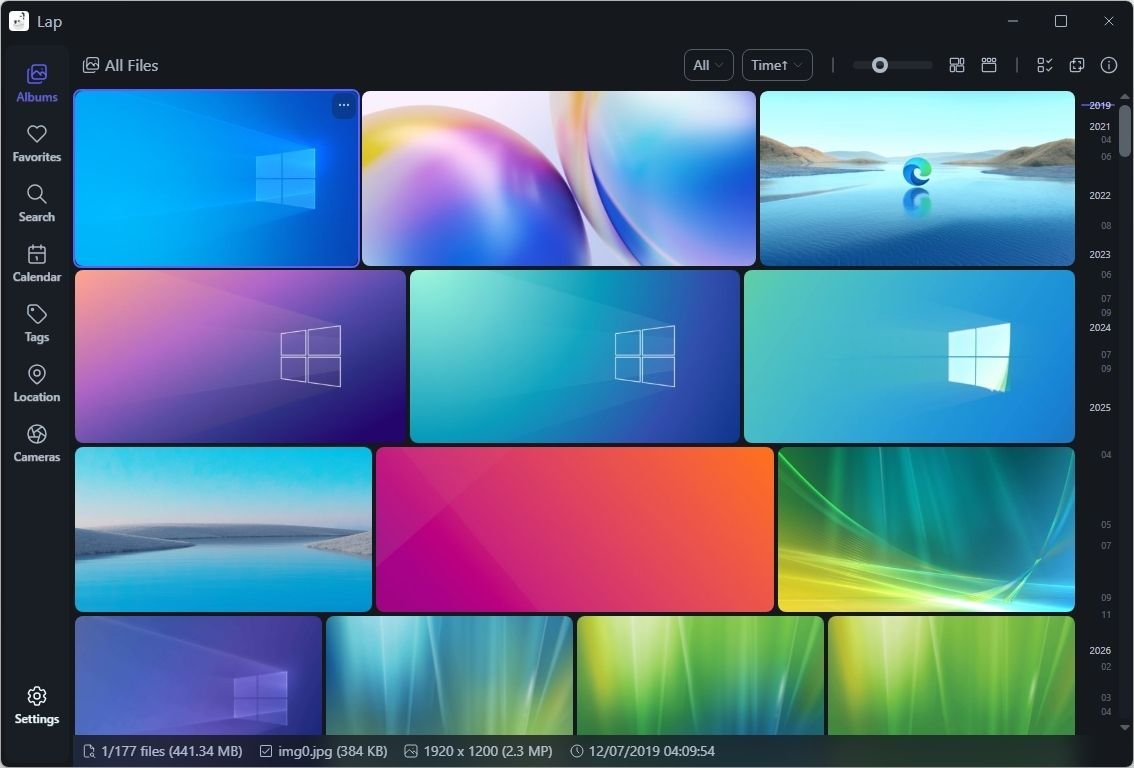
Although Lap is inspired by Google’s FastStone Image Viewer and Picasa, its design closely resembles the Photos app, making the learning curve minimal.

It has a left navigation panel to connect and access images and videos in your collection. At the bottom you have the settings that include the available options, such as appearance, navigation, display settings and search customization.
At the top right you have the different controls to sort and view, and in the toolbar you will find the option to search for duplicate files.
When you open an image, you can make edits, such as rotating, cropping, and resizing it.
Additionally, from the “Adjust” tab, you can use image filters (presets) and manually change brightness, contrast, and more.
While in the library, right-clicking on an image will give you access to the context menu with a host of options, including the ability to add comments, ratings, and more.
Performance and real-world usage
The app really shows its value when you start working with large libraries of locally stored photos. It’s designed to handle extensive collections without slowing down, and in practice, navigation through tens of thousands of images remains smooth and responsive.

Scrolling, filtering, and switching between views feel consistent, even as the library grows. A key reason for this performance is its folder-style design. There is no import process or lengthy indexing phase before you can start using the app. Simply point Lap at your existing directories and start browsing immediately.
Compared to apps like Photos, which can get slow with larger libraries or rely on syncing and background processing, Lap feels more direct and lightweight. It focuses on immediate access to local files rather than overlaying cloud services, which makes a noticeable difference in real-world usage.
I even tried connecting a network folder with less than 500 images and the Lap app is more responsive than Photos.
Download and install
Lap is available as a free open source download for Windows 11, Windows 10, macOS, and Linux.
You can download the latest version directly from project’s GitHub releases pagewhere all official builds are released and updated regularly.
If you want to install the app for Windows 11 (or 10), you need to download the “.msi” option.

It’s worth noting that during installation, you may see a SmartScreen warning because the app is currently unsigned. This is to be expected from many open source projects distributed outside of the Microsoft Store. However, the warning is always: install and use at your own risk.
Once installed, Lap runs as a standalone desktop application without the need to set up an account or cloud setup.
Windows Central’s opinion
I’m not looking for a photography app to replace cloud services, and that’s exactly why Lap stands out to me. It’s designed for people like me who maintain their local libraries, and in that capacity, it offers a fast, modern experience without the overhead of syncing or subscriptions.
When working with large collections, the performance difference is obvious. Being able to work directly with folders, skip imports entirely, and still get AI-powered local searches gives you a real advantage over Windows 11’s Photos app, which can feel slower and more reliant on the cloud as my library grows.
It’s not perfect. Some features still seem to be evolving and the lack of cloud sync won’t work for everyone. But if privacy, speed, and control matter more to you than cross-device access, Lap is the kind of desktop photo manager I think is worth trying.
Are you thinking of trying Lap photo manager? Let me know in the comments.
More resources
Explore more detailed how-to guides, troubleshooting tips, and essential tips to get the most out of Windows 11 and 10. Start browsing here:

Join us on Reddit at r/WindowsCentral to share your ideas and discuss our latest news, reviews and more.



