
Singapore’s parliament has promised that the country will not see jobless growth as artificial intelligence reshapes the economy. Bloomberg reported on Tuesday in coverage citing Channel NewsAsia.
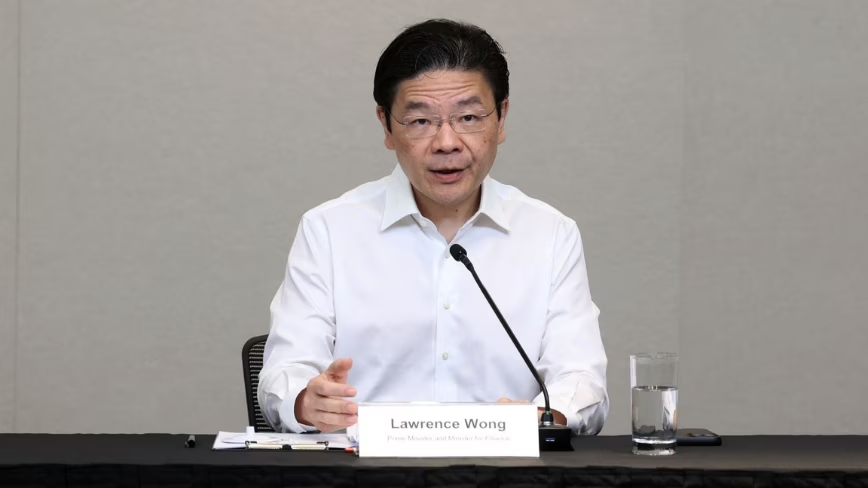
The statement reaffirms the position taken by Prime Minister Lawrence Wong in February during the parliamentary debate on Budget 2026, and represents the most explicit commitment a major Asian economy has made on the issue of AI and jobs to date.
Wong’s approach has been coherent. In his speech on February 26, the Prime Minister told MPs that the government would harness AI to grow the economy while ensuring that growth translates into good jobs and better wages. “These concerns are real and we must take them seriously, and we will take them seriously,” he said in response to questions from the opposition and secondary sectors about workers’ anxieties around the deployment of AI.
The bottom line is whether Singapore can deliver on its promise. Wong identified three specific concerns that had been raised by MPs: that greater use of AI could result in reduced employer investment in worker training, that older workers re-entering the workforce would face disproportionate barriers, and that entry-level professional and technical jobs could become unfilled before structural responses can take effect. He said the government would act early to prevent each outcome rather than responding after the fact.
Current labor market figures are favorable. The proportion of permanent employees in Singapore has reached a record level of almost 91 per cent, with gains in most sectors. Job openings continue to outnumber job seekers, with more than 40 percent of openings in entry-level professional, managerial, executive and technical positions. That is the kind of basis from which a promise of no growth without jobs it is plausible to do. The more difficult question is whether the pattern persists as AI deployment accelerates.
Wong has combined rhetorical commitment with spending on concrete programs. The AI Champions program will provide tailored support, including business transformation and workforce training, for companies aspiring to undertake comprehensive AI-powered business transformation. Four national AI missions have been identified in advanced manufacturing, connectivity and logistics, finance and healthcare, with a National AI Council overseeing development at the national level.
The union movement has responded with its own political demands. Labor MPs aligned with the National Trades Union Congress have called for AI-ready career pathsgreater job transition support for displaced workers and explicit measures to ensure that AI-enhanced workplaces continue to include older and lower-skilled employees. The NTUC has historically operated in close alignment with the ruling People’s Action Party, and its parallel formulation of the AI question reinforces, rather than challenges, Wong’s position.
The broader economic context is also relevant. Wong February Budget was framed around what the government has begun to describe as “a more dangerous world,” with explicit reference to the fragmentation of global trade, trade tensions between the United States and China, and the broader uncertainty that AI is introducing into white-collar labor markets across advanced economies.
His May Day speech continued to use the framework of artificial intelligence and employment as one of the main pillars of his government’s medium-term political positioning.
What the pledge does not specify is what counts as “jobless growth” or what triggers government intervention if the pattern emerges anyway. The technical definition is important because Singapore’s labor market structure is unusually responsive to government-driven adjustment, with active labor market programs, employer subsidies and immigration policies available as policy instruments.
Wong’s commitment is, in effect, a promise that those instruments will be implemented proactively if the AI implementation cycle begins to produce the structural pattern that the commitment rules out.
The test of credibility will be empirical. If Singapore’s overall employment rate, real wage growth and entry-level hiring volumes hold up over the next few years of AI implementation, the promise of no unemployment growth will appear prescient.
If they don’t, Wong’s government will face the political question of whether the policy framework is moving fast enough to deliver on the commitment in practice. Wednesday’s parliamentary reaffirmation suggests the government is treating the issue as a long-term commitment rather than a one-off rhetorical position.



