

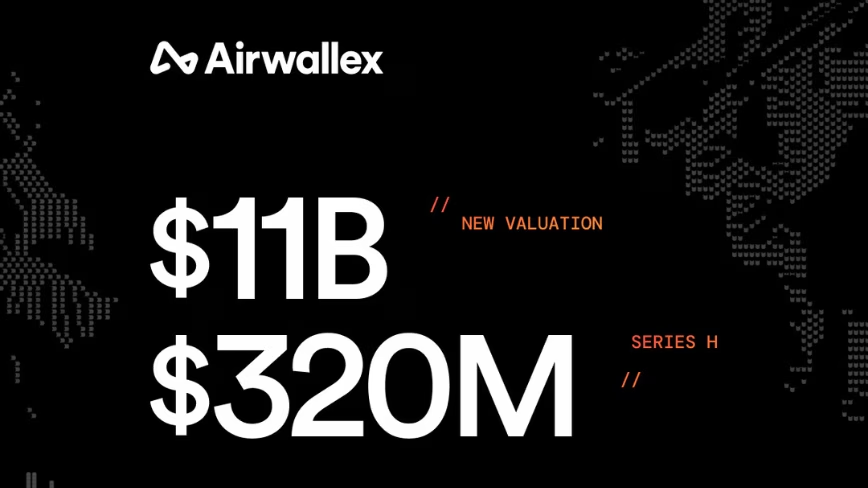
Airwallex has raised $320 million at a valuation of $11 billion, up from $8 billion in December. The payments company is now turning to “autonomous finance” and AI agents that carry out transactions on its behalf.
Airwallex, the global payments platform, has raised 320 million dollars in a Series H round. The deal values the company at $11 billion, up from $8 billion in December 2025. Returning investor Addition led the round.
That’s a quick climb. Airwallex has increased its valuation by $3 billion in about six months. The new money comes with a clear theme: the company wants to move from moving money to managing finances itself, with AI doing the work.
The list of investors is deep. In addition to Addition, the round attracted Baillie Gifford, Hummingbird, QED Investors, T. Rowe Price, Hedosophia, Haun VenturesWashington University in St. Louis and Amex Ventures. It is a combination of cross-funds, financial technology specialists and a cryptocurrency investor betting on agent payments.
Airwallex says the cash will accelerate its push into autonomous finance, expand its regulatory footprint into new markets and grow the teams building its AI-native financial software.
The impetus behind the increase
Airwallex is growing rapidly. In March 2026 it reached $1.3 billion in annualized revenue, a 74% year-over-year increase. Annualized transaction volume reached $287 billion, an increase of more than 120%.
The platform is also getting stickier. Over 90% of revenue now comes from customers using more than one Airwallex product. That cross-selling is what investors value, because it increases the value of each account over time.
The scale is real. Airwallex serves more than 676,000 businesses worldwide, directly or through platform partners. Its products span payment acceptance, invoicing, global accounts, corporate cards and expense management.
Founded in Melbourne in 2015, the company holds more than 85 licenses across North America, Europe, the Middle East and Asia-Pacific. It is jointly headquartered in San Francisco and Singapore and has more than 2,300 employees across 27 offices.
From payment methods to the financial brain
The talk this round is not just about payments. Airwallex says the licenses and settlement pathways it took ten years to build are exactly what an AI-driven economy needs. Now you want to build the smart layer on top of it.
“We believe this is the most momentous moment in the history of global finance and we are building accordingly,” said Jack Zhang, co-founder and CEO. “A decade ago, we didn’t know exactly what the agency economy would look like, but we built a foundation for it.”
To make the point, the company introduced two products. The first is T:0, an AI-native financial platform intended to run the entire financial function of a company. Automate accounting, forecasting, tax, compliance and reporting from day zero. It’s in private beta for now.
The tone of T:0 is forceful. Zhang wants founders to get “CFO-level books” without hiring a finance team or migrating systems. It’s a direct hit to the patchwork of tools that small businesses often put together.
Airwallex has also been purchasing that capacity. In early June it acquired Leapfin, a revenue recognition and reconciliation platform, to convert raw transaction data into GAAP-ready financial statements. That agreement feeds directly into T:0.
This idea goes back to a simple statement that Zhang likes to repeat: the AI era has no domestic market. Small teams now go global from day one, often led by a handful of people and a lot of agents. Airwallex wants to be your finance department.
A wallet for agents
The second product is Airi, an agent consumer wallet. At launch, it incorporates Airwallex’s one-click checkout, which the company says increased successful checkout conversions by up to 14% in early testing.
The bigger idea is what comes next. Airwallex plans for Airi to become a wallet infrastructure for software agents that buy things for you. That means delegated payments, spending limits, permission controls and multi-currency balances, all on regulated tracks.
The logic is simple. When an AI agent transacts on your behalf, it needs a secure global conduit to access real money, whether fiat or stable currency. Airwallex wants to be that conduit.
The land grab of the agent trade
Airwallex is not alone in this race. The fight for ownership of the payment method used by AI agents is now one of the hottest competitions in fintech.
The biggest names are already moving. Stripe has adapted its Link wallet for agents and anticipated stablecoin settlement for agent-to-agent payments. OpenAI has connected Visa to ChatGPT so its agents can buy and pay among millions of merchants. Mastercard, PayPal and Google are creating rival protocols.
Smaller players are also circling. Meow Technologies has launched what it calls the first banking agent platform for AI agents, with integrated approval workflows. The shared assumption is that agents will soon be moving money and someone has to have the keys.
The money follows the thesis. Mastercard recently agreed to buy stablecoin firm BVNK for up to $1.8 billion, and Stripe bought Bridge for $1.1 billion last year. Large payments companies clearly expect that brokers and stablecoins will need new pipelines.
Airwallex maintains that its advantage is the boring part: regulation. Building 85 licenses and local settlement networks takes years, and agents need that compliance to transact. Addition’s Lee Fixel made the same argument, saying the winners will build “on top of real financial infrastructure, not around it.”
the bet
The strategy carries risks. Airwallex is moving from a proven payments business to products that barely exist yet. T:0 is in beta and the agent wallet is primarily a roadmap.
It’s also full of people. Stripe is much bigger, the card networks have global reach and rivals like revolution They are putting strong pressure on corporate banking. Airwallex must turn its infrastructure leadership into software that people actually use.
Still, the moment is bold. Airwallex spent a decade building rails for a borderless economy, and is now betting that AI agents will be the biggest users of those rails. The question this round leaves open is whether the agent economy arrives fast enough to justify an $11 billion price tag. For now, the money is betting that this will be the case.



