
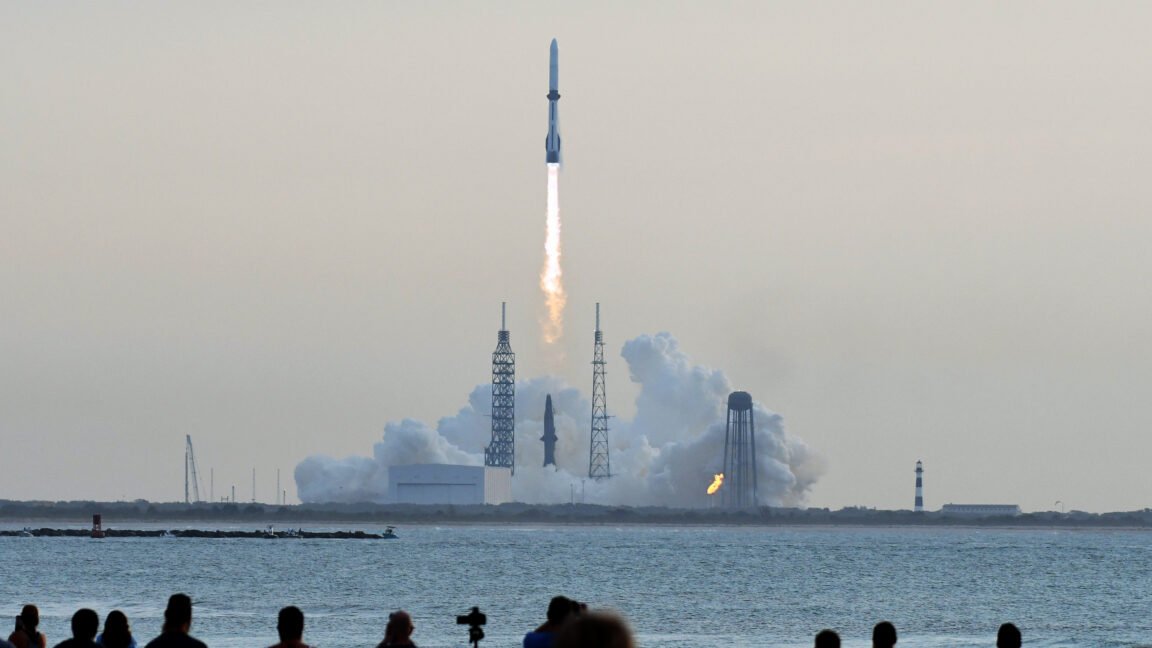
The third flight of Blue Origin’s heavy-lift New Glenn launcher began Sunday with the company’s first successful flight of an orbital-class booster, but ended with a setback for Jeff Bezos’ flagship rocket, a key element in NASA’s Artemis lunar program.
The 321-foot-tall (98-meter) New Glenn launch vehicle ignited its seven methane-fueled BE-4 engines at 7:25 a.m. EDT (11:25 UTC) on Sunday, beginning a slow ascent from its launch pad at Cape Canaveral Space Force Station, Florida.
The main engines, each producing more than half a million pounds of thrust, accelerated the rocket beyond the speed of sound in about a minute and a half. Three minutes into the flight, the booster shut down its engines and moved away from New Glenn’s upper stage, powered by two BE-3U engines burning liquid hydrogen and liquid oxygen.
New Glenn’s first stage continued a descending parabolic arc, briefly rising into space before guiding toward Blue Origin’s landing pad in the Atlantic Ocean, nearly 400 miles southeast of Cape Canaveral. Reigniting its engines for two braking runs, the booster settled on the ship for a smoke-filled but on-target landing less than 10 minutes after takeoff.
The landing marked the end of the second flight of this booster, called Never tell me the oddsafter debuting with a good launch and recovery on Blue Origin’s previous New Glenn mission in November. Blue Origin, founded and owned by Amazon’s Jeff Bezos, has landed and reused its New Shepard suborbital booster numerous times, but New Glenn surpasses New Shepard in difficulty and scale. It flies higher, travels faster and is three times the height of the New Shepard.
Technicians installed new engines in the booster for Sunday’s flight, but Blue Origin intends to reuse the engines from the November launch on future New Glenn missions, according to Dave Limp, the company’s chief executive.
New Glenn allows Blue Origin to reach a broader market for launches to low Earth orbit and beyond. SpaceX has demonstrated that it can recycle a Falcon 9 booster back into flight in just nine days and launch Falcon 9 five or more times in a week using a fleet of reusable boosters and three active launch pads. Blue Origin officials hope that reusing the New Glenn boosters will allow them to achieve a much faster launch rate.



