
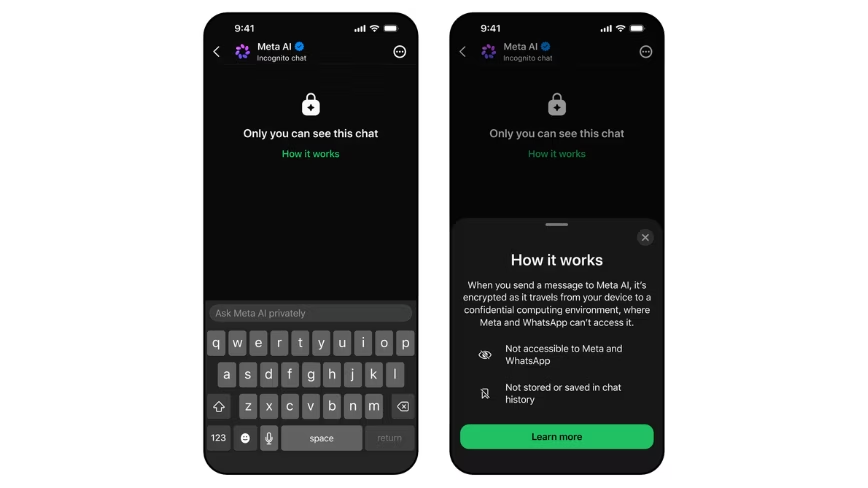
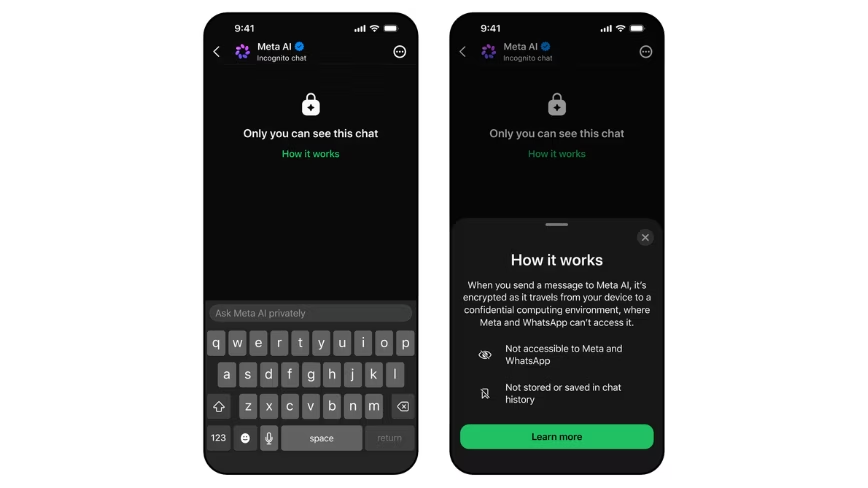
The new mode runs Meta AI on WhatsApp within the company’s private processing enclave, with conversations deleted by default and no server-side logs retained.
Meta has launched an incognito chat mode for Meta AI on WhatsApp and the Meta AI app, an effort to address the awkward fact that its assistant, like every other major AI chatbot, has so far been able to read the conversations users have with it.
The new way, the company announced on TuesdayIt processes user messages within what Meta describes as a secure environment that not even Meta can see, and conversations are deleted by default once the session ends.
The technical foundation is WhatsApp’s private processing system, the architecture the company published in April 2025 to allow AI functions to run on encrypted data within trusted execution environments on Meta servers.
Within that enclave, the model can read and respond to a query, but Meta’s engineers, its systems of record, or any of its business channels cannot access the content.
Other apps offer what they call incognito modes for AI conversations, but Meta’s framing in the ad is direct: “They can still see the questions coming in and the answers coming out.”
The launch directly responds to a category-wide privacy concern. AI chatbots have become a default tool for the kinds of questions users would once have asked a doctor, lawyer, or partner, with all the data exposure that entails.
OpenAI, Google, and Anthropic store conversation histories by default, with different user controls. Apple Intelligence routes some queries through Apple’s Private Cloud Compute, an enclave architecture that is the clearest existing analog to what Meta now includes within WhatsApp.
Two details of the product emerge from the design. First of all, conversations are not saved on the server at all; Users cannot access incognito chat history later because there is nothing to access.
Secondly, the default disappearing behavior means that even a compromised device has fewer leaks, as chat residue is deleted between sessions.
Meta has published a technical document describe the cryptographic architecture for external review.
A second feature is on the way. Sidechat with Meta AI, also protected by private processing, will allow users to get AI help within an existing WhatsApp conversation, with the assistant aware of the chat context but their responses remaining invisible to other participants.
Meta said Sidechat will come to WhatsApp “in the coming months,” without a firmer date.
The commercial logic of the launch is simple. WhatsApp has been built for a decade around end-to-end encryption as a selling point, and Meta’s pitch for AI on the platform has had to find a way to get around the central tension that an AI conversational assistant needs to read your messages to be useful.
Private Processing is the company’s attempt to square that circle. The Incognito Chat product is the first time the architecture has been included behind a user-facing feature at this scale.
Whether the implementation holds up under scrutiny is a separate question. Trusted Execution Environment-based AI systems have been audited and criticized across the industry, and researchers regularly demonstrate side-channel attacks against similar architectures from Apple, Google, and hyperscalers.
Meta has invited an external review of its Private Processing design, and the new whitepaper expands on that stance, but the model’s resistance to subpoena, in particular, has yet to be tested in court.
Incognito chat with Meta AI begins rolling out to WhatsApp and the Meta AI app this week, with wider availability in the coming months.
The launch comes at the end of a difficult fortnight for Meta on the privacy front, with US employees protesting the new company. mouse tracking software on Monday and the company a week away from laying off approximately 8,000 employees.
Within Meta, the bet seems to be that measures like this in terms of consumer privacy will overcome the optics of internal surveillance.



