

microsoft has unveiled two early-stage AI hardware concepts at its Build 2026 developer conference, aiming to make AI agents accessible without the need for a laptop or a dedicated app.
One of them is a small cube-shaped desktop device that features a touch screen and voice controls. The other is a wearable badge equipped with a camera and fingerprint sensor, which can be clipped to clothing or worn around the neck.
Microsoft has not yet said whether any of the devices will be offered as commercial products. Both are currently in testing with a few hundred employees and the results of these tests are expected to influence future designs.
The Laptop AI Badge and Desktop Cube
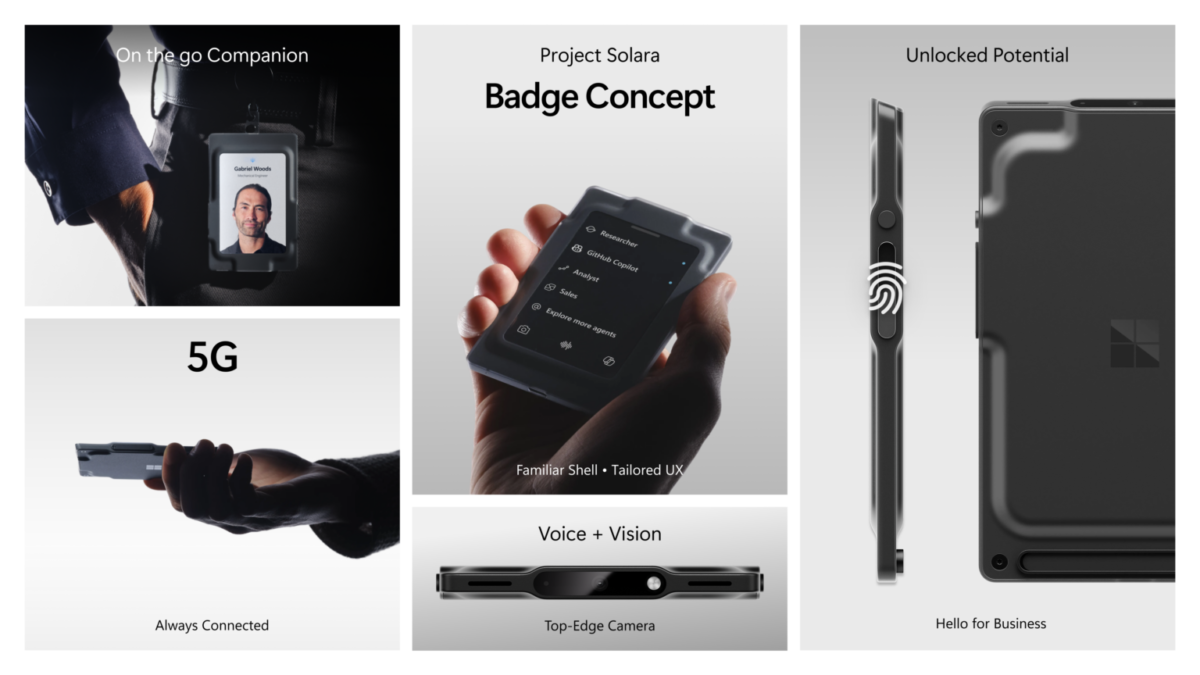
The wearable device, which Microsoft executive Steven Bathiche described as “a portable key card,” attracted the most attention during the demonstration.
It is activated with a fingerprint and has a small built-in camera. During a demonstration, Bathiche pointed the badge at the audience and asked them to take photos and send them to him, which the system did successfully.
The camera is intended to give AI agents more context about the user’s environment. Bathiche explained that it helps agents better understand and respond to their environment, meaning they can react not only to written or spoken commands, but also to what the device sees.
The second idea is a small cube equipped with a touch screen and voice controls, designed to sit on a desk.
Like the badge, it is based on artificial intelligence agents that are already widely used by developers and technical professionals, especially for writing and refining code. The goal is to keep these agents easily accessible without the need to use a laptop or monitor.
Microsoft’s AI hardware strategy and privacy concerns
CEO Satya Nadella described the effort as part of a broader rethinking of computing interfaces, referring to the devices as a “new form factor.”
This wording indicates that Microsoft is considering the possibility of AI not being limited to phones and PCs, but also being integrated into smaller devices that users keep close by throughout the day.
The prototypes suggest that Microsoft sees AI not just as software but also as something that could eventually need its own dedicated hardware layer.
Devices that continually observe their surroundings have come under scrutiny across the industry. Meta’s AI-enabled glasses have raised questions about how visual data is recorded, stored, and under what circumstances.
A wearable badge equipped with a camera raises similar concerns about bystander consent and data handling, particularly in work environments where the device can capture colleagues without their explicit knowledge.
Microsoft has not detailed how the visual data captured by the badge would be stored, processed, or protected.
Microsoft’s wearables history and broader AI hardware push
Microsoft’s history with wearables has been inconsistent. The company’s HoloLens mixed reality headset faced challenges achieving widespread adoption despite years of work and a notable contract with the US military.
Microsoft ceased production of HoloLens in 2024. Other tech giants are also reviewing wearable devices. Google has announced plans to re-enter the smart glasses market more than a decade after Google Glass, as Meta continues to expand its line of smart glasses. All three companies are betting that AI assistants can improve the usefulness of wearable hardware compared to previous attempts.
It is not yet clear whether Microsoft’s prototypes will go beyond internal testing, as the company has not yet specified any timeline for a possible commercial launch.




