

Cost is a critical metric for businesses when choosing any business software. For data analytics systems, enterprises primarily care about analytical insights, making lower insight costs critical to enterprise adoption.
As a senior software engineer at AWS building large-scale data infrastructure and distributed systems, I’ve noticed a consistent pattern: cost optimization is almost always treated as the last step. We are currently seeing similar problems in AI analytics systems. When you don’t build with costs in mind from the beginning, you run into huge inefficiencies. We are seeing huge problems with data inflation, token inflation, and massive context windows, which not only lead to costly and redundant model inferences, but also create a huge compliance overhead. This article discusses architectural strategies to solve these problems and ultimately optimize overall knowledge costs.
1. Programmatic data reduction: using the LLM as a code generation router
The costliest mistake you can make is treating base models as data processing engines. Taking a massive set of raw data, downloading it directly into the context window of an LLM, and asking it to find a trend is a waste of money. You are paying a nominal premium for the model to do basic filtering and arithmetic.
Instead, we need to use the LLM solely as an intelligent query router. When a user asks an analytical question, the first step should not be to retrieve the raw data. The first step is to have the LLM generate a deterministic and directed analytical query using languages such as SQL, R or Python. This code is then executed directly on your big data layer.
By keeping heavy data processing within efficient, native database engines, you reduce data to its essentials. The LLM only receives and analyzes the small aggregate result to generate information.
While working on AWS Bedrock, separating model access from raw data access was a key design principle.
2. Upstream ETL for inference acceleration
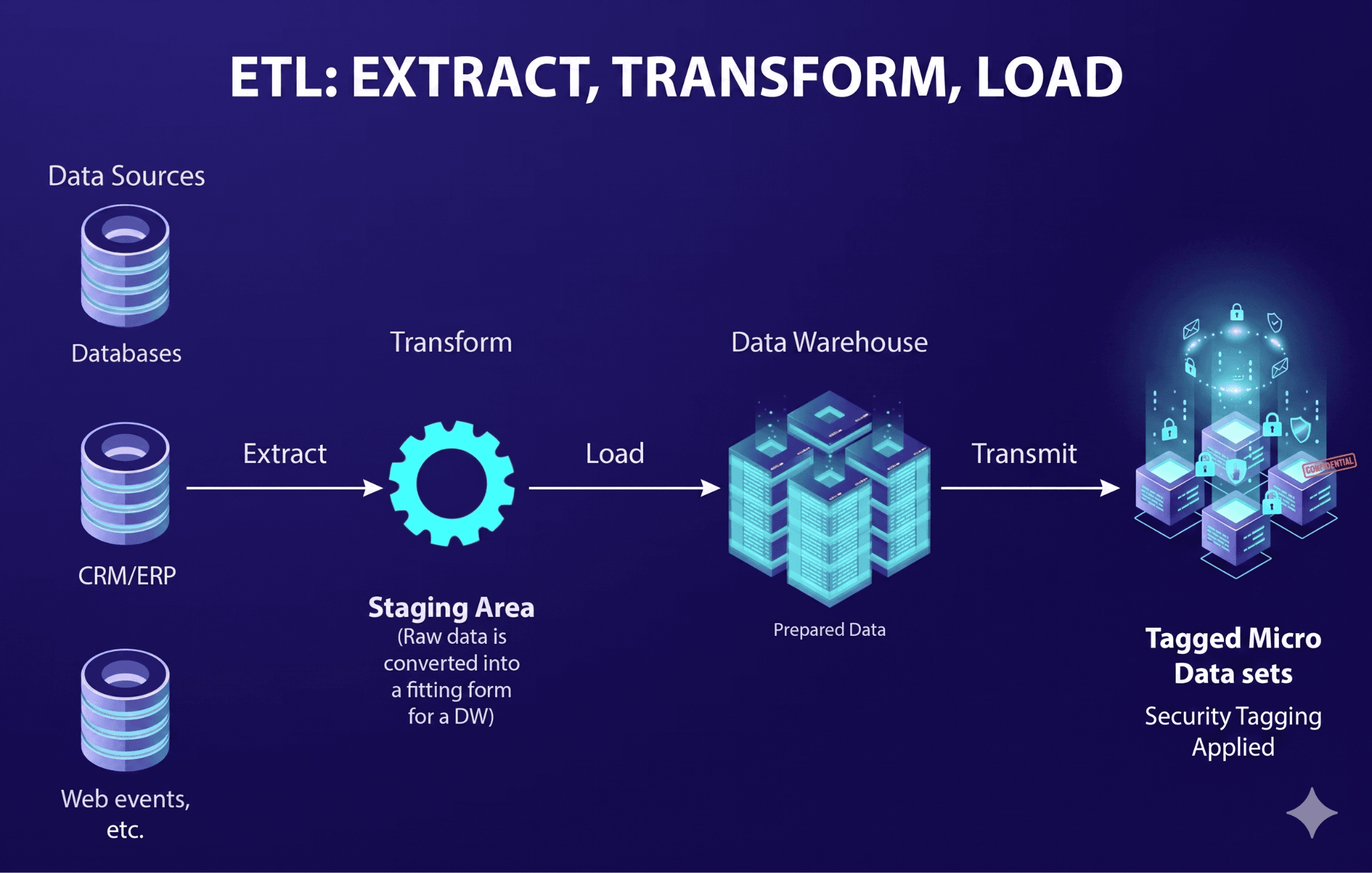
If your LLM dedicates its context window to filtering out noisy, unstructured data, your pipeline is fundamentally inefficient. We can solve this by moving data cleansing and structuring as high up as possible.
Pipelines can be created to perform heavy ETL (Extract, Transform, Load) processing, helping LLMs get the relevant data for a query much faster. Instead of passing raw streams directly to the AI application layer, we need specialized, continuous ETL processes that pre-aggregate and structure raw data before even performing an analytical query.
This eliminates the need for the LLM to classify data noise or perform basic data cleaning logic. You ensure that expensive model compute cycles are spent entirely on high-value synthesis, rather than parsing and filtering.
In my experience building high-performance stream processing pipelines using Amazon Kinesis Streams and Amazon DynamoDB, optimizing the data structure at the ingestion layer is critical. By handling the heavy lifting upstream, we effectively protect our downstream AI models from expensive, unstructured noise processing, directly reducing the token cost per query.
3. Microdatasets with rich metadata and security labeling
Building on the previous point, we can use these ETL processes to create smaller, finely processed data sets suitable for a particular information from a much larger data set. Instead of forcing an LLM to navigate a vast monolithic data lake, we break it down into narrowly focused micro-datasets.
We can use detailed labels and metadata for these smaller data sets so that LLMs can quickly identify exactly which data set to use for a given analysis. This allows the system to retrieve results much faster and with a much smaller context window.
Additionally, we can add special security labels to these microdata sets to explicitly identify who has access to them, further reducing risk. When a query arrives, the orchestration layer validates the user’s IAM credentials against these security labels before any recovery occurs. This does two things: it acts as an aggressive pre-filter that instantly removes unauthorized data (saving tokens and calculation time) and ensures that sensitive data is physically invisible to the AI model from the beginning.
This is the same approach we take on the AWS OpenSearch team, where we build specialized data access security services with fine-grained precision down to individual Amazon DynamoDB row elements. By moving data isolation and routing to the storage layer through tagging, the security architecture actively reduces the token footprint and eliminates data leakage risks.
4. Multi-tier execution architecture
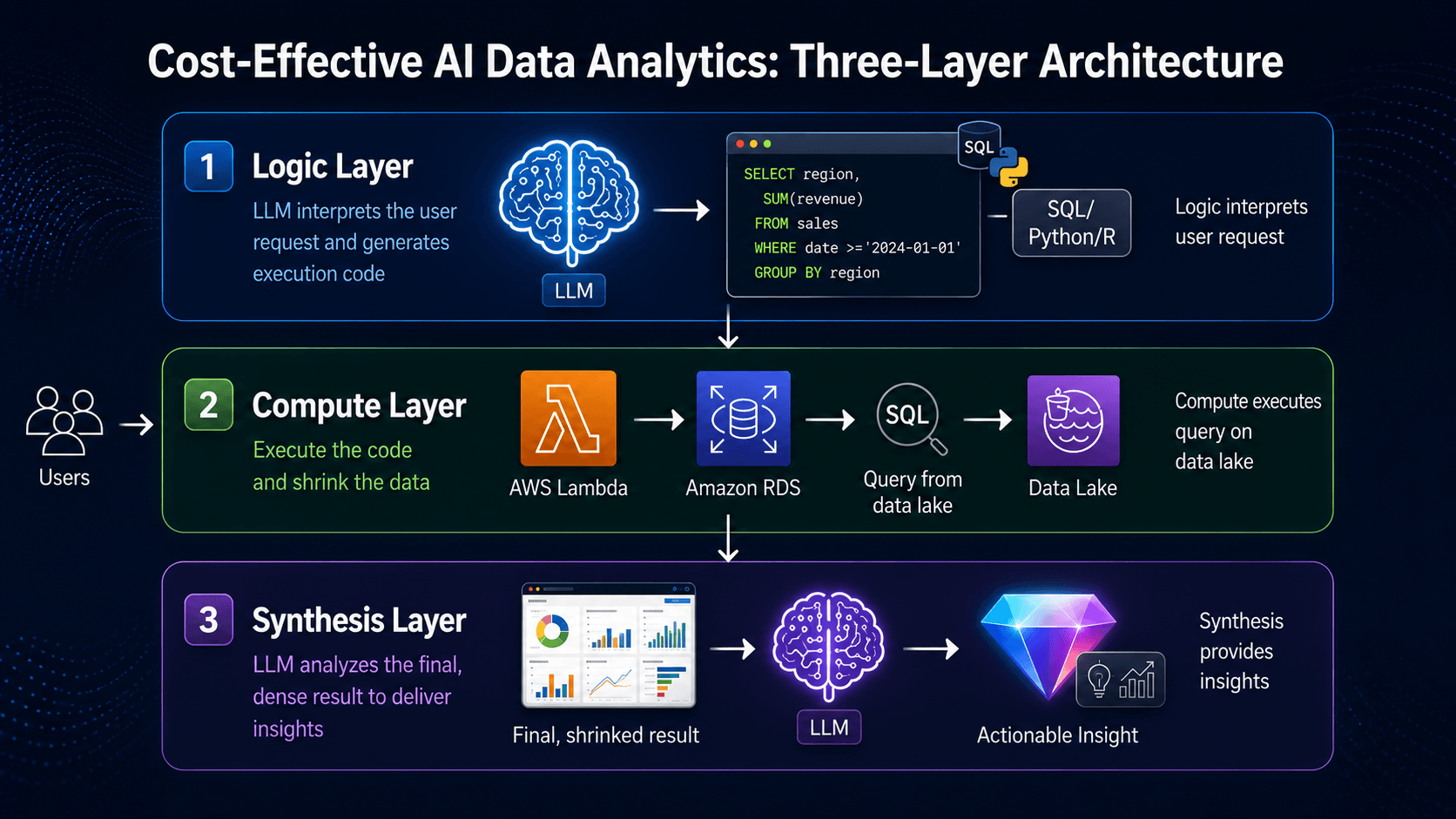
To bring these strategies together, it is essential to create a multi-layered architecture where LLMs write code to get data and only analyze the reduced end result to reduce costs. We need to build a strict structural wall between data manipulation and AI synthesis. In this architecture:
- Layer 1 (the logical level): The LLM interprets the user’s query and writes the execution code (SQL, Python, R).
- Layer 2 (the computing level): A dedicated database or runtime executes the code and reduces the data.
- Layer 3 (the synthesis level): The LLM reads only the final and dense result to provide the real information.
By separating execution in this way, you ensure that each token sent to a base model is doing useful work.
This aligns with the core design philosophy behind specialized enterprise platforms like AWS FinSpace. When handling massive, high-speed financial analysis, heavy data lifting is kept strictly within dedicated, highly optimized compute runtimes. AI models are only incorporated in the last mile for contextual interpretation, completely avoiding the cost trap of performing data manipulation within an LLM.
5. Change audit boundaries using zero trust recovery
As mentioned above, dumping massive sets of raw data into an LLM not only increases symbolic costs; creates a huge compliance overhead. If you rely on an LLM to process raw business data, your compliance audits (like SOC2 or GDPR) become a nightmare. Auditors are forced to review a non-deterministic black box that interacts with millions of unmapped data points.
We can resolve this by shifting the compliance audit limits upwards. Instead of relying on rapid engineering or expensive barrier models to leak sensitive data once it’s been obtained, we use a zero-trust recovery model. By applying data-aware row and item-level security directly to the native database and search index layer, along with the ETL security tags we analyze, unauthorized data cannot physically cross the boundary into the AI cluster.
Because of this, auditors do not have to guess what the LLM may have seen. They can programmatically verify deterministic ETL code, storage configurations, and tightly restricted access logs.
During my time on the AWS OpenSearch team, I created specialized data access security services to handle this exact type of precision. We show that enforcing absolute security at the storage and search layer is a good way to make enterprise compliance scalable. It eliminates the need for costly post hoc AI remediation and significantly reduces the time and money spent on data audits.
6. Miniaturized immutable compliance log
A final enterprise-scale infrastructure cost that is often overlooked is log retention. If you have to archive massive, raw context windows for every user query to comply with regulatory data retention laws, your storage bills will quickly become unsustainable.
Because our multi-tier architecture ensures that the LLM only reads a reduced final output string instead of carrying raw data, its logging footprint is dramatically reduced. We only need to record and archive those compact output strings, the generated execution code (such as the SQL or R query), and the associated metadata for compliance history.
This significantly reduces the costs of retaining and storing regulatory records. Storing small, structured queries and dense information is much cheaper compared to archiving bulk unstructured messages. While working on orchestration services for AWS Bedrock, keeping the data footprint small and auditable was key to leaving a highly optimized and easily auditable trail.
By reducing the data sent to the LLM, we not only save on token costs during the query, but we also save on storage costs over the next five years of compliance retention.
Conclusion
In the rush to integrate generative AI, it is easy to abandon fundamental engineering principles. Placing a basic model on top of a huge data lake and hoping for the best is a recipe for unsustainable IT bills and compliance nightmares. Good engineering means building systems that are efficient by design, not patching a bad architecture with an AI layer.
By moving heavy data processing through dedicated ETL, using LLM to generate programmatic queries, and applying zero-trust security directly at the storage layer, we stop treating AI as an expensive data transportation engine. Instead, we isolate you into what you do best: high-value logical routing and back-end synthesis.
Ultimately, addressing data and context overload at the infrastructure level does more than just clean up your data pipelines. Structurally reduces the overall cost per insight, proving that enterprise AI can be powerful and profitable at scale.
About the author
Tarun Chauhan is a Senior Software Engineer at AWS (Amazon) with 11 years of experience designing and building large-scale end-to-end distributed systems using cloud (AWS), Android/iOs and backend technologies. He has designed and built critical data security and infrastructure services for AWS OpenSearch, AWS FinSpace, and AWS Bedrock.



