

“All of our spacewalks are really designed for two people; the system isn’t really made to be easy for three people,” Akers told CollectSPACE. “That was a unique situation where we couldn’t get the capture bar on Intelsat VI, and the ground (controllers) and our team came up with the idea of having three people come out. With the teamwork and great support from the ground team, it worked out very well.”
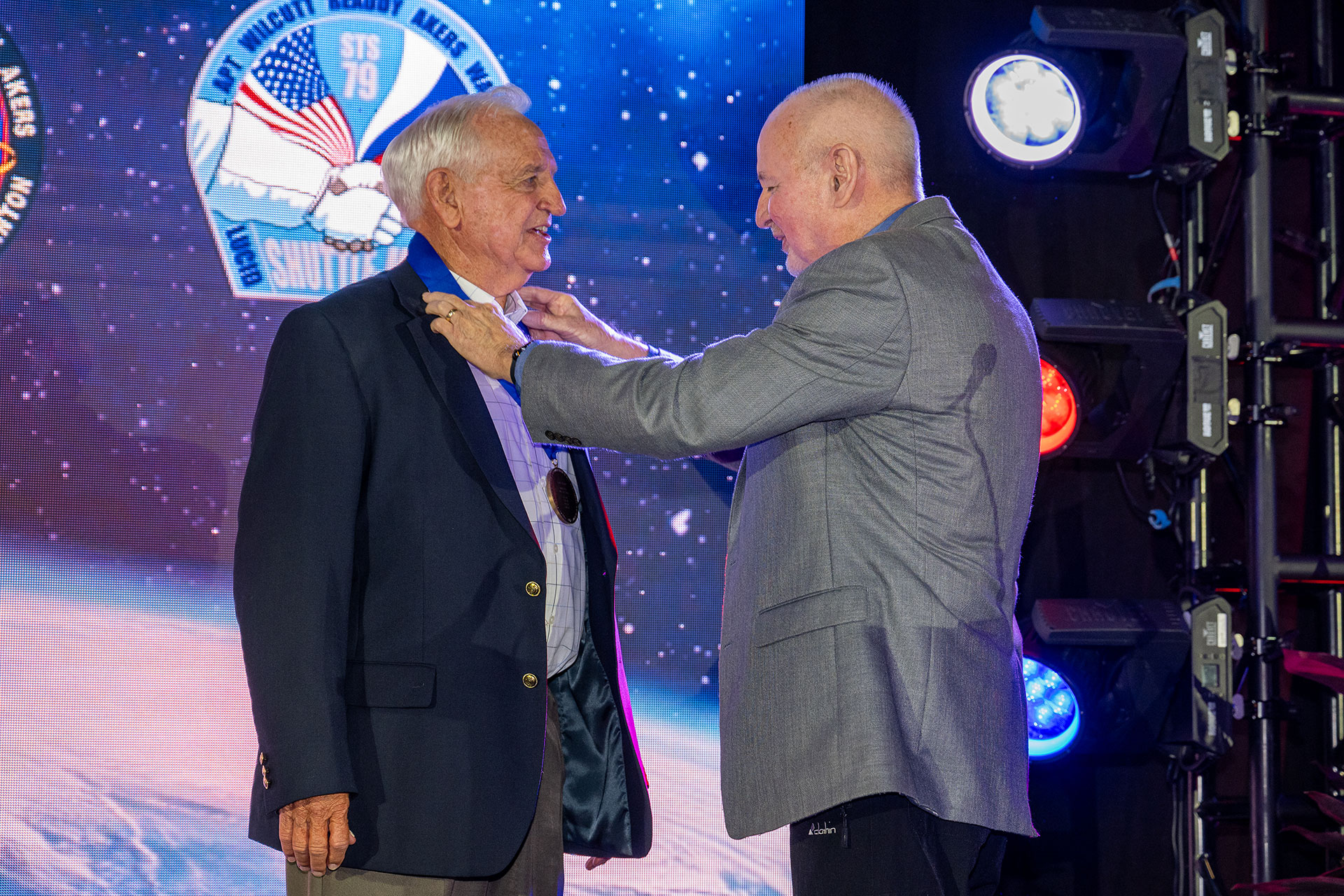
Brian Duffy (right) inducts Tom Akers into the U.S. Astronaut Hall of Fame at the Kennedy Space Center Visitor Complex in Florida on Saturday, May 16, 2026.
Credit: Kennedy Space Center Visitor Complex
Brian Duffy (right) inducts Tom Akers into the U.S. Astronaut Hall of Fame at the Kennedy Space Center Visitor Complex in Florida on Saturday, May 16, 2026.
Credit: Kennedy Space Center Visitor Complex
Akers and Tanner conducted spacewalks to repair and upgrade the Hubble Space Telescope (HST), carefully manipulating delicate optical instruments in a very small area. Tanner also helped assemble the large main structure and solar panel wings for the International Space Station (ISS).
“I’ve often been asked what the difference is between ISS and HST EVA (extravehicular activity), and I think it comes down to the hands and overall physical exertion,” Tanner said. “Manual dexterity in the hands was more important for the HST, and for the ISS, you are carrying quite large and heavy objects and maneuvering long distances. That is the biggest difference.”
In total, Akers spent nearly 30 hours of his nearly 34 days in space performing spacewalks. Tanner logged 43 days, including 46 and a half hours in EVA.
Join the ranks
Saturday’s ceremony was led by news correspondent John Zarella and included remarks from Curt Brown, chairman of the board of directors of the Astronaut Scholarship Foundation, which manages the selection and nomination process each year; Therrin Protze, director of visitor complex operations; and Kelvin Manning, deputy director of NASA’s Kennedy Space Center.
“Today’s induction of Tom Akers and Joe Tanner honors two astronauts whose careers embody excellence, leadership and service,” said Brown, who became a NASA astronaut in the same class as Akers and flew with Tanner on Atlantis. “Their lasting contributions to NASA and their continued work as educators and mentors reflect the best of the United States space program.”
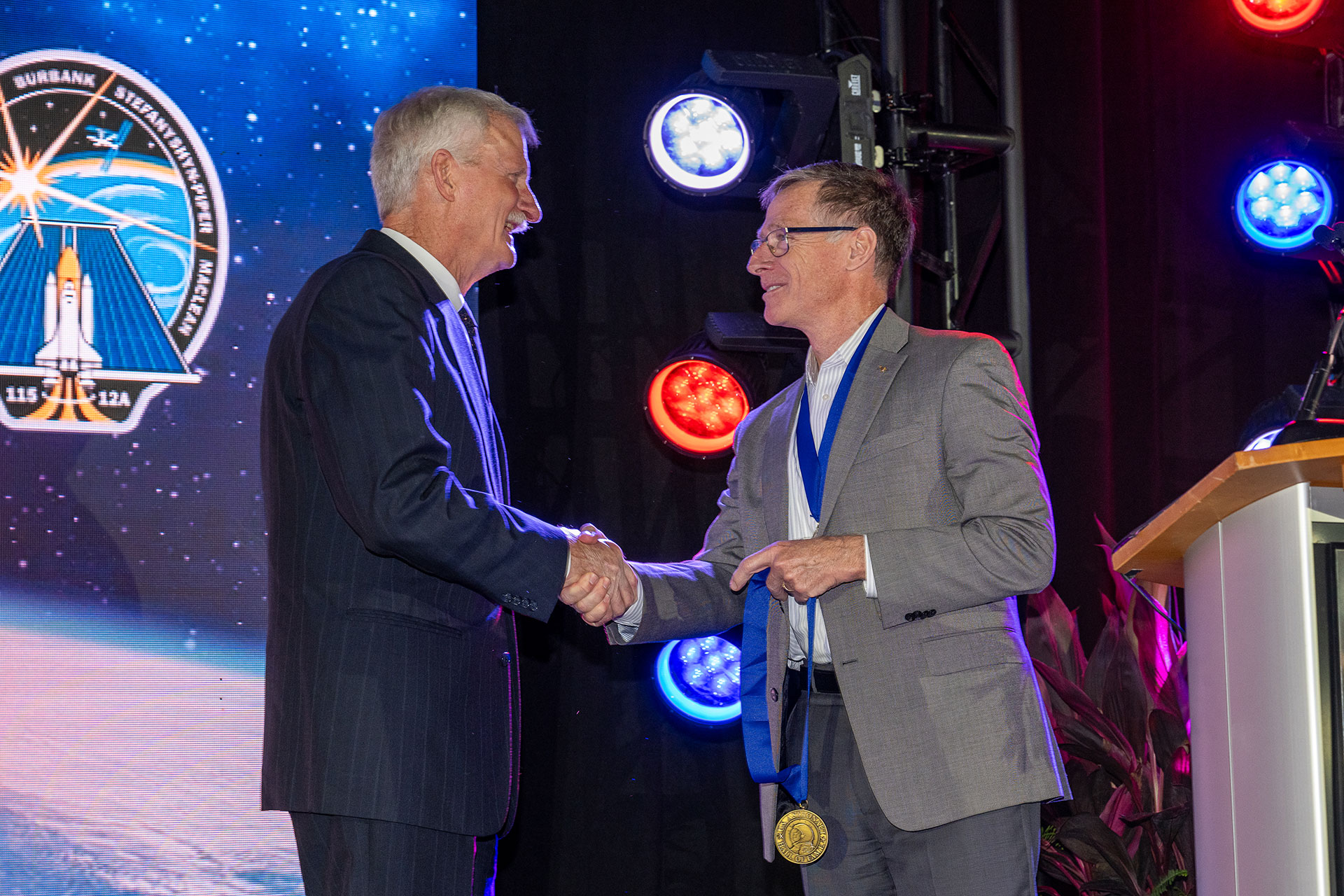
Joe Tanner (left) is inducted into the U.S. Astronaut Hall of Fame by his STS-115 pilot, Chris Ferguson, at the Kennedy Space Center Visitor Complex in Florida, May 16, 2026.
Credit: Kennedy Space Center Visitor Complex
Joe Tanner (left) is inducted into the U.S. Astronaut Hall of Fame by his STS-115 pilot, Chris Ferguson, at the Kennedy Space Center Visitor Complex in Florida, May 16, 2026.
Credit: Kennedy Space Center Visitor Complex
“We are proud to welcome them to the U.S. Astronaut Hall of Fame,” said Brown, who is member of the class of 2013.
Brian Duffy class of 2016formally inducted Akers and presented him with his Hall of Fame medal. Chris Ferguson, who flew as a pilot for Tanner’s last mission, STS-115and who was incorporated in 2022similarly honored his former crewmate. About 20 veteran NASA astronauts attended the event, including 15 other Hall of Famers.
The ceremony also included the unveiling of the etched glass portraits and mission patches, which will then be hung along with the other 111 similar plaques representing the new members. Founded in 1990, the US Astronaut Hall of Fame has been a Heroes & Legends attraction feature at the Kennedy Space Center Visitor Complex since 2016.



