

Can you predict what could happen in 250 years? It’s a difficult task, especially when you think about everything that has happened in the last 250 years. The world of 1776 is completely foreign to those of us who live in the 2020s.
The people of 1776 lived before the widespread adoption of conveniences such as indoor plumbing. No one knew fundamental scientific concepts like germ theory. The Wright brothers weren’t even a twinkle in their father’s eye.
Here in 2026, we have run out of new ideas and have bet our chips on AI coming up with some new ones. So, of course, Anthropic’s AI chatbot, Claude, was recently tasked with making several predictions for the year 2276, specifically related to California. As part of the America 250 celebrations, every U.S. state and territory has now contributed to a time capsule that will be buried in Philadelphia on July 4, 2026. Some states took up the task, with New Mexico including things like a bolo tie and Nevada placing poker chips in the 900-pound time capsule. But contributions from other states were pathetic, and Kansas submitted a single page listing government officials.
California arguably did the best work, including a qubit chip from the University of California, Berkeley, a fusion conductive segment from General Atomics, and a NASA photograph of California from space. California also included the aforementioned predictions, which are obviously difficult to judge since we don’t know what the future holds. But we can also take a look at it anyway.
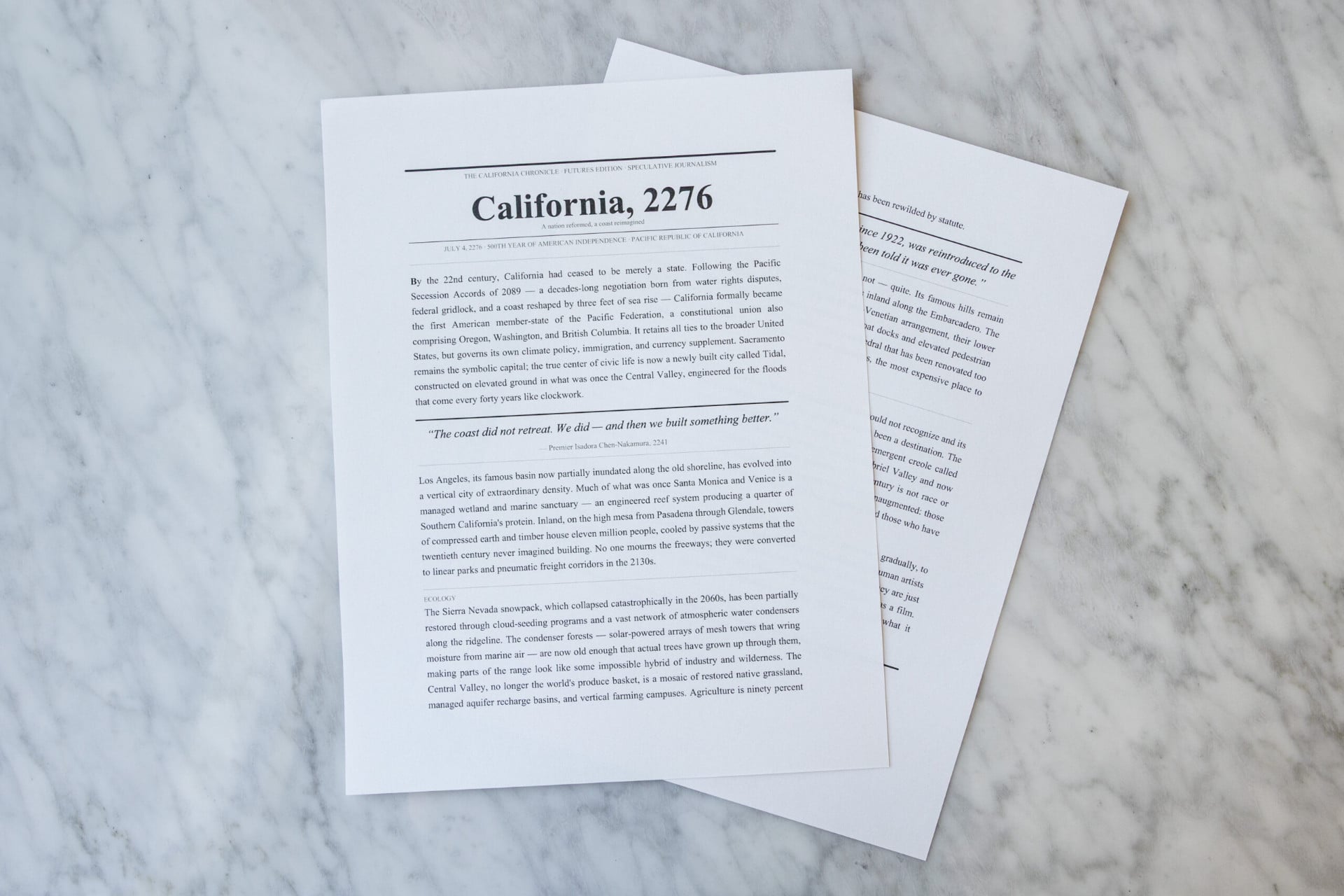
The forecast was made after feeding Claude. the notice“Write me a prediction of what California will be like in 250 years from July 4, 2026.” And from the beginning, it seems that California is involved in some kind of soft secession from the United States.
By the 22nd century, California was no longer simply a state. Following the Pacific Secession Accords of 2089—a decades-long negotiation born of disputes over water rights, a federal impasse, and a coast reshaped by three feet of sea level rise—California formally became the first American member state of the Pacific Federation, a constitutional union that also includes Oregon, Washington, and British Columbia. It retains all ties to the broader United States, but governs its own climate policy, immigration and monetary supplement. Sacramento remains the symbolic capital; the true center of civic life is now a newly built city called Tidal, built on high ground in what was once the Central Valley, designed for the floods that occur every forty years like clockwork.
Gizmodo reached out to Gov. Gavin Newsom’s office to ask if the prediction was manipulated in any way. We received no response, but we find it very interesting that Claude essentially predicted the creation of Cascadiaan idea with roots in the 19th century. Cascadia typically only includes the Pacific Northwestbut Claude seems to think that the entire West Coast, including California, will have some autonomy from the federal government on decisions like climate change and water rights.
The prediction also includes a quote from some kind of political leader that he never explains:
“The coast didn’t retreat. We did, and then we built something better.” — Prime Minister Isadora Chen-Nakamura, 2241.
The idea of how the California coast could change figures prominently in predictions, including what will happen in coastal areas of Los Angeles. According to Claude, Santa Monica and Venice, which touch the Pacific Ocean, will become managed wetlands and marine sanctuaries. But greater Los Angeles will also be much denser, with vertical cities housing millions of people. Inland, in places like Pasadena and Glendale, there will be towers of compressed earth and wood by the year 2276, according to Claude.
Los Angeles, its famous basin now partially flooded along the former coast, has evolved into a vertical city of extraordinary density. Much of what was once Santa Monica and Venice is a managed wetland and marine sanctuary: an engineered reef system that produces a quarter of Southern California’s protein. Inland, on the high table from Pasadena to Glendale, towers of compressed earth and wood house eleven million people, cooled by passive systems that the 20th century never imagined building. Nobody mourns the highways; they became linear parks and pneumatic freight corridors in the 2130s.
The idea of turning highways into pneumatic freight corridors is certainly not new. But the timing of such a conversion would depend on factors that are difficult to predict. It’s helpful to remember that people in the 1970s were sure we would run out of oil in the 21st century. It’s entirely possible that people in the 2130s were still hard at work with an American infrastructure that’s not all that different from that of the 2020s.
Claude also imagines that California’s Central Valley, an agricultural center, will once again be a natural place with native grasses.
The Sierra Nevada snowpack, which collapsed catastrophically in the 2060s, has been partially restored through cloud seeding programs and a vast network of atmospheric water condensers along the ridge. The condenser forests (arrays of solar-powered mesh towers that extract moisture from sea air) are now old enough that real trees have grown through them, making parts of the mountain range look like an impossible hybrid of industry and nature. No longer the world’s agricultural commodity basket, the Central Valley is a mosaic of restored native grasslands, managed aquifer recharge basins, and vertical agricultural campuses. Agriculture is ninety percent automated and twelve percent of the land; the rest has been rebuilt by law.
What about San Francisco? Claude seems to believe that he will not be a victim of climate change as many people predict in the 2020s.
San Francisco, which was predicted to be underwater, is not… at all. Its famous hills remain above the bay, although the bay itself has slid three blocks inland along the Embarcadero. The former towers of the financial district now rise in a sort of neo-Venetian arrangement, with their lower floors sealed off and their ground-level entrances replaced by boat docks and elevated pedestrian bridges. The city is magnificent and a little unreal, like a cathedral that has been renovated too many times and is even better. It is also, by most measures, the most expensive place to exist in the known world.
The strangest part of Claude’s predictions comes in a line about the “founders” of California.
Demographically, the California of 2276 is a place that its 1850 founders would not recognize and that its 1976 founders would find eerily familiar. The state has always been a destination.
The phrase “founders of 1850” makes sense because that is the year California became a state. But, as far as I know, “1976 founders” doesn’t make sense. That year was the United States bicentennial, but it is unclear what type of founders they are referring to. When I typed “founders of California 1976” into Google, the AI preview appeared to first interpret the query as the 1776 Spanish missionaries who founded Mission San Francisco de Asís and Mission San Juan Capistrano in what is now Orange County.
But Google also suggested that perhaps he was talking about the “founders” of Apple, who founded the tech giant in 1976. Is that what Claude meant? It’s not clear, but it’s funny to think of the founding of Apple as the beginning of a new California.
Claude’s predictions also include ideas about languages, including those that currently exist, as well as a not-yet-invented language called Pacifican.
The dominant languages are English, Spanish, Mandarin, Tagalog, and an emerging creole called Pacifista, a liquid, musical language born in the schools of the San Gabriel Valley and now heard in film, music, and political speeches. The big issue of this century is not race or class in the old sense, but rather the division between the augmented and the unaugmented: those who have integrated neural and biological technologies with their cognition and those who have not, by choice or access.
And let Claude imagine that Hollywood will be little more than a historical footnote in 2276.
Hollywood, now a museum district and architectural heritage zone, gradually gave way to a distributed creative economy in which narrative entertainment is co-authored by human artists and AI collaborators under strict attribution law. Ironically, the studios still exist; They’re just not in Los Angeles anymore and they’re no longer making what anyone in 2026 would recognize as a movie. The California of 2276 is still the world’s imagination: it has simply changed what it imagines.
Benjamin Franklin wrote a letter to a friend in 1788, wishing he could see the The world in 300 years.—the 21st century we live in now.
Franklin would probably be surprised by both the social and technological changes. That may be the area where predictions become more difficult. Franklin lived when women did not have the right to vote and slavery was the norm. Ben was often a forward-thinking person, but one imagines that he would still experience more than a little culture shock if he could be transplanted to the year 2026. The very concept of condoms would make his mind reel.
Ben couldn’t see any of the changes that occurred over the last few centuries, just as we won’t be able to see the year 2276. But hopefully there are still people who can read these predictions. You’ll notice that Claude didn’t mention anything about the Skynet takeover and the robot wars of the 2250s. Either we have nothing to fear, or Claude is keeping quiet to make sure humanity doesn’t see it coming when the robot uprising begins.



