

The cliché is that the only certainties in life are death and taxes. I maintain, however, that that particular aphorism lacks vision. If you’re a regular YouTube viewer and/or someone interested in science, you already know that there are at least two more things you can rely on: that anything Drake “Styropyro” Anthony uploads will be a) worth watching and b) at least slightly scary.
This is demonstrated by our hero’s latest video, which apparently does not meet the standards of his main channel (in which he was last seen connecting a bunch of car batteries, if you have forgotten) and therefore appeared on his second channel. However, don’t be fooled into thinking it’s any less quintessentially Styropyro: not unless you think that putting together a light-generating plasma tube by waving some sealed metallic mercury inside it somehow constitutes softening.
The video begins with Anthony telling the history of the device he’s about to make, which dates back to 1675, which is impressive considering the device in question is basically a light bulb. As Anthony explains, astronomer Jean Picard (perhaps a distant ancestor, or at least a spiritual ancestor) decided to see if anything would happen if he put mercury inside a vacuum glass tube and then shook it a little. In fact, something happened: Picard discovered that the mercury glowed with a strange, otherworldly light. Light is the result of something called the triboelectric effect, which you can learn all about here.
The first half of the video is curiously vulnerable, because it shows Anthony being noticeably bad in something, namely. working with glass. (It seems like he has a lazy eye, which certainly can’t help.) Anyway, once you’ve gathered the necessary glassware, it’s your turn to break up the mercury, which is carefully placed into a small makeshift glass bulb. Anthony then hooks this up to a vacuum pump, expels the air and, uh, mercury vapors, and seals the newly evacuated bulb with a blowtorch.
It turns out that Picard must have had a good eye, because the glow is quite subtle in anything but total darkness; Anthony explains that the effect depends on the purity of the mercury used, and his is “pretty dirty.” But that’s okay, because there’s something Picard didn’t have, but Anthony did: a lot of noble gases. Gases such as neon and krypton are already well known for their use in tube lighting, where the glow is produced by passing an electric current through a low-pressure tube containing one of those gases. The current ionizes the gas, producing an intense glow.
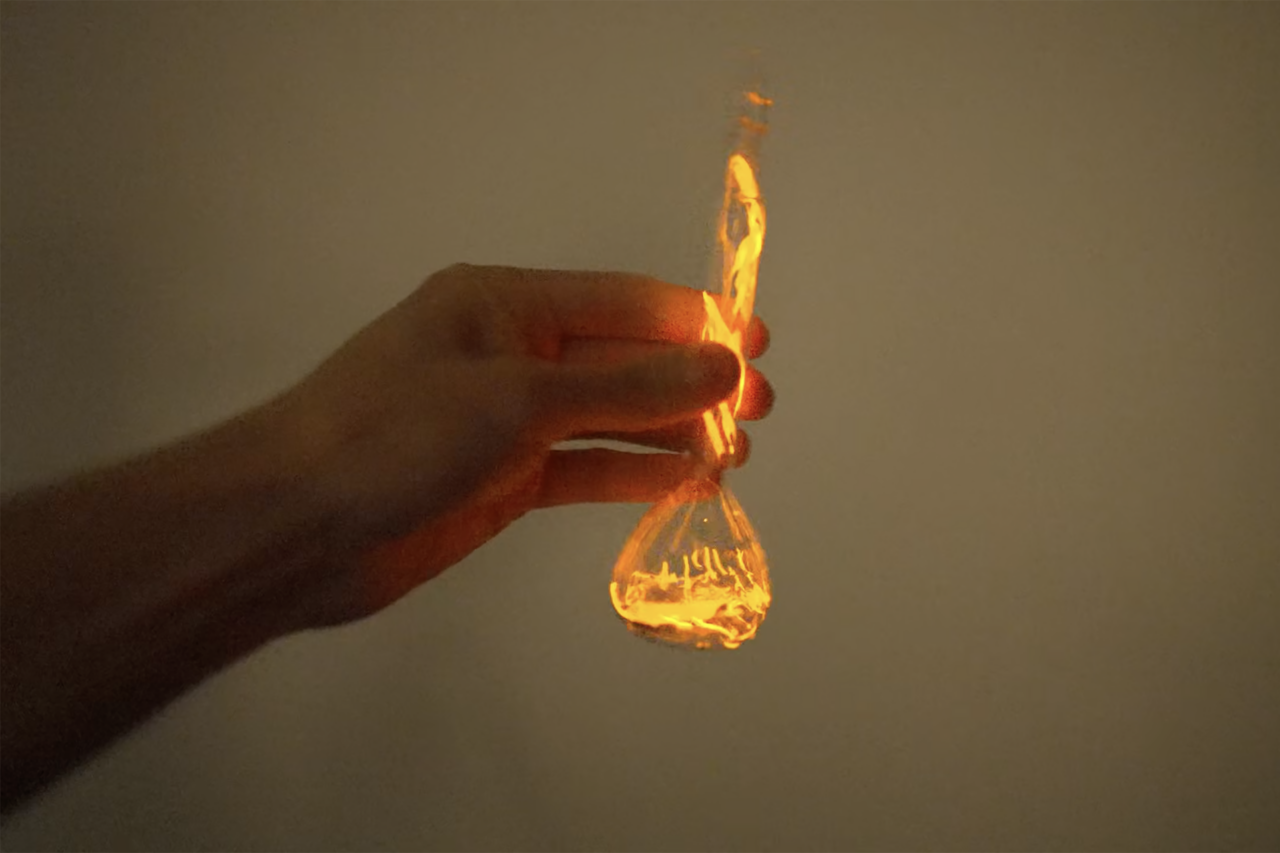
This also works with the mercury tube, as Anthony demonstrates by holding it close to a Tesla coil. But! If you combine the two ideas, you will get truly incredible results. Anthony begins by adding mercury to a flask and pumping out the air, as before, but this time he pumps a small amount of neon into the tube. Once sealed and cooled, you shake it up and… holy shit, lightning in a bottle!
The rest of the video is dedicated to building tubes of different shapes and experimenting with different noble gases. Krypton produces blue flashes instead of the bright red of neon, while returning the mercury/noble gas tubes to the electric field generated by the Tesla coil also produces remarkably beautiful results.
Don’t try this at home, obviously, but it looks great.



