

A Paris startup wants to loosen Nvidia’s grip on AI, not with a new chip, but with software. ZML has released a free tool that runs open source models quickly on Nvidia, AMD, Google, Apple, and Intel Silicon alike.
Nvidia still dominates AI hardware, but its walls continue to thin. ZML, a Paris startup backed by AI pioneer Yann LeCun, has released free software that runs open source language models on a combination of chips. TechCrunch reports. The list covers five targets: Nvidia, AMD, Google TPU, Intel and Apple.
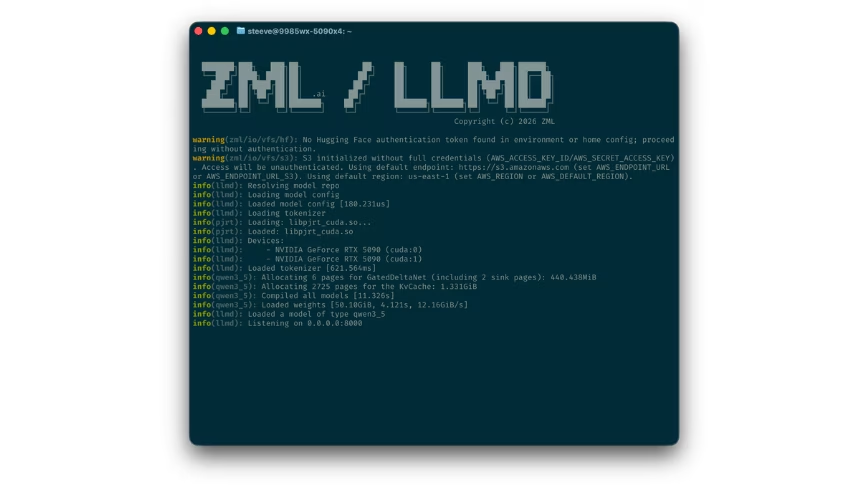
the tool, ZML/LLMDIt is an inference server. Inference means running a trained model to respond to requests, the part of AI that now consumes most of the computation. Founder Steeve Morin says the goal is to break down the silos that tie users to a single provider and squeeze each chip at its maximum speed.
Why a chip combination is important
The cost is the driver. As AI bills rise, enterprises and clouds want the freedom to choose cheaper or less power-consuming silicon for a given job. “The idea is to give the power back to the people to create their own system,” Morin said. If you do it right, it will look less like a feature and more like a wedge under Nvidia’s moat.
It could also raise a wave of new chip makersmany of them European. Morin named Axelera, Fractile, Kalray, SiPearl, VSORA and others. Software that treats its chips as first-class, not second-class, gives buyers a real reason to try them.
A busy and expensive race
Morin isn’t ruling out Nvidia and says ZML has a good relationship with the chip giant. But the field is full of people. He “gold rush inference” has created rivals like Baseten, recently valued at $13 billion, as well as the teams behind the open source projects vLLM and SGLang. They are all chasing the same prize: making AI. cheaper to run.
Morin believes ZML goes further. “We’ve gotten to the point where we’re co-designing silicon,” he said. Their small team of 20 has worked quickly and there are more releases to come.
Why is it important
LLMD is shipping free for now to collect usage, but it is not a paid product yet. Its unusual root is the biggest sign. A tool built for loosen Nvidia’s grip and to return Europe’s own AI stack He landed in Paris, not in Silicon Valley. Morin, who raised $20 million from investors including Xavier Niel’s Kima Ventures, put it bluntly. “I couldn’t do ZML anywhere else but Paris,” he said.



