
When we think about deaf people, we often assume stereotypes, such as “disabled” older adults with earphones. However, this perception is far from the truth and often leads to poor decisions and defective products.
Let’s look at when and how deafness arises and how to design better experiences. for people with hearing loss.
Deafness is a spectrum
Deafness encompasses a wide continuousfrom minor to profound hearing loss. About 90-95% of deaf people come from hearing familiesand deafness is often not simply a condition that people are born with. It frequently occurs due to exposure to loud noisesand it also arises with age, illnesses and accidents.

Sound intensity is measured in units called decibels (dB). Everyone is in the deafness spectrumfrom normal hearing (up to 15 dB) to profound hearing loss (91+ dB):
- Mild hearing loss16–25dB
With a hearing loss of 16 dB, a person can lose up to 10% of speech when the speaker is more than 3 feet away. - Mild hearing loss26–40dB
Soft sounds are difficult to hear, including whispers, which are around 40 dB in volume. It is more difficult to hear soft speech sounds at a normal volume. With a hearing loss of 40 dB, a person can miss 50% of the discussions in a meeting. - Moderate hearing loss41–55dB
A person may hear almost nothing when another person speaks at a normal volume. With a hearing loss of 50 dB, a person may not catch up to 80% of speech. - Moderately severe hearing loss56–70dB
A person may have trouble hearing the sounds of a dishwasher (60 dB). At 70 dB, you may miss almost the entire word. - Severe hearing loss71–90dB
A person will not hear speech when speaking at a normal level. They may only hear some very loud noises: vacuum cleaner (70 dB), blender (78 dB), hair dryer (90 dB). - Profound hearing loss91+dB
You cannot hear any words and, at most, very loud sounds, such as a music player at full volume (100 dB), which would be harmful to people with normal hearing, or a car horn (110 dB).
It is worth mentioning that hearing loss can also be situational and temporary, as people with “normal” hearing (0 to 25 dB hearing loss) will always encounter situations where they cannot hear, for example due to noisy environments.
Useful things to know about deafness
Assumptions are always dangerous, and in the case of deafness, there are quite a few that are not accurate. For example, most deaf people don’t actually know a sign language; 1% in US.
Furthermore, despite our expectations, there are actually there is no universal sign language that everyone uses. For example, British signers often cannot understand American signers. There are globally around 300 different sign languages actively used.
“We never question content being available in different spoken or written languages, and the same should apply to sign languages.”

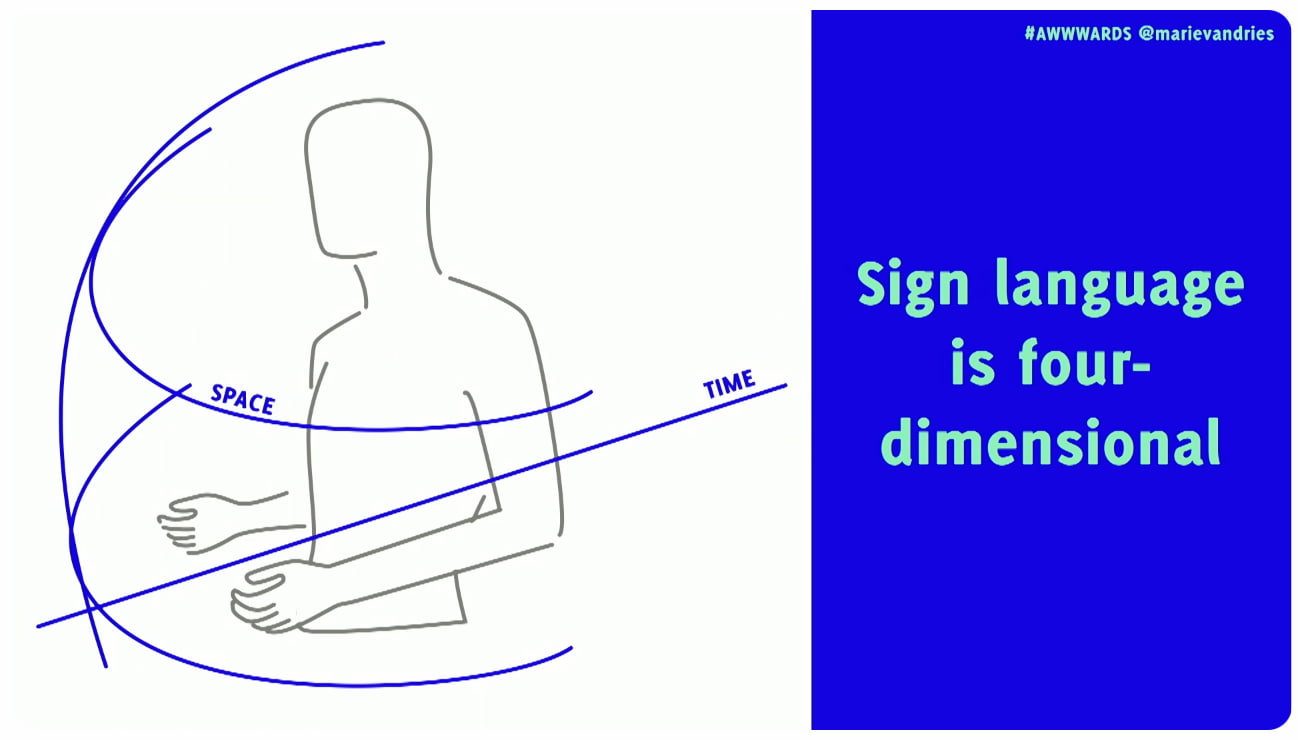
Sign languages are not just gestures or pantomime. they are 4D spatial languages with their own grammar and syntax, separate from spoken languages, and have no written form. They rely heavily on facial expression to convey meaning and emphasis. And they are not universal either: each country has its own sign language and dialects.
- you can only understand 30% of the words through lip reading.
- Most deaf people don’t know anything. sign language.
- Many sign languages have local dialects that can be difficult to interpret.
- Not all deaf people are fluent speakers and often rely on visual clues.
- For many deaf people, spoken language is their second language.
- Sign language has 4 dimensions.incorporating 3D space, time and also facial expressions.
How to communicate respectfully
Keep in mind that many deaf people use the spoken language of their country as your second language. Therefore, to communicate with a deaf person, it is best to ask them in writing. Don’t ask how much a person can understand or if they can read your lips.
However, as Rachel Edwards notedDon’t assume that someone is comfortable with written language because they are deaf. Sometimes their literacy level may be low, so providing information in text form and assuming it covers deaf users may not be the answer.
Also, don’t assume that all deaf people can read lips. You can only see about 30% of the words in someone’s mouth. That is why many deaf people need additional visual cuesas text or speech with cues.

It is also crucial to use respectful language. Deaf people do not always see themselves as disabledbut rather as a cultural linguistic minority with a unique identity. Others, like Meryl Evan has noteddo not identify yourself as deaf either hearing problemsbut rather as “hearing impaired.” Therefore, it is mainly up to each individual how they want to identify themselves.
- Deaf (capital ‘D’)
Culturally deaf people who have been deaf since birth or before learning to speak. Sign language is usually the first language and written language is usually the second. - deaf (lowercase ‘d’)
People who developed hearing loss later in life. Used by people who feel closer to the world of hearing or hearing problems and prefer to communicate in writing and/or orally. - Hearing problems
People with mild to moderate hearing loss who normally communicate orally and use hearing aids.
In general, avoid hearing impairment if you can, and use Deaf (for those deaf for most of their lives), deaf (for those who became deaf later), or hearing problems (HoH) for partial hearing loss. But either way, ask politely first and then respect the person’s preferences.
Practical UX Guidelines
When designing user interfaces and content, consider these key accessibility guidelines for deaf and hard of hearing users:

- Don’t make the phone mandatory or the only method of contact.
- Provide text alternatives for all audible alerts or notices.
- Add haptic feedback on the mobile (e.g. vibration patterns).
- Ensure good lighting. to help people see facial expressions.
- circular seats It usually works best, so everyone can see each other’s faces.
- Always include descriptions of unspoken sounds. (e.g. rain, laughter) in its content.
- Add a transcript and subtitles for audio and video.
- Clearly identify each speaker on all audio and video content.
- Design multiple ways to communicate in each instance (online + in person).
- Invite video participants to keep the camera on to facilitate lip reading and visualization of facial expressions, which convey tone.
- Always test products with the real communityinstead of making assumptions for them.
Concluding
I keep repeating myself like a broken record, but better accessibility always benefits everyone. When we improve the experiences of some groups of people, we often also improve the experiences of completely different groups.
As Marie Van Driessche rightly pointed out, to design a great accessibility experience, we must design with people, instead of for them. And that means always including people with lived experience of exclusion in the design process, since they are the true experts.
Accessibility never happens by accident: it is a deliberate decision and commitment.
No digital product is neutral. There must be a deliberate effort to make products and services more accessible. Not only does it benefit everyone, but it also shows what a company stands for and values.
And once you have a commitment, it will be much easier maintain accessibility rather than adding it at the last minute as a crutch, when it’s too late to do it right and too expensive to do it right.
Learn about “smart interface design patterns”
You can find more details at design patterns and UX in Smart interface design patternsour 15h video course with hundreds of practical examples from real-life projects, with live UX training later this year. Everything from mega dropdown menus to complex business tables, with 5 new segments added every year. Skip to free preview. Use code BIRDIE to save 15% off.

Useful resources
Useful books
- The sound is not enoughby Svetlana Kouznetsova
- Misalignment: How inclusion shapes designby Kat Holmes
- Building for everyone: Expand your product reach through inclusive design (+ free extract), by Annie Jean-Baptiste

(yk)



