
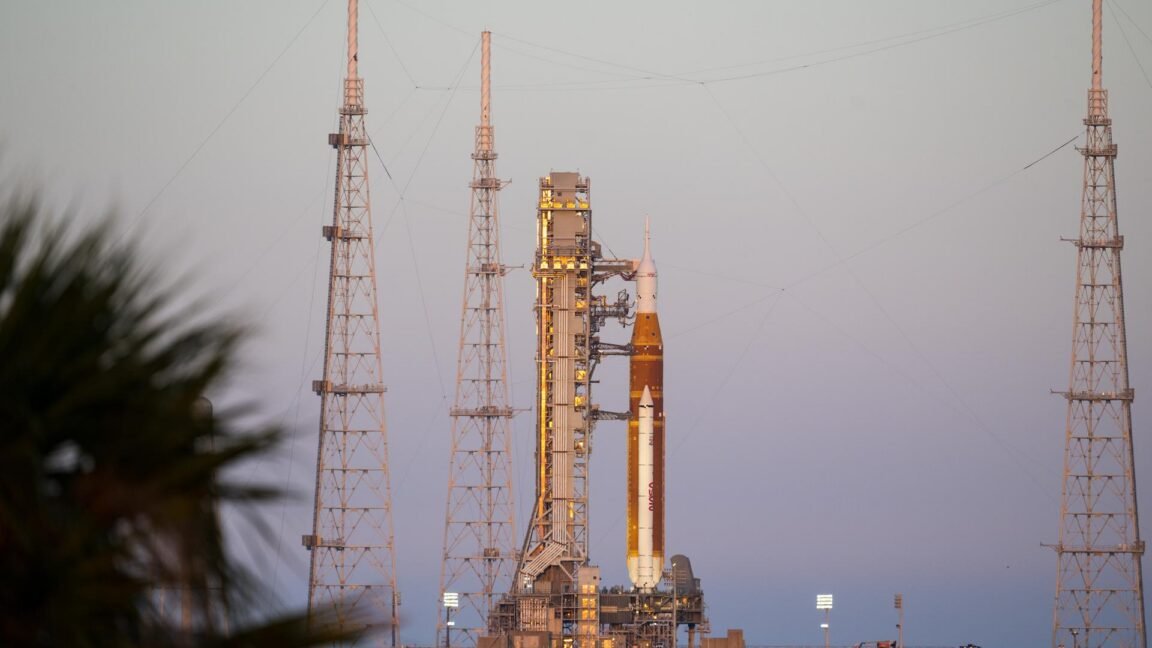
The mission will last more than nine days from takeoff to landing. After separating from the SLS rocket, the Orion spacecraft will spend just over a day in an elliptical orbit altitude more than 40,000 miles from Earth. Astronauts and mission controllers in Houston will spend this time activating and testing the spacecraft, with special attention to Orion’s life support and environmental control systems, which were not part of an unpiloted Orion test flight four years ago.
Glover and Wiseman will take manual control of the spacecraft to evaluate Orion’s handling characteristics, directing the thrusters to guide the capsule back to the upper stage of the SLS rocket to practice docking maneuvers on future Artemis missions. Assuming all is well, Orion will fire its main engine for a translunar injection, or TLI, which will operate approximately 25 hours into the mission. This is the event that will send astronauts to the Moon.
This mission will not land. This will occur on a future Artemis mission, currently scheduled for Artemis IV, no earlier than 2028. NASA is working with SpaceX and Blue Origin to develop commercial human-rated landers to transport astronauts from the Orion spacecraft in lunar orbit to the surface of the Moon and back. Those landers, along with the new lunar spacesuits, will not be ready for a landing mission next year, as NASA officials had hoped.
NASA Administrator Jared Isaacman last week announced a restructuring of the Artemis program, shifting focus from building a space station in orbit around the Moon to building a base on the lunar surface. Program changes also included replanning the next Artemis mission—Artemis III—from a landing mission to a flight to dock an Orion crew capsule with one or both commercial landers closer to Earth.
The change will increase the chances of launching Artemis III next year. Sending SpaceX or Blue Origin landers to the Moon will require mastering in-orbit refueling, and neither company has demonstrated that capability yet. No refueling is required for a low-Earth orbit test mission on Artemis III.
“Over the last 10 weeks, the agency has prepared a manned lunar test vehicle and also restructured the program to which it belongs,” Amit said. Kshatriya, associate administrator of NASA. “This was done deliberately. A team that understands that the campaign has a greater purpose, a workforce that sees the road ahead is held to a higher standard. This flight and the future reinforce each other. This is how Apollo worked and this is how we will work.
“Behind this flight there is a campaign, landings, a lunar base, deep space nuclear propulsion. “That begins, not ends, with what happens Wednesday night.” Kshatriya said.



