
TL;DR
Rivian founder runs three companies with $12.3 billion raised. Mind Robotics just hit $1 billion at a $3.4 billion valuation.
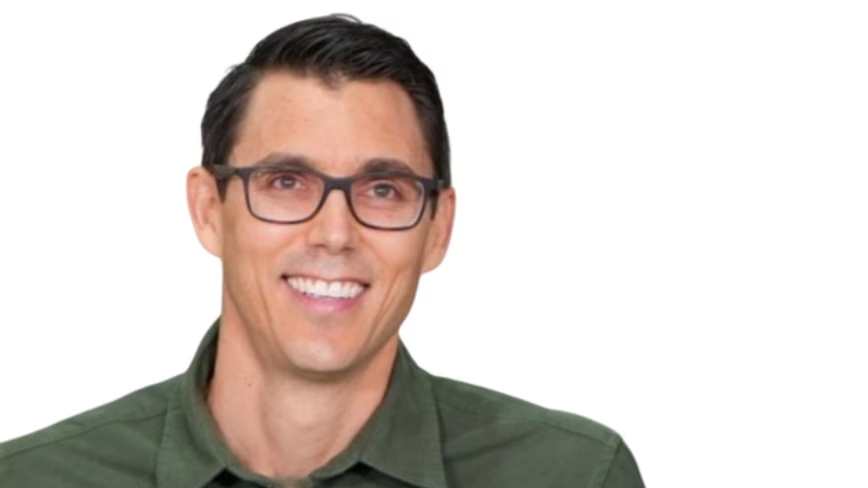
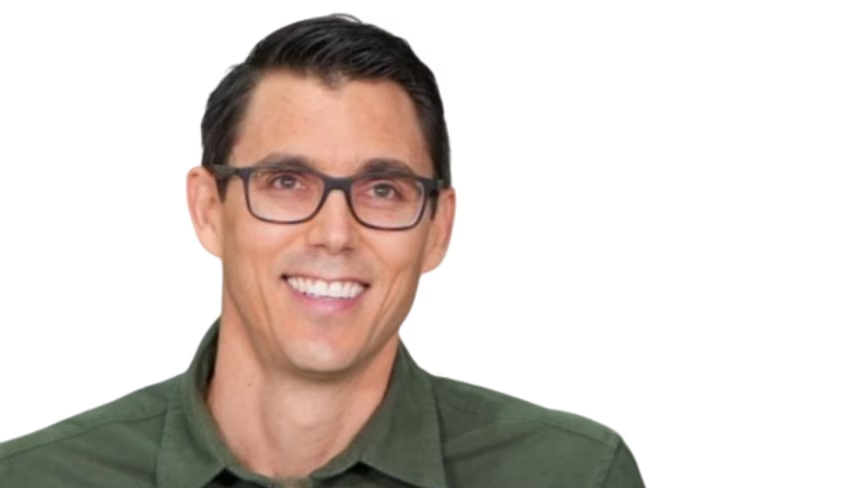
RJ Scaringe has raised more than $12.3 billion in three startups and the pace is accelerating. Rivian’s founder and CEO, who has a PhD in mechanical engineering from MIT, now simultaneously runs an electric vehicle maker, an autonomous micromobility company, and an industrial AI robotics startup, each of which is attracting capital at a speed that would be remarkable for any individual company.
The latest data came this week when Mind Robotics, Scaringe’s industrial robotics company, closed a $400 million round led by Kleiner Perkins, bringing its total funding to more than $1 billion and its valuation to $3.4 billion. The venture arms of Volkswagen and Salesforce also participated. Mind Robotics was founded in 2025, initially as an internal Rivian project called “Project Synapse,” and has raised $115 million in seed funding, $500 million in a Series A in March, and now $400 million more in less than two months. The company is building AI-powered robots designed to handle dexterous, reasoning-intensive manufacturing tasks that conventional industrial automation cannot, using Rivian’s own production lines as a live training environment.
Scaringe’s second company, Also, is an electric micromobility company spun out of Rivian in 2025. It has raised more than $300 million, including a $200 million Series C led by Greenoaks In March that valued the company at more than $1 billion. DoorDash invested alongside a multi-year commercial agreement to deploy Also’s purpose-built small autonomous electric vehicles for last-mile deliveries. The company’s product line includes a $3,500 electric bicycle and a four-wheeled electric cargo vehicle designed to fit on a bike lane.
The overwhelming majority of the $12.3 billion, more than $11 billion, went to Rivian itself, most of it between 2018 and the company’s successful initial public offering in November 2021. Rivian was founded in 2009 as Mainstream Motors and operated in near obscurity for nearly a decade before revealing its R1T pickup truck and R1S SUV prototypes at the 2009 auto show. Los Angeles 2018. The money came quickly: Amazon led a $700 million round in early 2019, Ford invested $500 million, and by the end of that year, Rivian had closed four rounds of financing. A $2.5 billion raise in July 2020 and a $2.65 billion raise six months later preceded the IPO, which generated nearly $12 billion in gross proceeds at $78 a share and briefly valued the company at more than $100 billion.
Today, Rivian’s market capitalization stands at approximately $18.2 billion, a significant decline that reflects the broader struggles of the electric vehicle sector. But the company continues to attract major partnerships. Volkswagen has surpassed Amazon as Rivian’s largest shareholder through a $5.8 billion software joint venture, and Uber reached a settlement worth up to $1.25 billion for up to 50,000 Rivian R2 autonomous robotaxis in 25 cities by 2031.
What makes Scaringe unusual is not just the amount of capital but its breadth. Large seed rounds have become more common in recent years, but they have generally gone to defense technology or AI companies founded by former OpenAI or Anthropic employees, not electric micromobility or industrial robotics. Eclipse, one of Scaringe’s largest backers and a major investor in both Also and Mind Robotics, credits its combination of engineering depth and product instinct. Jiten Behl, an Eclipse partner and former Rivian executive, described Scaringe’s ability to communicate a vision without going overboard as “an art.”
Comparison to other serial entrepreneurs who have raised billions across multiple companies – Elon Musk, Sam Altman, Palmer Luckey – is inevitable but inaccurate. Several investors told TechCrunch that Scaringe’s distinguishing quality is the absence of self-promotion. “It’s not about him“said a source.”When you talk to him, he has an enthusiasm for the product that is completely external.Joe Fath, also of Eclipse, noted that Scaringe “He has the rare combination of being a great engineer and at the same time having an exceptional instinct for product design,“a couple he described as”incredibly rare.“
The question that arises from $12.3 billion spread across three companies, all run by the same person, is whether Scaringe can keep up. It travels between Palo Alto, Irvine, Rivian’s factory in Normal, Illinois, and a second factory under construction in Georgia. Mind Robotics is scaling rapidly, also preparing to deliver its first products in the US in 2026, and Rivian is ramping up the R2 SUV as it navigates a hostile tariff environment that has seen at least a dozen electric vehicle models canceled or suspended this year.
The industrial robotics market attracts capital at an extraordinary ratewith companies from 1X to Unitree and Foundation Industries raising hundreds of millions for physical AI systems. Mind Robotics’ argument that it has access to a high-volume live factory for training data gives it a structural advantage that most competitors lack. Whether that advantage translates into lasting business depends on execution on a scale that even Scaringe hasn’t attempted yet.
Behl phrased the question differently. “The big question is how much can it do?” said. “That is a question that already assumes that it is reaching its limit. The thing is, he doesn’t see it that way.“



